

Did you know the Taurid meteor stream reliably produces slow, bright fireballs every autumn?
Trailing comet Encke and a family of fragments, the Taurids form a broad debris belt Earth crosses for weeks in late October and early November.
Their slow entry speed lets larger particles dig deep into the atmosphere, creating long, colorful trails and frequent fireballs that stand out even under modest skies.
Read on to learn the best nights to watch, what a fireball can tell scientists, and how to plan a patient, rewarding autumn sky‑watch.
Core Overview of the Taurid Meteor Stream and What Observers Should Expect
The Taurid meteor stream is a broad debris belt trailing Comet Encke and related objects like asteroid 2004 TG10, which was spotted on October 8, 2004. It splits into two branches, Northern Taurids and Southern Taurids, that Earth crosses every autumn. Both components overlap in late October and early November, pushing total meteor counts higher and delivering slow, bright fireballs more reliably than most other annual showers.
Taurid meteors enter the atmosphere at roughly 17 miles per second (27 km/s, about 65,000 mph). That’s one of the slowest speeds of any major shower. The leisurely pace, combined with the stream’s large particle sizes, lets meteoroids penetrate deep into the atmosphere, around 42 miles (66 km), producing long, brilliant trails and frequent fragmentation. Observers consistently describe Taurid fireballs as bright, colorful, and occasionally accompanied by breakup flashes.
The stream’s breadth and the influence of Jupiter’s 7:2 mean‑motion resonance distribute debris across a wide arc of Earth’s orbit. That gives the Taurids weeks of visibility rather than a single sharp peak. Hourly rates stay modest, typically 5 meteors per hour per branch under dark skies, but individual events often reward patient viewers with memorable fireballs.
Essential characteristics at a glance:
- Source debris: Primarily Comet Encke (3.3‑year orbit) and the Encke Complex of fragments.
- Entry speed: Approximately 17 mi/s (27 km/s), slow by meteor shower standards.
- Penetration altitude: Deep, around 42 miles (66 km), compared to 58 miles (93 km) for faster Orionids.
- Visual signature: Bright, slow, often colorful, with frequent fireballs and visible fragmentation.
- Activity profile: Extended, diffuse, with Northern and Southern streams overlapping in late October and early November.
Origin of the Taurid Meteor Stream and the Role of Comet Encke
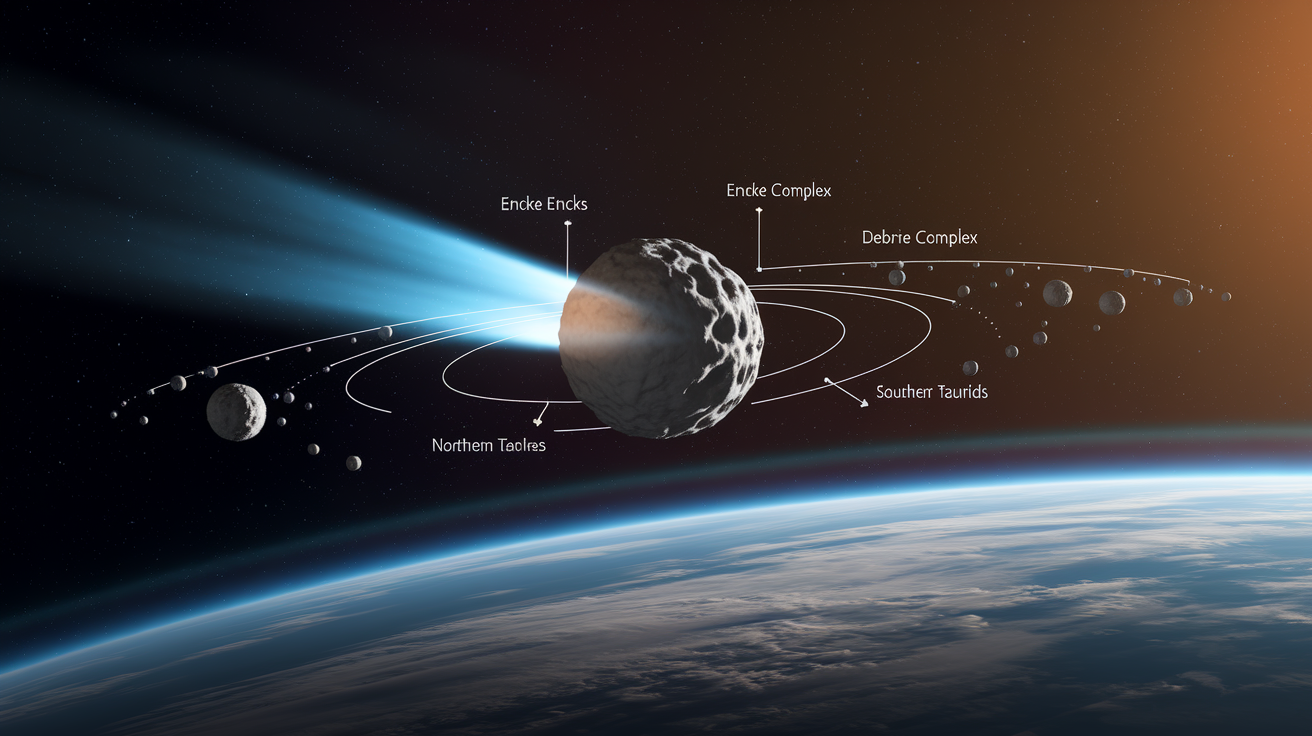
Comet Encke sits at the heart of the Taurid system. With a nucleus roughly 4.8 km (about 3 miles) across and one of the shortest orbital periods among bright comets, just 3.3 years, it sheds dust and larger meteoroids every time it swings through the inner solar system. Over millennia those particles have spread into a vast debris field. Earth crosses sections of that field twice a year.
But Encke itself may be only a fragment. The leading hypothesis traces the Taurid stream back to the breakup of a much larger comet approximately 20,000 to 30,000 years ago. That event seeded the Encke Complex, a sprawling group of related objects including asteroid 2004 TG10 and at least ten similar bodies that share nearly identical orbits. The Southern Taurids map cleanly to Encke’s current orbit. The Northern Taurids correlate more closely with 2004 TG10 and its companions, hinting at separate but related parentage within the ancient fragmentation event.
How Encke’s Orbit Feeds the Stream
Encke’s rapid 3.3‑year return ensures a steady supply of fresh material. Each perihelion pass heats the comet’s icy surface, releasing jets of gas and dust that carry away meteoroids ranging from micron‑scale grains to pebbles and boulders. Solar radiation pressure, planetary gravity, and the Poynting–Robertson drag slowly disperse those particles along the comet’s orbital path, forming two distinct dust trails that broaden over centuries. Jupiter’s 7:2 mean‑motion resonance, an orbital coupling in which the planet’s gravity gives periodic nudges, helps maintain the stream’s coherence while also perturbing fragments into slightly different orbits. That sculpting action explains why Earth now encounters two streams from one extended debris cloud.
Activity Windows, Peak Dates, and Annual Variability of Taurids
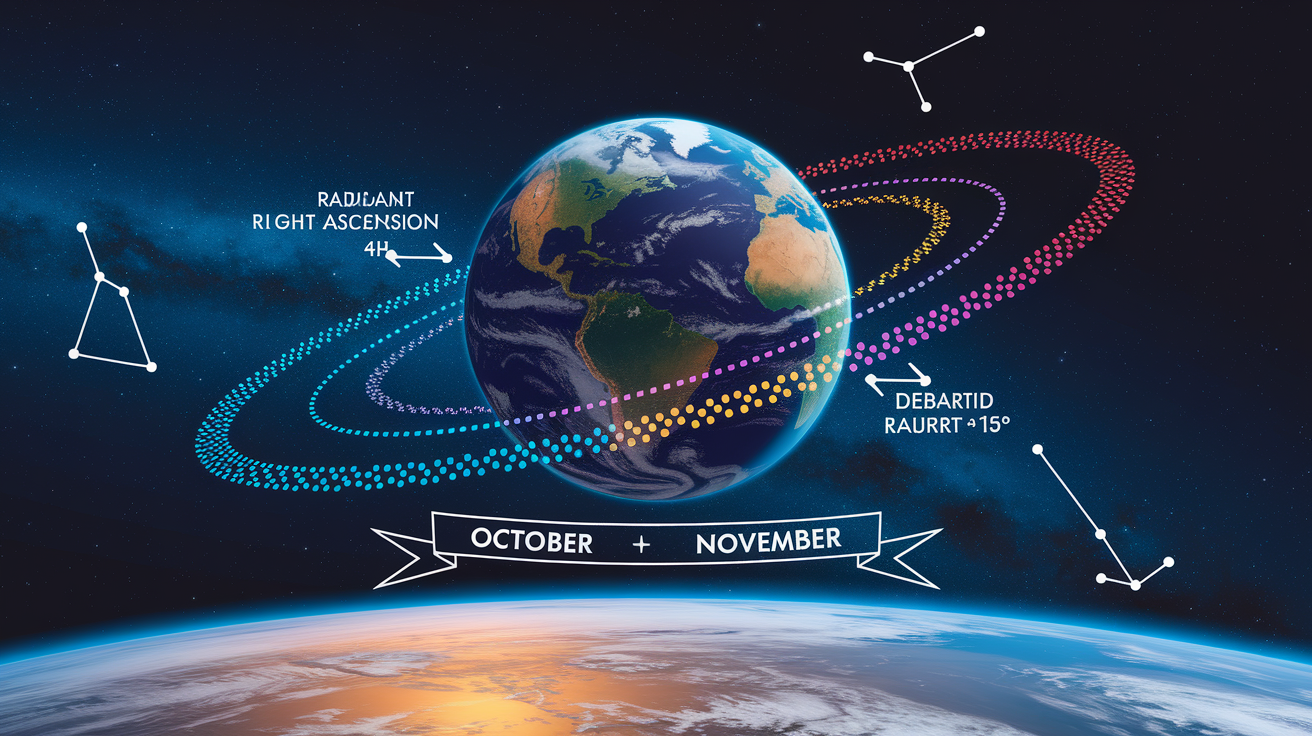
Earth’s orbit intersects the Taurid debris belt over an extended interval each autumn, with no single sharp crossing. The Southern Taurids typically appear first, followed by a several‑week overlap with the Northern Taurids. Published activity ranges differ because the stream’s complex, filamentary structure means no single date marks the “true” start or stop.
Common windows and predicted peaks:
| Stream | Activity Window | Typical Peak | Notes |
|---|---|---|---|
| Southern Taurids | Sept 10 – Nov 20 (or Sept 23 – Nov 12) | Oct 10 or Nov 5 | Earlier range preferred by some networks; later range by others |
| Northern Taurids | Oct 13 – Dec 2 (or Oct 20 – Dec 10) | Nov 9 or Nov 12 | Overlap with Southern Taurids boosts combined rates late October – early November |
The radiant, the point from which meteors appear to radiate, sits near Right Ascension 4 hours and Declination +15°, within the constellation Taurus. That location rises in the east shortly after sunset and reaches its highest point around local midnight, making midnight the best hour for meteor counts regardless of which calendar date you choose.
Predictions vary because the stream is neither uniform nor static. Debris orbits evolve under solar radiation pressure, planetary perturbations, and fragmentation events. Concentrated filaments drift past Earth on slightly different schedules from year to year, and models rely on sparse historical data and evolving radar observations. That uncertainty doesn’t diminish the stream’s reliability. It simply means that pinpointing a single “best” night remains more art than science.
Observing the Taurid Meteor Stream: Best Nights, Conditions, and Sky Position
The Taurid radiant rises early in the evening and climbs steadily, reaching its highest point near local midnight. That timing makes the hours around midnight the most productive, when the radiant’s elevation gives you the largest effective collecting area of the sky above you. Meteors can appear anywhere, but longer trails and brighter fireballs tend to show up when you scan away from the radiant, where perspective effects stretch the trails across a greater arc of sky.
Dark‑sky conditions are essential. Taurid rates stay modest, about 5 meteors per hour from each stream at peak under pristine skies, so light pollution cuts visible counts sharply. Allow at least 30 minutes for your eyes to fully adapt after leaving a lit area. The faintest Taurids, though less spectacular, still contribute to the overall experience when your rod cells reach peak sensitivity.
Practical viewing checklist:
- Scan broadly: Point your gaze away from Taurus, toward Orion, Gemini, or Auriga, to catch long, slow trails.
- Check the moon: A new moon or a moon below the horizon transforms viewing. In 2026 the new moon falls on November 9 at 07:02 UTC, offering ideal conditions around the North Taurid peak.
- Plan for overlap weeks: Late October into early November typically delivers higher combined counts and an increased chance of fireballs.
- Watch multiple nights: The stream is broad; peak‑night predictions can miss secondary concentrations by a day or more.
- Dress warmly and recline: Long sessions in cool autumn air demand insulation and a comfortable chair or blanket to support sustained sky‑scanning.
- Expect low rates, high impact: Taurids favor quality over quantity. Prepare for patient waiting punctuated by memorable fireballs.
Fireballs in the Taurid Meteor Stream and Notable Swarm Years
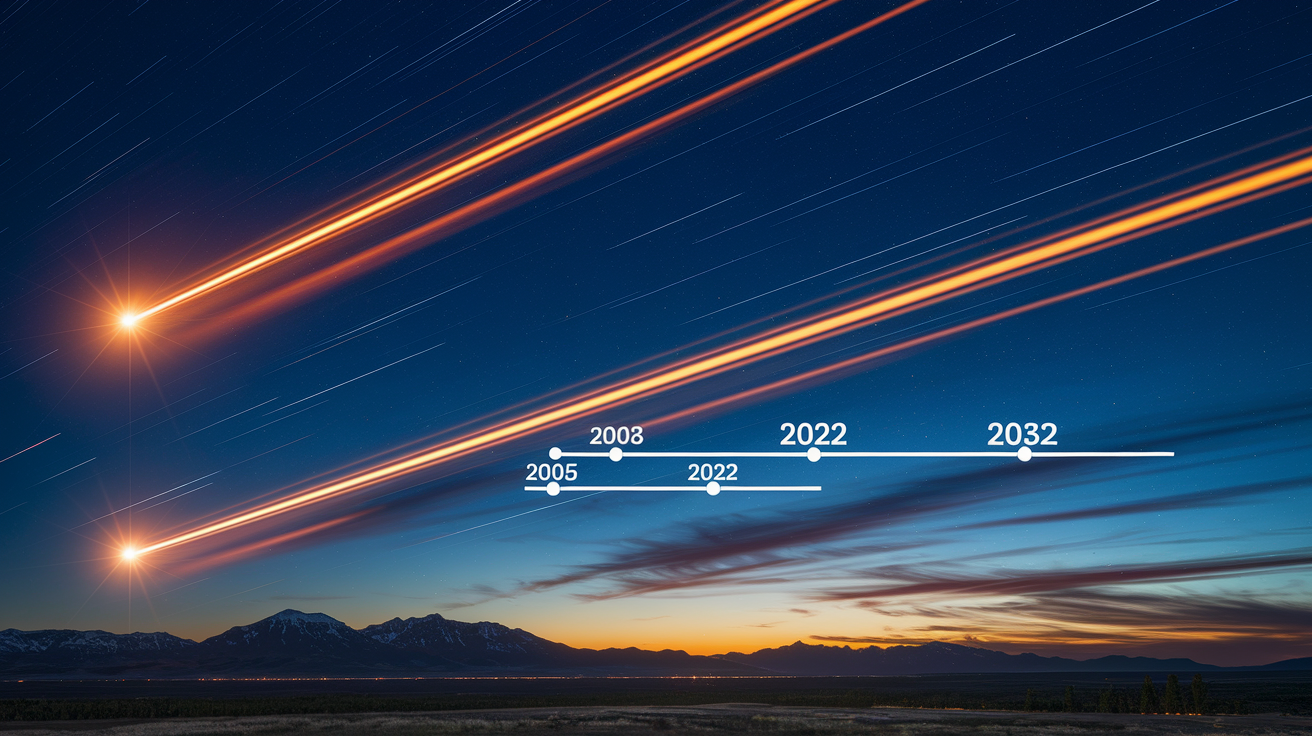
Taurids are unusually rich in fireballs, meteors brighter than the planet Venus. In typical years, roughly 1 percent of visible Taurids qualify as fireballs. During documented swarm years, that fraction climbs to about 7 percent, transforming routine watches into nights punctuated by brilliant, fragmenting bolides that leave glowing persistent trains and occasionally trigger sonic booms.
Enhanced fireball displays were recorded in 2008, 2015, and 2022, years when Earth’s orbit carried it through denser concentrations of larger debris. The pattern suggests a periodicity, with swarms occurring roughly every three to seven years as gravitational perturbations and orbital evolution shift the densest filaments in and out of Earth’s path. The next widely predicted strong swarm is expected near 2032, when models place a debris concentration close to Earth’s orbit and a new moon on the predicted peak night promises optimal viewing.
Fireball frequency matters scientifically as well as visually. Boulder‑sized Taurid meteoroids that survive deep into the atmosphere offer clues about the parent body’s composition, fragmentation history, and the hazard profile of the stream. A single bright fireball can deliver more data, through video triangulation, spectroscopy, and infrasound recording, than dozens of faint trail photographs.
Evidence and Uncertainties in Swarm Forecasting
Predicting Taurid swarms relies on radar observations, all‑sky camera networks, and forward modeling of the debris field’s orbital evolution. Radar detects meteoroids too small to see, building statistical profiles of stream density and structure. Video networks triangulate bright fireballs to reconstruct entry trajectories and original heliocentric orbits, which analysts then compare against Encke’s orbit and the orbits of known asteroids in the Encke Complex.
Yet swarm models disagree in detail. Some simulations predict tight concentrations returning every three years; others favor seven‑year intervals tied to Jupiter resonances. Historical fireball records are patchy, and orbital integrations over millennia accumulate uncertainties from chaotic perturbations. Until better observational coverage, especially around predicted swarm years, fills those gaps, forecasts remain probabilistic rather than certain. What’s clear is that some years deliver significantly more bright fireballs than others. That pattern is real even if its exact schedule stays blurry.
Beta Taurids and the Daytime Component of the Taurid Stream
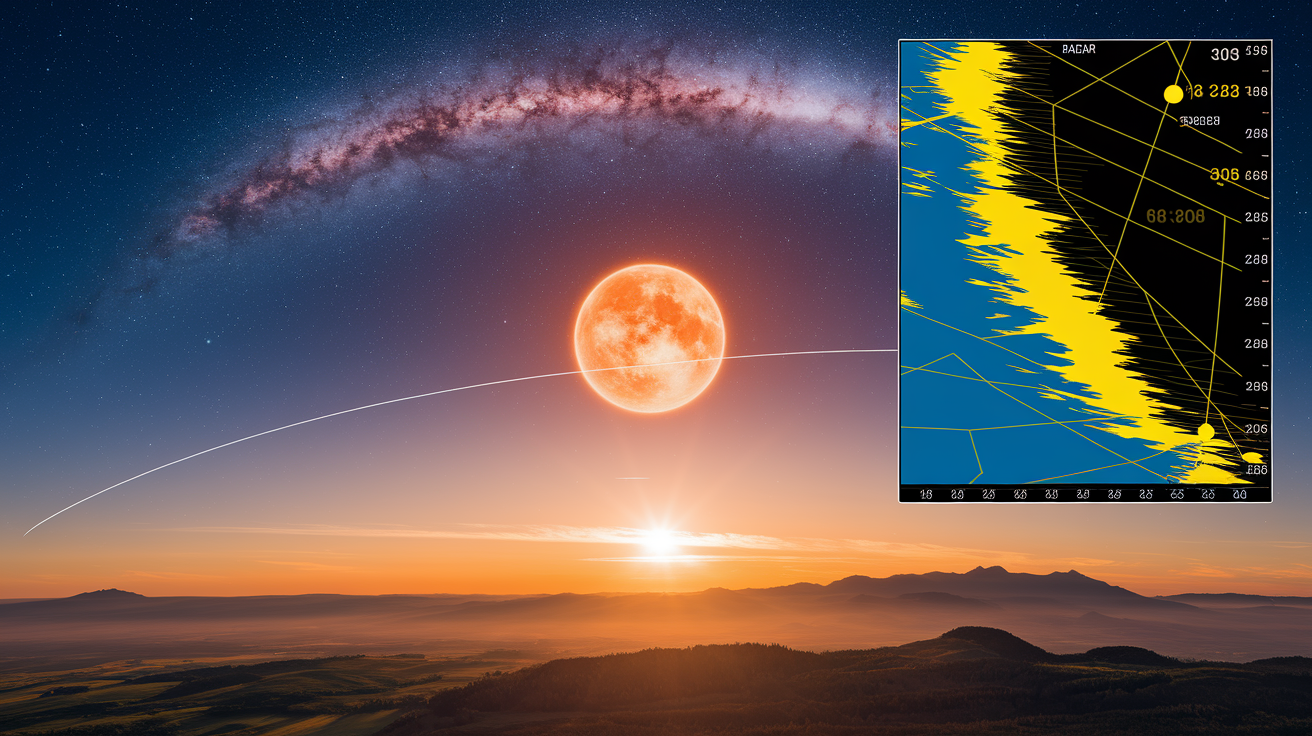
Earth crosses a different segment of the Taurid debris cloud in late June, producing the Beta Taurids, a daytime meteor stream undetectable by eye because its radiant stays too close to the Sun. Radar and specialized camera systems operating at twilight have confirmed Beta Taurid activity, revealing meteoroids with orbits that match the same Encke Complex family.
Some researchers think the Beta Taurids represent a denser concentration of larger debris encountered during Earth’s June crossing. Historical observations, including enhanced radar counts and inferred larger‑particle populations, have fueled speculation that the daytime stream occasionally delivers Tunguska‑scale objects, meteoroids tens of meters across capable of airburst explosions. Evidence remains circumstantial, but the Beta Taurids underscore that the Taurid stream is a year‑round presence along Earth’s orbital path, not merely an autumn fireworks display.
Photography and Instrumentation for Capturing Taurid Meteors and Fireballs
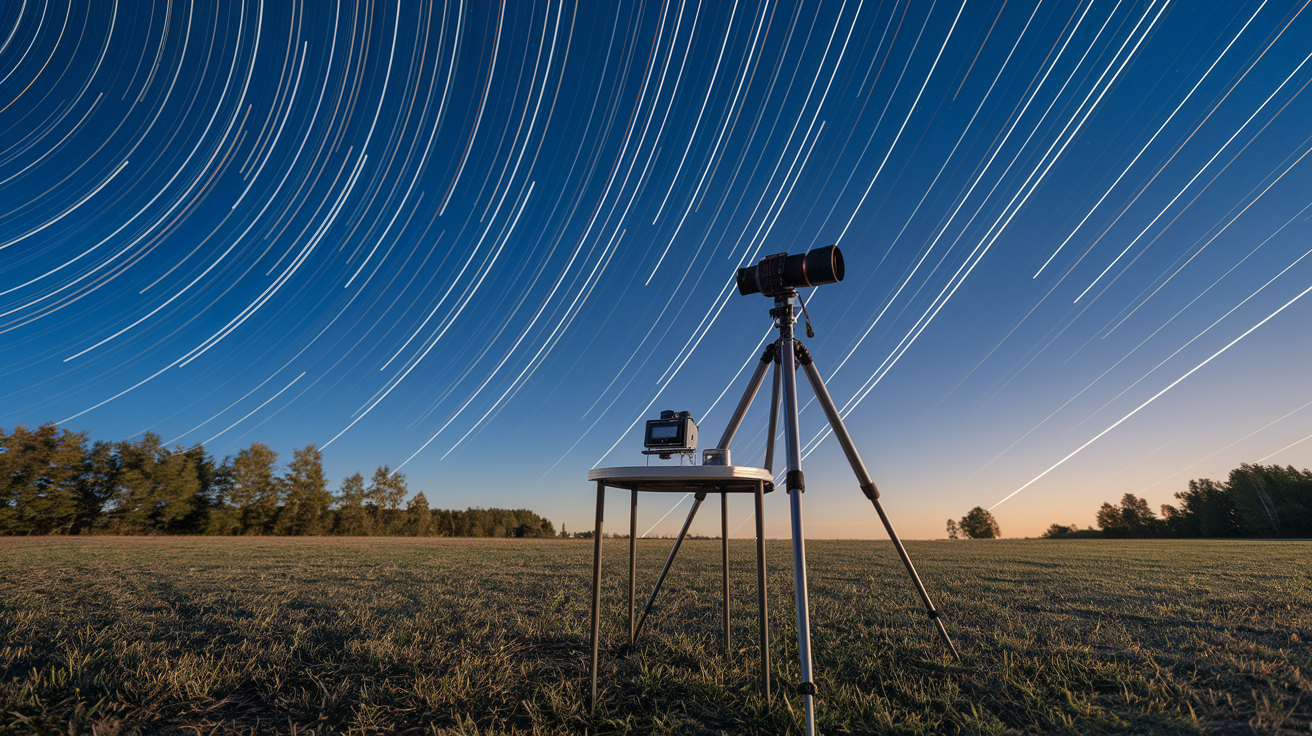
Photographing Taurids demands wide fields of view and long exposures to collect the relatively faint light of slow‑moving trails. A full‑frame or APS‑C sensor camera mounted on a sturdy tripod, paired with a fast wide‑angle lens (14 to 35 mm at f/2.8 to f/4), offers the best compromise between sky coverage and light‑gathering power. Set exposures between 15 and 30 seconds, choosing ISO values from 800 to 3200 depending on local light pollution and sky clarity.
Aim your lens away from the Taurus radiant to capture the longest trails. Meteors radiating from a central point appear short and foreshortened if you shoot straight at that point; perpendicular framing stretches trails across the frame and often captures the bright head and persistent train in sharp relief. Use an intervalometer or the camera’s built‑in interval mode to shoot continuously through the night. Fireballs are unpredictable. A gap between frames usually guarantees you’ll miss the best event of the session.
Imaging essentials:
- Tripod and wide lens: Stable mount, 14–35 mm focal length, aperture f/2.8–4.
- Exposure and ISO: Start at 15–30 seconds and ISO 1600; adjust darker or lighter based on test frames.
- Frame composition: Include foreground interest (trees, horizon) for context; point away from the radiant for long trails.
- Interval shooting: Continuous captures with minimal gaps ensure fireball coverage.
- Video option: For bright fireballs, consider dedicated all‑sky video cameras or short high‑ISO video clips to record fragmentation sequences and sonic signatures.
Scientific Analysis and Modeling of the Taurid Meteor Stream

Understanding the Taurid stream’s structure and evolution requires integrating observations across radar, video, photographic, and spectroscopic data. Meteoroid orbits are calculated from multi‑station video triangulation, which determines atmospheric entry velocity, trajectory angle, and the pre‑atmospheric heliocentric orbit. Those orbits cluster around Comet Encke’s path but show enough dispersion to reveal the stream’s complex internal architecture.
Taurid debris spans a wide size distribution. Dust grains a few hundred microns across produce faint telescopic meteors. Centimeter‑scale pebbles yield the typical naked‑eye Taurids. Meter‑to‑decameter boulders generate the bright fireballs and occasional airbursts. That breadth reflects both the original fragmentation event 20,000 to 30,000 years ago and ongoing secondary breakup driven by thermal stress, collisions, and tidal forces during close solar passes.
Orbital modeling must account for several forces that reshape the stream over time. Solar radiation pressure pushes smaller particles outward faster than gravity pulls them inward, spreading dust along a trailing arc. Jupiter’s 7:2 mean‑motion resonance periodically clusters debris into denser filaments and also scatters fragments into slightly different orbital planes. Fragmentation injects fresh material with marginally different velocities, seeding new sub‑streams. Together, these processes sculpt the Taurids into a dynamic, evolving structure rather than a static dust trail.
Key evolutionary drivers:
- Jupiter’s 7:2 resonance: Periodic gravitational nudges that concentrate and disperse debris filaments.
- Solar radiation pressure: Size‑dependent force that separates small dust from large meteoroids along the orbital path.
- Fragmentation events: Thermal stress and collisions that inject new particles with altered orbits.
- Planetary perturbations: Close encounters with Venus, Earth, and Mars that shift stream geometry slowly over millennia.
Reporting, Networks, and Citizen Science for Taurid Meteor Stream Monitoring
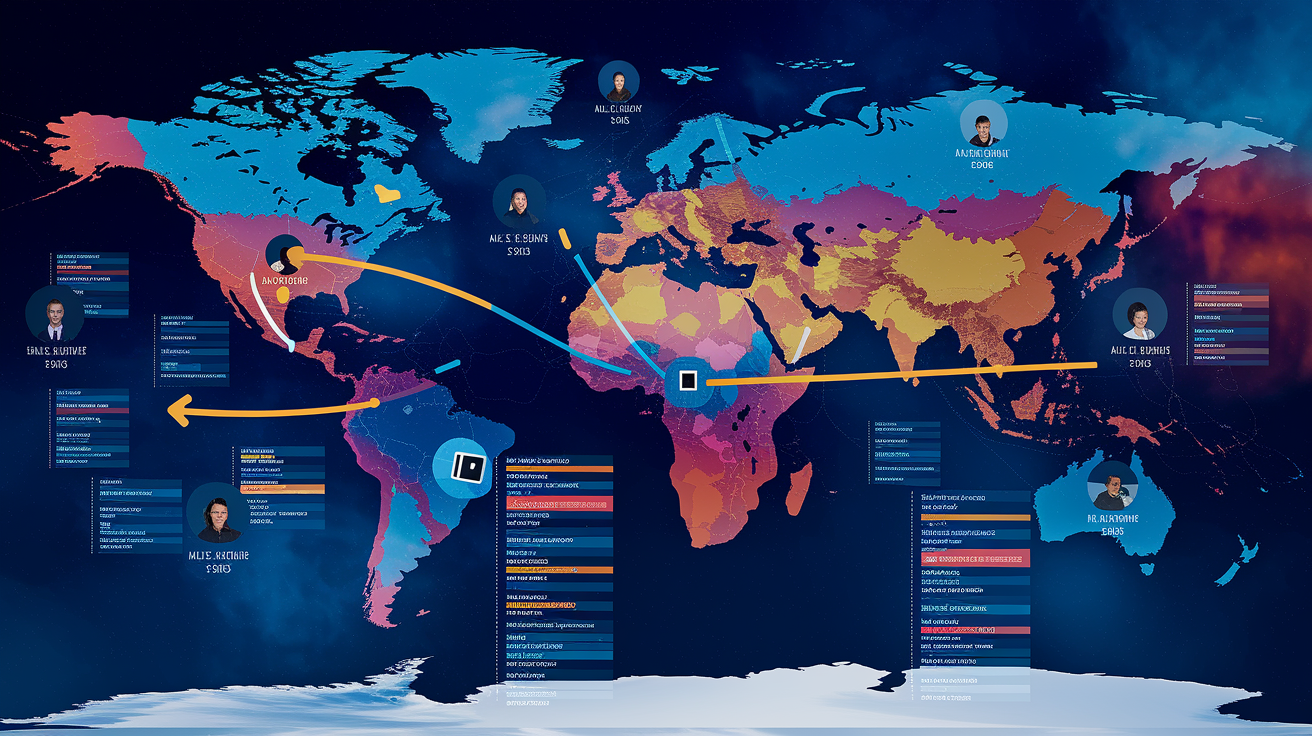
Professional meteor networks operate arrays of all‑sky cameras and radar stations that automatically record Taurid activity, but citizen observers contribute valuable complementary data. Visual counts, fireball reports with accurate time stamps and direction notes, and amateur video captures help fill geographic gaps and validate automated detection algorithms. Organizations such as the International Meteor Organization coordinate global campaigns during predicted peaks, pooling observations to build statistical profiles of hourly rates, radiant drift, and fireball frequency.
Submitting a useful report requires basic data: the date and time (preferably UTC), your location (latitude and longitude or nearest town), sky conditions (cloud cover, limiting magnitude), and a description of each meteor including brightness estimate, duration, color, and whether it fragmented or left a persistent train. Fireball sightings benefit from noting the approximate start and end points relative to bright stars or constellations, which triangulation software can use to reconstruct the trajectory.
How to contribute:
- Join a reporting network: Register with the International Meteor Organization, American Meteor Society, or regional groups that aggregate observations.
- Log time and location: Record each observation with UTC time, geographic coordinates, and current sky transparency (limiting magnitude).
- Describe fireballs in detail: Note brightness relative to planets, color, fragmentation, persistent train duration, and approximate path across constellations.
- Submit video or photographic captures: If you record a fireball, upload the file with embedded time stamps and camera location to enable trajectory analysis.
Final Words
We covered what the Taurid meteors are, their link to Comet Encke and related bodies, and the Northern and Southern branches that produce slow, bright fireballs.
The guide also explained activity variability, the daytime Beta Taurids, observing and photography tips, and how models and citizen reports help scientists.
Keep looking up and sharing data — your sightings improve forecasts and our understanding. The taurid meteor stream stays a subtle, rewarding target for both casual viewers and researchers, and that’s a good thing.
FAQ
Q: Is the Taurid meteor stream danger?
A: The Taurid meteor stream is generally not dangerous to people on Earth; most meteoroids burn up high in the atmosphere. Occasionally bright fireballs occur, but large-impact risks are rare and monitored by researchers.
Q: How often does Earth pass through the Taurid meteor stream?
A: Earth passes through the Taurid meteor stream every year, encountering its debris annually as our orbit crosses the stream’s path; encounter intensity varies year to year due to filaments and debris clustering.
Q: What will be the biggest meteor shower in 2026?
A: The biggest meteor shower in 2026 depends on moon phase and stream activity; professional predictions vary, so consult updated astronomy calendars for confirmed peak rates and visibility.
Q: How long does the Taurid meteor shower last?
A: The Taurid meteor shower lasts several weeks each year, with activity spread over a long period because the stream is broad and contains multiple filamentary debris trails that Earth crosses at different times.