

Want a meteor shower you can watch right after dinner instead of at 2 a.m.?
The Chi Cygnids peak around September 13–15, 2025, and their radiant sits high in Cygnus as soon as full darkness falls.
They’re slow, about 15 km/s, and faint, so expect roughly 1–2 meteors per hour under decent skies, and moonlight can cut counts sharply.
This post shows when to go, where to look, and simple tips to make those slow streaks worth the wait.
Key Details for Observing the Chi Cygnids This Year
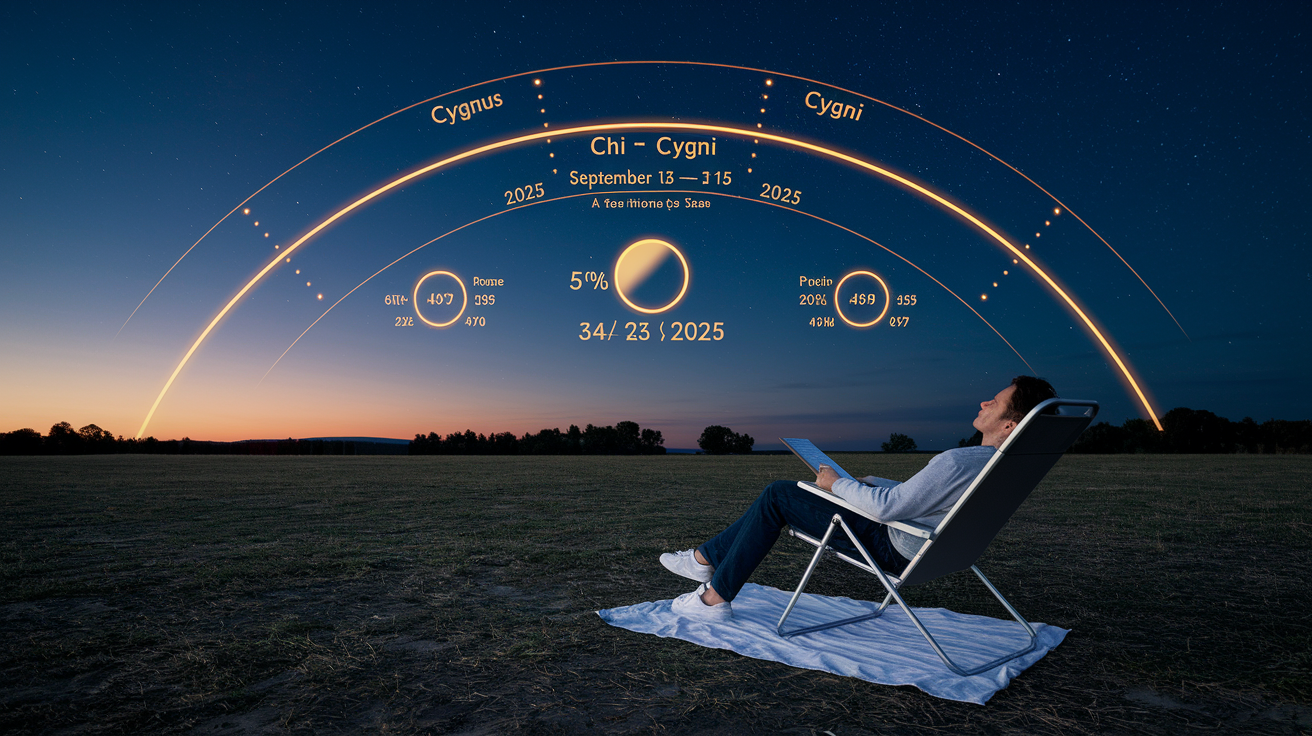
The Chi Cygnids run from late August through mid‑September. In 2025 you’re looking at peak activity around September 13–15. The radiant sits close to the variable star Chi Cygni in Cygnus, the Swan. What’s unusual here is the early‑evening geometry. Once darkness falls, the radiant’s already high overhead, near the zenith, instead of rising late at night like most meteor showers.
These meteors arrive slowly. Only about 15 km/s (roughly 33,500 mph), so they’re easier to track visually than the faster streaks you’d see from something like the Leonids. Typical visual rates run about 1–2 meteors per hour under decent conditions. The shower shows noticeable increases roughly every five years (2010, 2015, 2020, and now 2025). For 2025, moonlight’s going to interfere a bit. On the night of September 13–14 the Moon is about 51% illuminated and rises before midnight. On September 14–15 it’s down to 40% and rises just after midnight. That second window leaves more early‑evening dark time.
Here’s your quick checklist:
Peak dates: September 13–15, 2025.
Moon brightness: 51% on Sept 13–14 (rises before midnight), 40% on Sept 14–15 (rises just after midnight).
Radiant placement: High overhead early in the evening, near Chi Cygni in Cygnus.
Expected rates: 1–2 meteors per hour for visual observers. Low but rewarding.
Best strategy: Watch early evening after dark from a dark site. Recline for comfort.
Equipment: None required. Naked eye is ideal.
Radiant Location and Cygnus Sky Navigation for Chi Cygnids
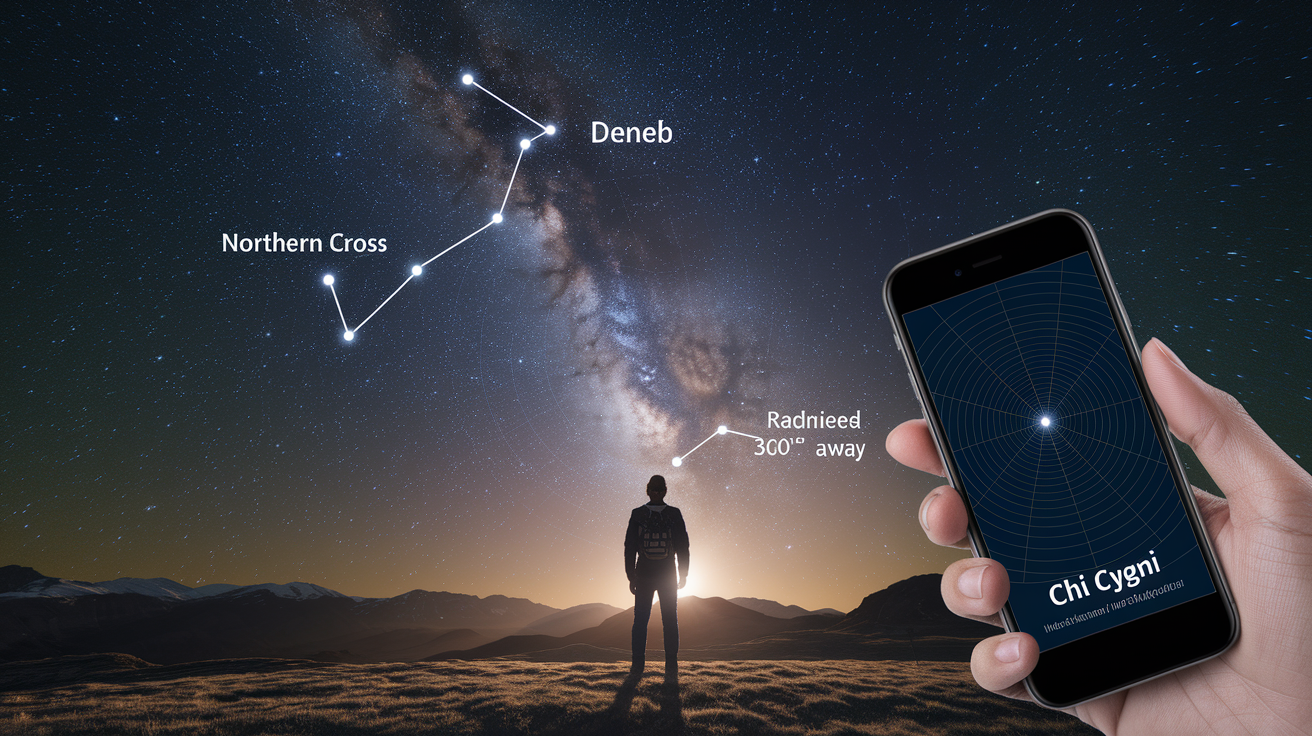
Cygnus sits high in the northern sky during summer and fall. Its brightest stars form the Northern Cross. Deneb marks the tail (top of the cross), and the wings spread east and west. Chi Cygni is not a bright star. It’s a variable that sits roughly mid‑body in the Swan, south of Deneb and a bit west of center. You won’t spot Chi Cygni by naked eye every night, but you don’t need to. Star apps like Stellarium or SkySafari let you drop a pin on Chi Cygni’s coordinates, and that marks your radiant zone.
The radiant is the point in the sky where meteor trails appear to originate. It’s not where meteors actually are, but a perspective effect, like railroad tracks vanishing at a point. Don’t stare directly at the radiant. Meteors closer to it will look short and slow. Meteors farther from it will show longer, more obvious trails. Aim your gaze about 30–40° away from Chi Cygni, somewhere overhead or toward the eastern side of Cygnus. Because the radiant is already high at dusk, you can start looking as soon as full darkness settles. No waiting until 2 a.m. like you would for the Geminids.
| Reference Star/Structure | How It Helps You Locate the Radiant |
|---|---|
| Chi Cygni | Marks the approximate radiant center (use an app to pinpoint it). |
| Deneb | Brightest star in Cygnus; radiant lies south‑southeast of Deneb. |
| Northern Cross shape | Chi Cygni sits inside the cross body; radiant is west of the long axis. |
| Cygnus wings (Albireo to Delta Cygni) | Radiant falls between the wing stars; wings frame your target zone. |
Chi Cygnids Activity Cycle, Parent Body, and Scientific Background

The Chi Cygnids stayed under the radar for a long time because they’re faint and their activity spikes only every five years or so. The first strong detection came in 2010, then again in 2015, 2020, and now 2025. Each time, camera networks and visual observers reported slow, faint meteors radiating from Cygnus in mid‑September. Low‑light video cameras in Puerto Rico logged 449 likely Chi Cygnid meteors during the 2020 return, confirming the pattern. That’s a total count from continuous monitoring, not meteors per hour. Visual observers saw far fewer. After enough cycles, researchers formally recognized the Chi Cygnids as a distinct, periodic shower instead of random background noise.
We still don’t know what produces them. The five‑year recurrence and orbital characteristics suggest a Jupiter‑family comet, a small, short‑period comet with an orbit controlled by Jupiter’s gravity. Jupiter perturbs the comet’s debris stream, nudging particles into Earth’s path roughly every five years. Without a known parent, we can’t predict exact peak times or intensities the way we do for showers linked to cataloged comets. The orbit and timing fit the Jupiter‑family model, but no specific comet candidate has been matched yet.
Predicting the Chi Cygnids is tricky because small changes in particle density or stream geometry shift the peak date and rate from one cycle to the next. That’s where observations matter. Each five‑year return gives researchers a chance to refine models, map the debris cloud’s structure, and hunt for the parent body. For now, the shower remains a modest, episodic curiosity. Low rates, but reliable enough to plan around once you know the pattern.
Visibility Conditions and Best Hours for the Chi Cygnids
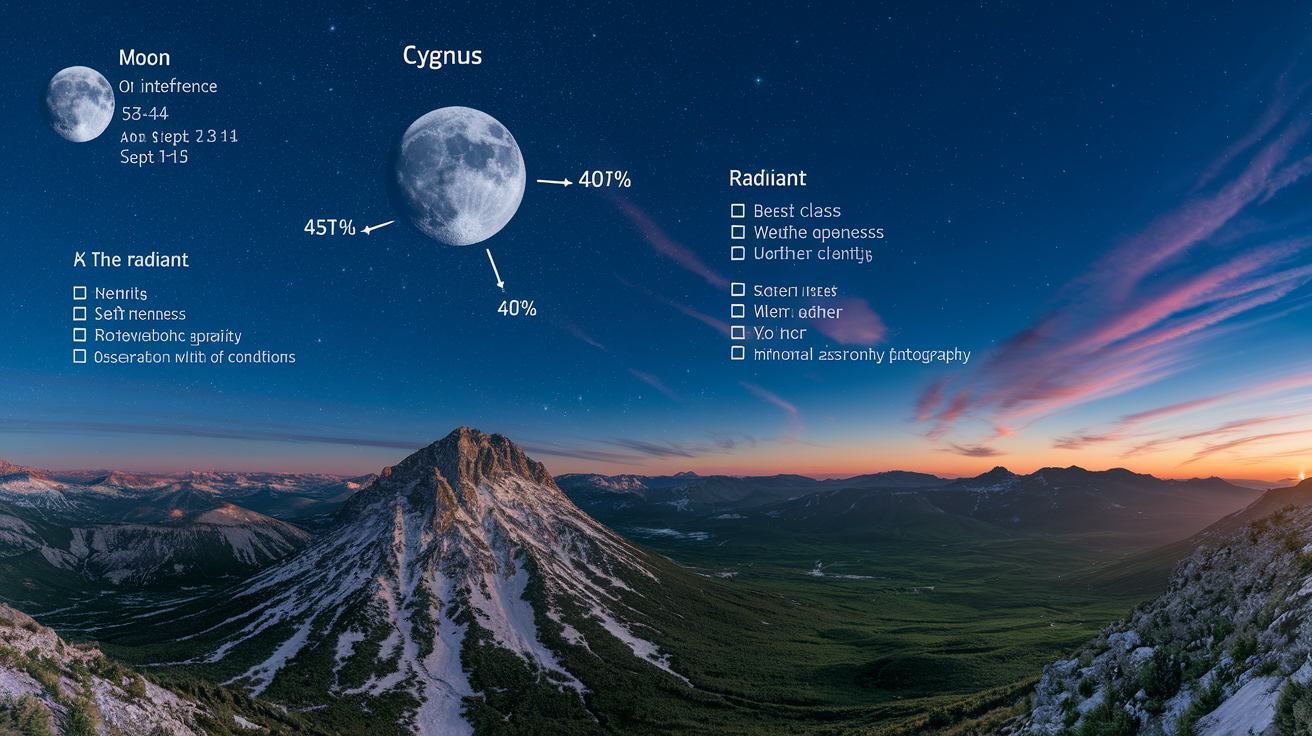
The Northern Hemisphere owns this shower. Cygnus rises high and stays visible all night during September for observers between roughly 30° and 60° N latitude. Southern Hemisphere observers see Cygnus low on the northern horizon or not at all, depending on latitude. Meteor rates drop fast when the radiant sits below about 30° elevation. The early‑evening geometry helps northern watchers: the radiant is already high at dusk, so you don’t lose half the night waiting for it to rise. But there’s a catch. Faint meteors are highly sensitive to sky brightness, and early evening often means lingering twilight glow or moonlight.
Moonlight cuts deep. A bright Moon can reduce visible meteor counts by 50–80%, especially for a faint shower like this one. Light pollution has a similar effect. Move from a Bortle 4 suburban site to a Bortle 2 rural site, and you might double your counts. Weather matters just as much: high clouds, haze, or humidity scatter light and dim faint streaks. The best plan is a dark‑sky site with dry, transparent air and minimal moon interference. Even a couple hours of truly dark early evening beats a whole night under a bright Moon or suburban skyglow.
Site‑selection criteria:
Bortle class 1–3: Rural or remote sky. Stars visible to magnitude +6.0 or fainter.
Horizon openness: Overhead view unobstructed by trees or buildings. Radiant is high, so zenith coverage matters more than horizon sweep.
Moon placement and phase: Prefer nights when the Moon rises late or is a thin crescent. Early‑evening dark time is critical.
Weather clarity: Dry air, no haze, no high clouds. Check humidity and dewpoint forecasts.
Observation window length: Plan at least 1–2 hours starting right after full darkness to catch a meaningful sample.
Practical Observing Tips for the Chi Cygnids

Naked‑eye watching beats binoculars or cameras for spotting random meteors. You need a wide field to catch streaks anywhere overhead. Set up a reclining lawn chair or a thick blanket on the ground so you can look straight up without straining your neck. Give yourself 20–30 minutes for dark adaptation once lights are off. Your eyes will start picking up fainter stars and fainter meteors. The Chi Cygnids are slow and subtle, so patience is part of the method. One or two meteors per hour means you might wait 30 minutes between events. That’s normal.
Safety basics: if you’re driving to a remote site, let someone know where you’ll be and when you expect to return. Dress warmer than you think you need to. September nights can drop into the 40s°F (4–9°C) even after a warm day, and you’ll be sitting still. Dew forms fast on clear nights, so keep a towel handy to wipe off chairs, phones, or any surface that gets wet. A red‑light headlamp helps you move around without killing dark adaptation.
Core observing practices:
- Choose a site with the darkest possible sky. Bortle 1–3 if available.
- Recline or lie flat. Avoid standing and craning your neck upward.
- Face roughly overhead or slightly east. Don’t stare at the radiant itself.
- Allow 20–30 minutes for full dark adaptation before counting meteors.
- Dress in layers and bring a blanket. September nights get cold fast.
- Keep a simple log: note the time, count meteors, and estimate brightness if possible.
Photographing the Chi Cygnids Slow Meteors
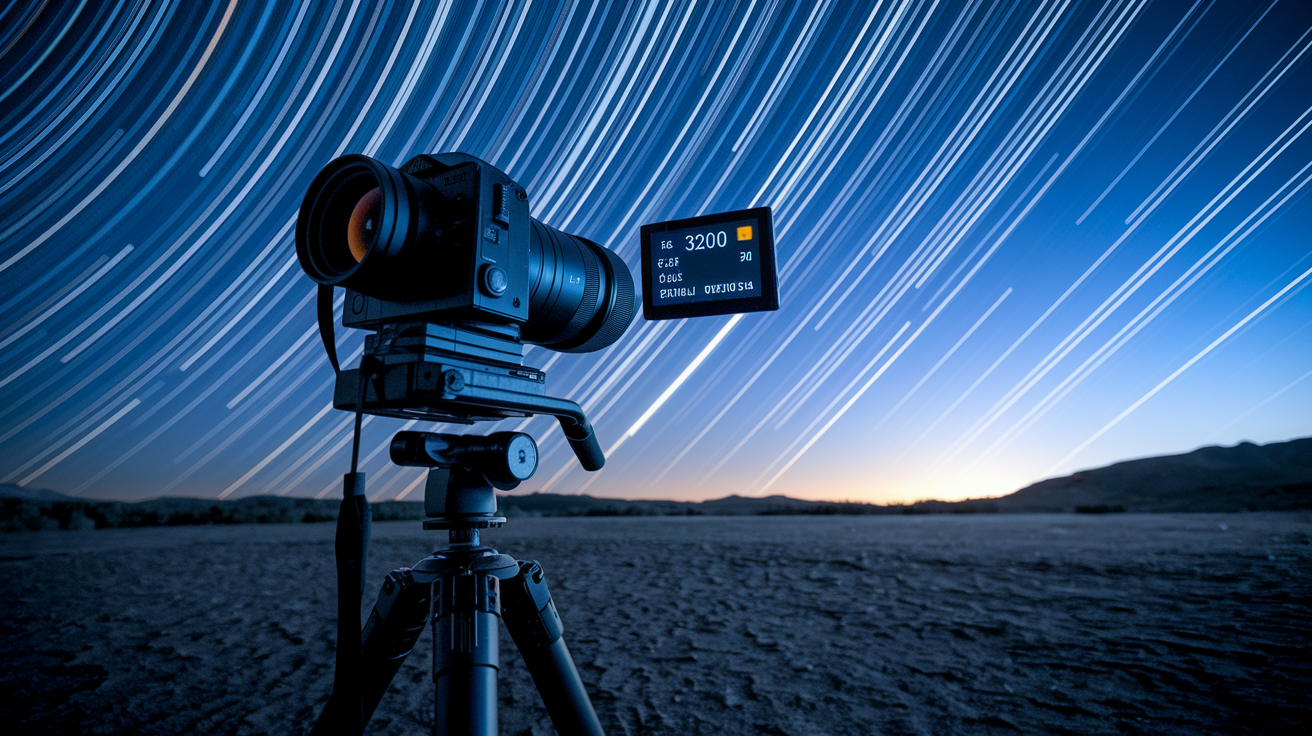
Slow meteors are easier to photograph than fast ones. 15 km/s gives the camera sensor time to record the full trail without motion blur turning it into a faint smudge. Use a wide‑angle lens (14–35 mm focal length) mounted on a tripod, no tracking needed. Point the camera toward Cygnus or straight up, and let it run in interval mode: one frame every 20–30 seconds, over and over for an hour or two. That way you don’t have to guess when a meteor will appear. The camera just keeps shooting and eventually one crosses the frame.
Start with ISO 1600–3200 on a modern camera (ISO 3200–6400 if your sensor handles noise well and the sky is very dark). Set the aperture as wide as your lens goes. f/2.8 or f/4 is typical for meteor work. Shutter speed around 20–30 seconds balances star trailing (stars will drift slightly but stay sharp enough) and meteor capture. An intervalometer or built‑in interval timer automates the sequence so you can sit back and watch with your eyes while the camera works. Review frames every 20–30 minutes to check focus, framing, and histogram. Adjust ISO or shutter if the sky is too bright or too dim.
Five quick setup tips:
Use a sturdy tripod. Wind or accidental bumps ruin long sequences.
Manual focus on a bright star. Use live view and zoom in to confirm sharp focus.
Shoot RAW if you plan to stack or process frames later. JPEG is fine for quick timelapse review.
Frame Cygnus or the zenith, not the exact radiant. Meteors farther from the radiant show longer trails.
Bring spare batteries. Interval shooting drains power fast, especially in cool night air.
Reporting Chi Cygnids Observations to Meteor Organizations

Variable showers need observer reports to map activity year by year. The International Meteor Organization (IMO) and the American Meteor Society (AMS) both accept visual meteor observations, and those reports feed into global databases that researchers use to refine shower profiles, peak times, and intensity forecasts. A single observer’s hourly count might seem small, but combine hundreds of reports from different sites and you get a clear picture of how the shower behaved across the globe. The 2020 Chi Cygnid detections came largely from automated cameras, but visual reports filled in geographic and brightness details the cameras missed.
Keep a simple log while you watch: note your start and end time, the center of your field of view (constellation or azimuth/altitude), your limiting magnitude (faintest star you can see), and the number of meteors you attribute to the Chi Cygnids versus sporadics or other showers. You don’t need fancy formatting. Just enough detail that someone reading your report knows what you saw, when, and under what conditions. After your session, visit the IMO or AMS website and enter your data. Most forms walk you through the fields step by step.
Essential data to include:
Observation period: Start and end time in UT (Universal Time) or local time with time zone noted.
Limiting magnitude: Faintest star visible in your field. This tells researchers how dark your sky was.
Meteor counts: Total meteors seen, broken into Chi Cygnids and sporadics if you can tell the difference by radiant and speed.
Field center and percentage of sky: Where you were looking (e.g., “zenith” or “Cygnus overhead”) and roughly how much sky was in view (e.g., “~60% overhead, trees blocking south”).
Final Words
In the action, we ran through the essentials: active late August to mid-September, peak around Sept 13–15, radiant near Chi Cygni in Cygnus. Meteors are slow (~15 km/s) and faint, so expect 1–2 per hour and plan for moonlight that can cut counts.
We also covered where to look, simple camera settings, and how to log sightings for science. If you step outside with dark skies and patience, the chi cygnids meteor shower can reward you with a few quiet, satisfying streaks. Enjoy the sky.
FAQ
Q: What time should I go out to watch the meteor shower?
A: The best time to go out to watch a meteor shower is from local dusk through pre-dawn; aim when the shower’s radiant is highest—often after midnight, though some showers peak earlier.
Q: What time is the meteor shower on July 29th?
A: If a meteor shower peaks on July 29th, plan to watch from late evening into the pre-dawn hours; check the specific shower’s radiant rise and your time zone for the exact peak window.
Q: Is there a meteor shower on September 14th?
A: Yes, the Chi Cygnids are forecast to peak around September 13–15, so September 14th is within that window, with the radiant near Chi Cygni and best viewing early evening to midnight.
Q: What time to see the Geminid meteor shower?
A: The Geminid meteor shower is best seen after midnight into the pre-dawn hours on its peak nights (around December 13–14), when the radiant climbs high and rates are strongest.