

What if the best ruler for finding tiny exoplanets is a glass tube of iodine?
The iodine cell method puts a sealed tube of iodine vapor in the path of starlight, imprinting thousands of narrow absorption lines onto the stellar spectrum.
Those iodine lines act as a simultaneous wavelength reference, so instrument drift and real Doppler shifts show up separately.
Here’s what we’ll do: explain how the cell creates that in-situ ruler, how software separates the star and iodine signals, and why this trick lets radial-velocity searches reach meter-per-second precision and stay stable over years.
Fundamentals of the Iodine Absorption Cell
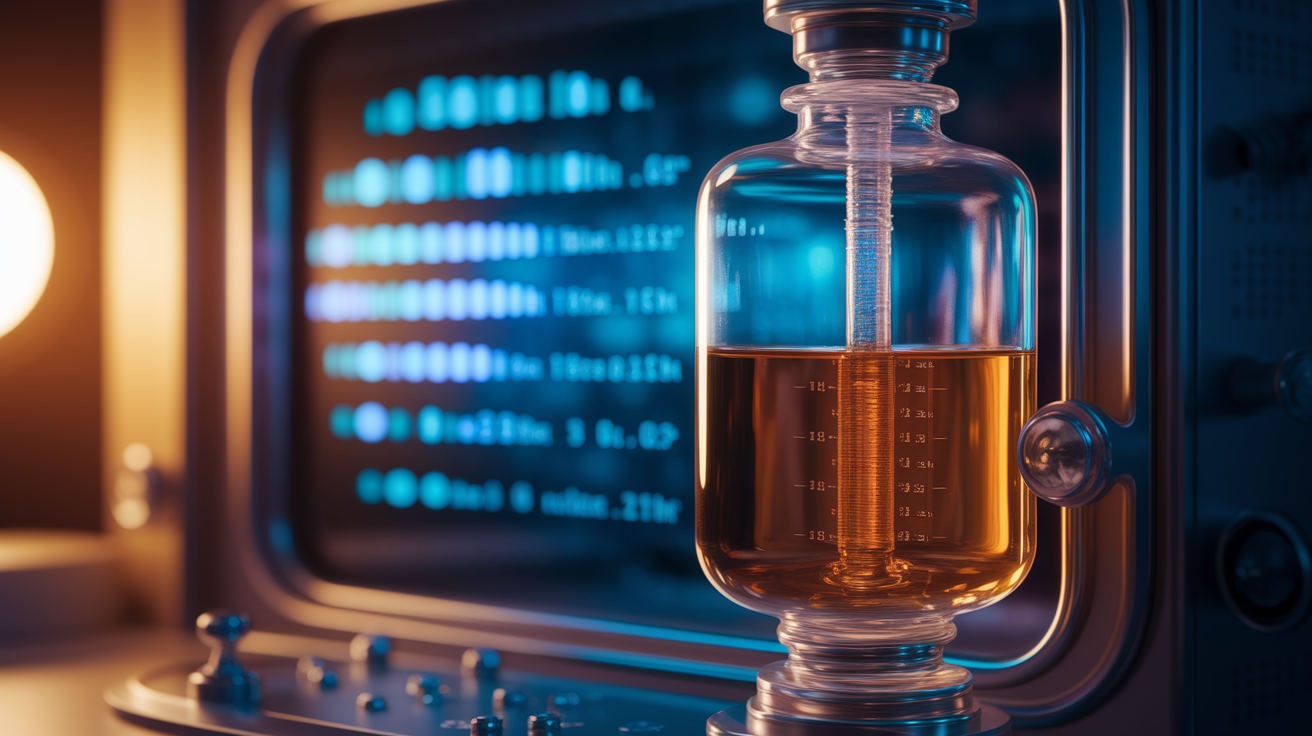
An iodine absorption cell is a sealed glass tube filled with molecular iodine vapor (I₂), held at a controlled temperature. When you place it in the path of starlight entering a spectrograph, the iodine molecules absorb photons at thousands of precise wavelengths between roughly 500 and 620 nanometers. This creates a dense forest of narrow absorption lines that overlay directly onto the stellar spectrum. Each line works as a stable wavelength marker, letting astronomers track tiny shifts in the star’s spectrum caused by orbiting planets tugging the star back and forth. The iodine pattern doesn’t change, so any apparent shift must come from the star itself or from the instrument drifting.
Iodine works well here because its spectrum is extraordinarily rich. Within the usable range, thousands of absorption lines create a fingerprint so detailed that even sub-meter-per-second Doppler shifts become measurable when you model the data carefully. The method works as an in-situ reference because the iodine and starlight travel the same optical path through the spectrograph. Instrument drift, thermal expansion of optics, or slight misalignments affect both spectra identically, and the iodine pattern reveals those changes directly in the recorded data. This is fundamentally different from separate calibration sources that follow different paths and can miss drifts happening between calibration exposures.
The long-term stability of an iodine cell depends on a few key physical properties. Molecular iodine transition frequencies are governed by quantum mechanics and don’t drift over observational timescales. Holding the cell at a stable temperature (typically 50 to 70°C) ensures the line depths and shapes remain consistent. Iodine vapor doesn’t break down or react under normal optical illumination, so cells can operate for decades. Because the iodine spectrum is imprinted simultaneously with every stellar observation, there’s no need for separate lamp exposures at different times of the night.
How Iodine Lines Interact With Stellar Spectra

When starlight passes through the iodine cell, the result is a hybrid spectrum. The stellar continuum and the star’s own absorption features remain visible, but now they carry thousands of additional narrow dips from iodine molecules absorbing specific colors. A typical high-resolution spectrum in the green to yellow range shows 30 to 100 iodine lines per 1 km/s Doppler width, depending on wavelength. This density means that even small Doppler shifts produce detectable changes in the pattern of line positions across the detector. The iodine reference travels with the light through every optical element, experiencing the same focus errors, wavelength distortions, and detector pixel responses as the stellar spectrum itself.
The process unfolds in five steps. Starlight from the telescope enters the spectrograph and passes through the iodine cell mounted in a temperature-controlled enclosure. Iodine molecules in the vapor phase absorb photons at their characteristic wavelengths, imprinting narrow lines onto the stellar continuum. The combined spectrum gets dispersed by the spectrograph grating, spreading different wavelengths across the detector. A CCD or similar detector records the intensity at each pixel, capturing both the stellar features and the iodine absorption pattern. Software separates the overlapping stellar and iodine components by forward-modeling the observed spectrum, using high-resolution iodine atlases and the instrument’s point-spread function.
Because both signals share the same optical path, any wavelength shift caused by instrument flexure or thermal drift appears identically in the iodine lines and the stellar lines. By measuring where the known iodine pattern lands on the detector, the software calculates how much the wavelength scale has shifted, then applies that correction to extract the true stellar Doppler velocity. This simultaneous calibration is the core reason iodine cells can reach precisions below 10 meters per second over multi-year campaigns, even when instrument conditions vary.
Mathematical Basis of Precision Wavelength Calibration
The Doppler shift caused by a star’s motion changes the observed wavelength of every spectral line according to the relation Δλ / λ = v / c, where Δλ is the wavelength shift, λ is the rest wavelength, v is the radial velocity, and c is the speed of light. For a star moving at 10 meters per second relative to Earth, the fractional shift is 10 / (3 × 10⁸), roughly 3.3 × 10⁻⁸. At a wavelength of 550 nanometers (5500 Å), this corresponds to a shift of roughly 0.00018 Å. Measuring such tiny displacements requires both high spectral resolution and a stable wavelength reference. The iodine cell provides that reference by imprinting lines whose rest wavelengths are known to within a few megahertz, corresponding to Doppler uncertainties around 2 meters per second or better across the usable range.
Doppler Shift Formula and Numerical Example
Consider a stellar absorption line at 5500.000 Å observed with an iodine-calibrated spectrograph. If the star has a radial velocity of +15 m/s (moving away), the line shifts to 5500.000 × (1 + 15 / 3×10⁸), about 5500.000275 Å. The iodine lines, which have fixed laboratory wavelengths, remain at their rest positions in the star’s reference frame but appear shifted on the detector by the same instrumental drift that affects the stellar spectrum. By comparing where iodine lines land on the detector to their known rest wavelengths, the software determines the instrument’s wavelength zero-point for that exposure. The difference between the measured stellar line position (corrected for instrumental drift) and the rest wavelength then yields the star’s velocity. If the instrument drifted by 0.0001 Å between calibration and observation, the iodine pattern reveals that shift, and the correction is applied before computing the final radial velocity.
Forward Modeling and Component Separation
Forward modeling reconstructs the observed spectrum by combining three components. The stellar template, the high-resolution iodine atlas, and the instrumental point-spread function (PSF). The stellar template is a high signal-to-noise spectrum of the star taken without iodine, representing the star’s intrinsic absorption features. The iodine atlas is a laboratory measurement of the I₂ absorption spectrum at very high resolution, often recorded with Fourier-transform spectrometers at resolving powers around 2,300,000. The PSF describes how the spectrograph spreads a monochromatic input across multiple detector pixels, accounting for optical aberrations, grating imperfections, and detector effects.
The software divides the observed spectrum into small wavelength chunks, typically 1 to 2 Å wide. For each chunk, it adjusts three free parameters. The Doppler shift of the stellar template, the wavelength zero-point (to account for instrumental drift), and the shape of the PSF. The model convolves the high-resolution iodine atlas with the PSF, multiplies the result by the Doppler-shifted stellar template, and compares the synthetic spectrum to the observed data. By iterating this process across hundreds of chunks and averaging the resulting velocities, the method achieves precisions well below the width of a single spectral resolution element. The PSF reconstruction is crucial because it allows the software to track how the instrument’s optical performance varies across the detector and over time.
| Input Component | Description |
|---|---|
| Stellar Template | High-S/N spectrum of the target star without iodine, used to model intrinsic stellar features. |
| Iodine Atlas | Laboratory-measured I₂ spectrum at resolving power around 2,000,000, providing rest wavelengths for calibration lines. |
| Instrument PSF Model | Mathematical description of how the spectrograph spreads light, reconstructed chunk-by-chunk from iodine data. |
Instrument Modeling and Deconvolution Techniques

High-precision radial velocity measurements depend on accurate characterization of the spectrograph’s point-spread function, which describes how a single wavelength is distributed across detector pixels. The PSF varies spatially across the detector because optical aberrations, grating illumination patterns, and pixel-response non-uniformities differ from one location to another. It also changes over time as the instrument warms, cools, or flexes under gravity when the telescope moves. The iodine method handles this variability by reconstructing the PSF independently for each spectral chunk in every observation. Because the iodine absorption spectrum contains so many narrow lines, the software can measure how each line is spread by the instrument at that specific location and moment, then use that local PSF to deconvolve the stellar features.
A typical reduction divides the observed spectrum into chunks roughly 2 Å wide, corresponding to about 100 km/s in velocity space at 5500 Å. Within each chunk, the software fits a parameterized PSF model, often a Gaussian or a sum of Gaussians, adjusting the width and shape to match the observed iodine line profiles. The high-resolution iodine atlas provides the intrinsic line shapes, so any additional broadening or asymmetry in the data must come from the instrument. By iterating the fit, the code determines the PSF that, when convolved with the atlas, best reproduces the observed iodine pattern. That same PSF is then used to model the stellar absorption features in the chunk, letting the software extract a Doppler shift even when stellar and iodine lines overlap.
Deconvolution is implicit in this forward-modeling approach. Rather than attempting to remove the instrumental broadening and recover an idealized spectrum, the method generates synthetic spectra that include all the instrumental effects and compares them directly to the data. This avoids amplification of noise that traditional deconvolution often introduces. The PSF reconstruction also captures wavelength-dependent effects, such as changes in resolution or focus across the spectral range, ensuring that the Doppler extraction accounts for real optical behavior rather than assuming an idealized, uniform instrument. The result is a velocity measurement for each chunk, and the final radial velocity is a weighted mean of hundreds of these independent estimates, significantly reducing random errors.
Practical Setup in Observatories
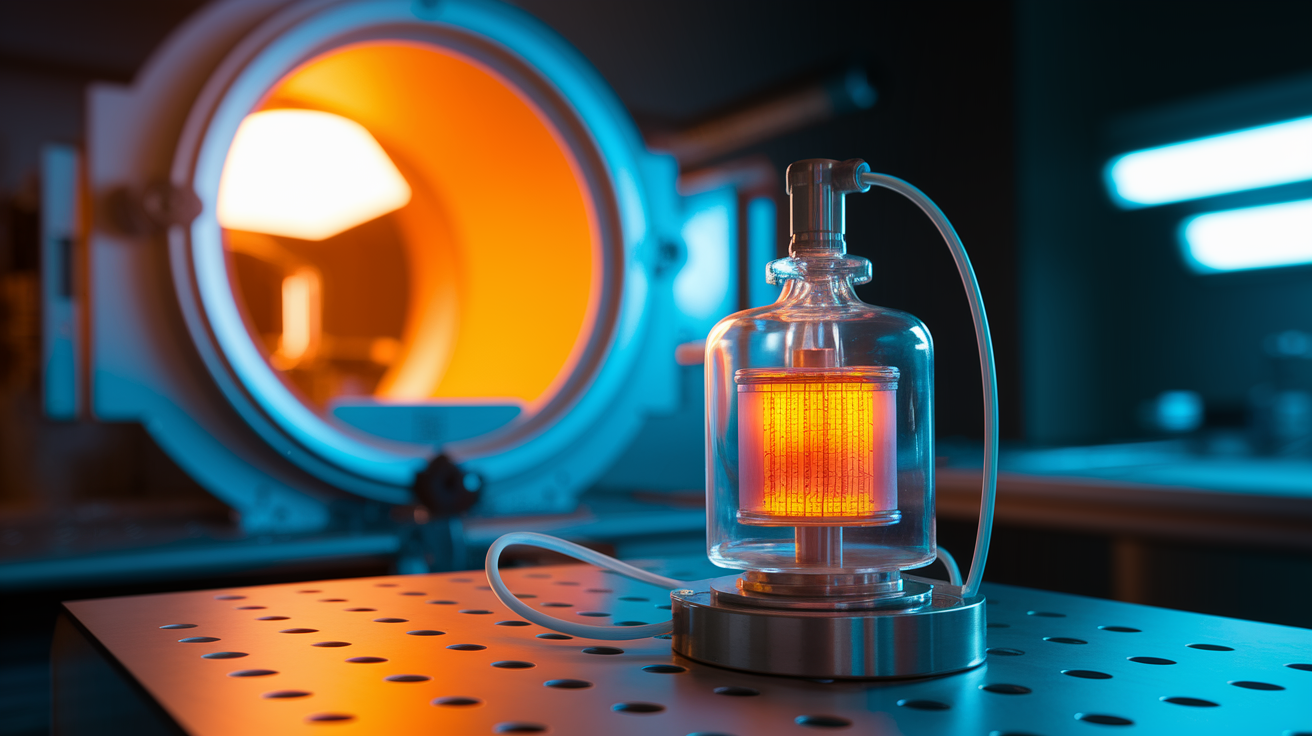
In a typical observatory setup, the iodine cell is mounted in the converging beam between the telescope and the spectrograph entrance slit. This location ensures that the cell is uniformly illuminated and that the iodine absorption is imprinted on all spatial positions across the slit. The cell itself is a sealed Pyrex tube, often around 10 cm long and a few centimeters in diameter, containing a small crystal of solid iodine. Heating the tube to 50 to 70°C sublimes the iodine into vapor, filling the cell with molecular I₂ at a pressure high enough to produce strong absorption but low enough to avoid significant pressure broadening of the lines. A resistive heating jacket surrounds the cell, and temperature sensors (typically thermistors or platinum resistance thermometers) monitor the vapor temperature to within 0.1°C or better.
Temperature stability is critical because the depth and shape of iodine absorption lines depend on the Boltzmann distribution of molecules across rotational and vibrational energy levels. A temperature change of 1 K shifts the effective line strengths and can introduce systematic radial-velocity offsets of roughly 1 meter per second. Crossing the iodine dew point, where vapor begins to condense back into solid, produces abrupt jumps of 50 m/s or more as the optical density changes discontinuously. To avoid these effects, observatories operate the cell well above the dew point and use feedback-controlled heaters to hold the temperature constant within 100 millikelvin over the course of a night. The cell is typically removed from the optical path during calibration exposures taken with other sources, such as tungsten-halogen lamps or hollow-cathode lamps, to allow independent checks of spectrograph performance.
Typical operational parameters include temperatures of 50 to 70°C, stabilized to within ±0.1°C or better to prevent Boltzmann-distribution shifts. Vapor pressure stays low enough to minimize pressure broadening, typically corresponding to a few millimeters of mercury. Optical alignment positions the cell in the converging beam so that it’s uniformly filled with starlight, avoiding vignetting or partial illumination that would distort the iodine pattern.
Advantages and Limitations of the Iodine Cell Method
The iodine cell method offers long-term wavelength stability because the molecular transition frequencies are fixed by quantum mechanics and don’t drift over decades. Because the iodine spectrum travels the same optical path as the starlight, the method automatically corrects for most instrumental drifts, including thermal expansion, flexure, and small alignment changes. This self-calibrating property allows observatories to achieve radial-velocity precisions in the range of 1 to 10 meters per second without frequent external calibration lamp exposures. The technique is also cost-effective compared to laser frequency combs or stabilized Fabry-Pérot etalons, requiring only a temperature-controlled cell and software for forward modeling rather than complex laser systems or fiber-fed calibration units.
But the method has several limitations. Iodine absorption lines are only useful between roughly 500 and 620 nanometers, so the technique can’t calibrate observations at bluer or redder wavelengths where many stellar features or planet atmospheric signatures reside. The dense iodine pattern reduces the effective signal-to-noise ratio of the stellar spectrum by absorbing a significant fraction of the incoming photons, typically lowering throughput by 20 to 40 percent depending on wavelength. Forward modeling is computationally intensive and requires high-quality template spectra, which must be obtained in separate observations without the iodine cell. The PSF reconstruction depends on having many iodine lines per spectral chunk, which can be challenging at the edges of the usable range where line density drops. The method is sensitive to temperature control and crossing the dew point, requiring careful thermal management to avoid systematic errors.
Restricted wavelength coverage (500 to 620 nm only). Throughput loss of 20 to 40% due to iodine absorption. Requires separate template observations without iodine. Computationally demanding forward-modeling and PSF fitting. Sensitive to temperature drifts and dew-point crossing, necessitating precise thermal stability.
Comparison With Laser Frequency Combs and Other Techniques
Laser frequency combs generate thousands of evenly spaced emission lines across a broad wavelength range, with each line’s frequency locked to an atomic clock. This provides absolute wavelength calibration with uncertainties at the centimeter-per-second level or better, far exceeding the 1 to 2 m/s uncertainty typical of iodine atlases. Astro-combs, which are combs adapted for astronomical spectrographs by filtering the line spacing to match the instrument resolution, can in principle deliver radial-velocity precisions approaching 1 cm/s. But comb systems require stable lasers, nonlinear fiber setups to generate supercontinuum light, and careful filtering, making them more complex and expensive than iodine cells. Combs also require separate calibration exposures, so they don’t automatically correct for drifts that occur during a science integration in the way iodine does.
Thorium-argon (Th-Ar) hollow-cathode lamps have been the traditional calibration source for decades. They produce emission lines across the optical and near-infrared, but the line density is lower than iodine or combs, and the lamps suffer from intensity drifts and spectral shifts as the cathode ages. Th-Ar calibration typically achieves precisions of tens of meters per second, sufficient for many applications but inadequate for detecting Earth-mass planets in habitable zones. Unlike iodine, Th-Ar exposures are taken separately from science observations, so any drift between calibration and science frames introduces errors. Some modern spectrographs use stabilized Fabry-Pérot etalons, which generate dense, uniform forests of lines, but these also require separate exposures and careful thermal control.
The iodine method sits between these extremes. It delivers better long-term stability than Th-Ar by providing simultaneous calibration, and it’s far simpler and cheaper than laser combs while still reaching precisions sufficient for most exoplanet surveys. For wavelength ranges outside the iodine window or for programs targeting sub-m/s precision, combs are becoming the preferred choice, but iodine remains competitive for surveys focused on the green-yellow spectral region and willing to accept meter-per-second uncertainties.
| Technique | Typical Precision | Operational Notes |
|---|---|---|
| Iodine Cell | 1 to 10 m/s | Simultaneous calibration, limited to 500 to 620 nm, requires temperature control and forward modeling. |
| Laser Frequency Comb | 0.01 to 1 m/s | Absolute calibration, broad wavelength coverage, complex and expensive, separate exposures required. |
| Th-Ar Lamps | 10 to 100 m/s | Simple and inexpensive, prone to drifts, lower line density, separate calibration exposures. |
Historical Development and Key Milestones
The iodine cell technique was developed in the early 1990s as astronomers pushed radial-velocity precision below 10 meters per second to search for Jupiter-mass planets around nearby stars. Early implementations at Lick Observatory and with the HIRES spectrograph on the Keck I telescope demonstrated that iodine could provide stable wavelength references over multi-year campaigns. These efforts culminated in the detection of several exoplanets in the mid-1990s, including planets around stars like 70 Virginis and 47 Ursae Majoris, validating the method’s ability to track Doppler shifts at the few-meter-per-second level. The technique allowed long-term surveys to distinguish true planetary signals from instrumental artifacts by providing continuous, in-situ calibration that tracked spectrograph drifts night after night.
By the early 2000s, iodine-based surveys had achieved precisions better than 3 m/s, enabling detections of Saturn-mass and Neptune-mass planets. Improvements in detector technology, higher-resolution spectrographs, and refined forward-modeling algorithms steadily pushed the floor lower, with some programs reporting per-measurement scatter below 1 m/s for bright stars under ideal conditions. The method also became a standard tool for asteroseismology, where precise radial velocities reveal stellar oscillations with periods of minutes to hours. As laser frequency combs matured in the 2010s, iodine cells remained widely used for surveys targeting stars in the green-yellow range, particularly for programs with large samples where the cost and complexity of combs were prohibitive.
The 1990s saw first exoplanet detections using iodine cells at Lick and Keck, demonstrating sub-10 m/s precision over multi-year timescales. The early 2000s brought precision improvements to around 3 m/s, enabling detection of lower-mass planets and expanding the catalog of known exoplanets. From the 2010s onward, iodine remains competitive for specific wavelength ranges and large surveys, while laser combs begin to dominate programs targeting extreme precision or broad spectral coverage.
Final Words
We started by defining the iodine absorption cell and why iodine’s dense lines make a stable in situ reference. Then we showed how those lines imprint on stellar spectra, the forward-model math and PSF work that pulls out tiny Doppler shifts, practical observatory setup, plus pros, limits and comparisons to combs.
If you want a clear takeaway: the iodine cell method for precision radial velocity calibration explained gives a proven, cost-effective path to sub-m/s stability, with known tradeoffs, and it still helps us find new worlds.
FAQ
Q: What is an iodine absorption cell and how is it used for radial velocity calibration?
A: The iodine absorption cell is a sealed glass cell filled with iodine vapor that provides thousands of stable absorption lines between 500–620 nm, used as an in‑situ wavelength reference imprinted on stellar light for precise radial velocity calibration.
Q: Why is iodine’s dense absorption spectrum ideal for precision Doppler work?
A: Iodine’s dense spectrum is ideal because thousands of narrow, stable lines between 500–620 nm act like a finely spaced ruler, tracking instrument drifts and enabling sub‑m/s Doppler precision over long times.
Q: How do iodine lines interact with stellar spectra?
A: Iodine lines interact with stellar spectra by superimposing thousands of narrow absorption features onto incoming starlight, providing simultaneous calibration and allowing direct measurement of instrument shifts during each exposure.
Q: What are the main steps from starlight entering the spectrograph to iodine imprint formation?
A: The main steps are 1) starlight passes through the iodine cell, 2) iodine imprints narrow absorption lines, 3) spectrograph disperses light, 4) detector records the combined spectrum, 5) models later separate the components.
Q: What is forward modeling and how does it enable cm/s to m/s precision?
A: Forward modeling fits a synthetic combined spectrum built from a high‑resolution iodine atlas, a stellar template, and an instrument PSF, adjusting Doppler shift until the model matches data, yielding cm/s–m/s velocities.
Q: What operating temperatures and placement are used for iodine cells in observatories?
A: Iodine cells are typically kept at 50–70°C and inserted in the telescope optical path before the spectrograph entrance (slit or fiber). Temperature and alignment are actively monitored to keep line profiles stable.
Q: What are the main advantages and limitations of the iodine cell method?
A: The main advantages are long‑term stability and simultaneous in‑situ calibration that enable multi‑year Doppler precision; limitations include reduced throughput, confinement to 500–620 nm, complex forward modeling, and instrument dependence.
Q: How does the iodine cell compare to laser frequency combs and Th‑Ar lamps?
A: Iodine cells are cost‑effective and robust for long‑term relative calibration; laser frequency combs offer superior absolute accuracy and broader coverage but are costlier and complex; Th‑Ar lamps are simpler but less stable.
Q: What inputs are required for a typical iodine forward-modeling pipeline?
A: The required inputs are a high‑resolution stellar template spectrum, a high‑resolution laboratory iodine atlas, and an accurate instrument PSF model, all combined during forward modeling to extract Doppler shifts.
Q: What was the historical role of the iodine cell in exoplanet discovery?
A: The iodine cell enabled early radial velocity detections in the 1990s achieving roughly 3 m/s precision; it was central to instruments like HIRES and Lick and helped pave the way for modern calibration techniques.