

Predicting meteor showers is mostly geometry, not guesswork.
It comes down to when Earth’s path crosses a stream’s node, the spot where a tilted orbit punches through the ecliptic.
This guide shows the orbital elements and formulas you need to compute nodal longitude, the node distance from the Sun, and the date when Earth reaches that longitude.
You’ll see practical thresholds, a step by step workflow, and when to use quick analytical checks versus full numerical integrations.
Read on to learn how a few equations let you predict shower timing with hours-to-days accuracy and why small orbital shifts matter.
Determining Orbital Intersection Between Earth and Meteoroid Streams
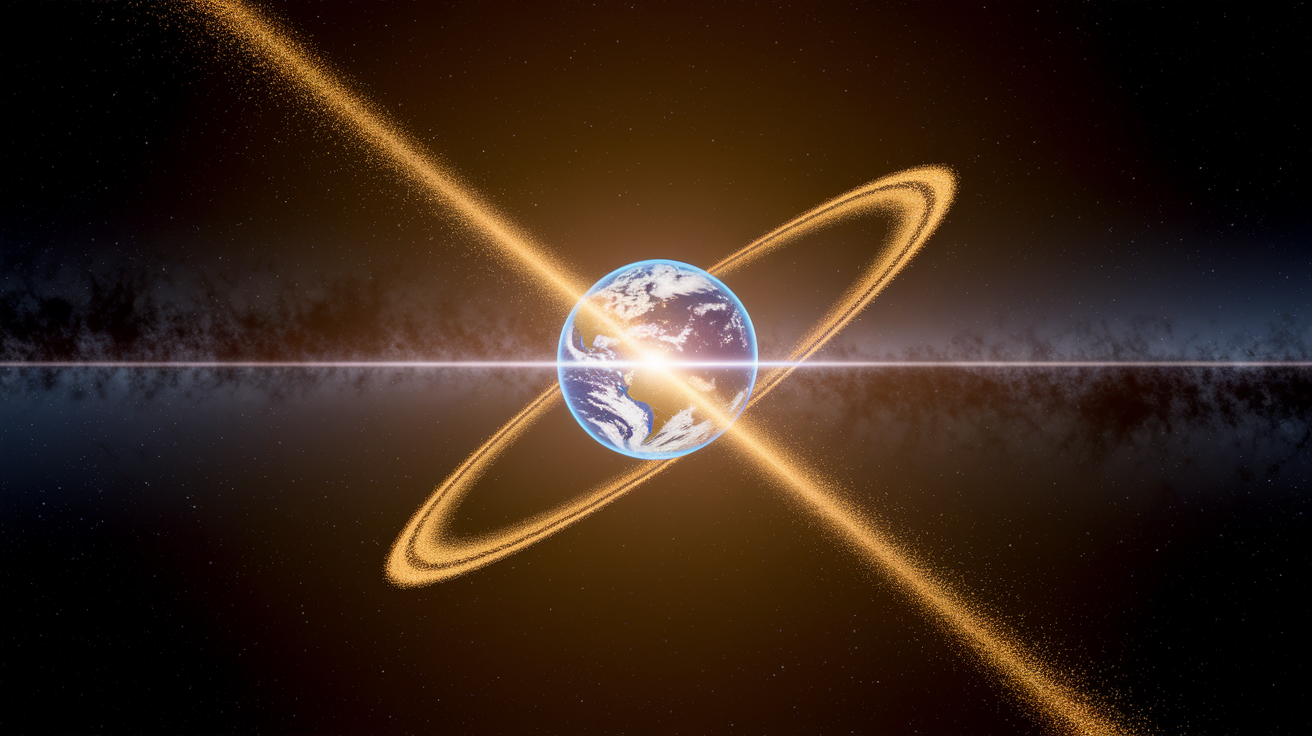
Earth sweeps through space on a nearly circular path. Sometimes it passes through clouds of tiny debris left behind by comets or active asteroids. These clouds orbit the Sun on their own trajectories. We call them meteoroid streams.
An orbital intersection happens when Earth’s orbit crosses the same region a stream occupies. The critical spot is the node, where the stream’s tilted orbit punches through the flat plane of Earth’s orbit (the ecliptic). If Earth arrives there when meteoroids are present, you get a meteor shower.
Predicting these crossings means comparing orbital geometry. You locate the stream’s ascending node (where it crosses the ecliptic heading north) and descending node (heading south). Then check whether Earth’s orbit comes close to either one. If the nodal longitude of the stream matches Earth’s ecliptic longitude at some point during the year, and the distance between the two orbits at that node is small enough (usually less than 0.01 AU, about 1.5 million kilometers), particles slam into our atmosphere at tens of kilometers per second and flash into meteors.
The intersection date depends on when Earth reaches the stream’s nodal longitude. Because Earth orbits once per year, this happens on roughly the same calendar date annually. Small shifts occur due to nodal precession, the slow drift of the stream’s node caused by gravitational tugs from planets.
Four indicators signal a potential crossing:
Nodal longitude match: Earth’s ecliptic longitude lines up with the stream’s node longitude.
Minimal nodal distance: The stream’s orbit sits close to 1 AU from the Sun at the node, with small vertical offset.
Timing alignment: Earth passes the nodal region within days or weeks of when stream particles cross it.
Stream density: Enough meteoroids are present in that part of the stream to produce visible activity.
Orbital Elements Required for Nodal Crossing Calculations

To figure out where a meteoroid stream intersects the ecliptic, you need its classical Keplerian orbital elements. Six numbers describe the size, shape, tilt, and orientation of the orbit.
Inclination i tells you the orbit’s tilt relative to the ecliptic. The longitude of the ascending node Ω pinpoints the spot on the ecliptic where the orbit crosses northward. Argument of perihelion ω measures the angle from that ascending node to the orbit’s closest point to the Sun, in the direction of motion. Semi‑major axis a sets the orbit’s size, eccentricity e controls its shape (circle or ellipse), and mean anomaly M locates the body along its orbit at a reference time.
Two elements matter most for nodal alignment. Ω directly specifies the ecliptic longitude of the ascending node, the coordinate Earth must reach for an intersection. Inclination i determines how steeply the stream orbit cuts through the ecliptic. Low i means the stream stays close to Earth’s orbital plane and produces a longer crossing window. High i creates a sharper, shorter intersection zone.
The elements with the strongest influence on whether Earth encounters the stream:
Longitude of ascending node Ω: defines where the node sits on the ecliptic.
Inclination i: controls the vertical separation and the length of the crossing corridor.
Argument of perihelion ω: sets the distance from the Sun at the node, affecting whether particles reach 1 AU.
Mathematical Formulas for Computing Nodal Distances
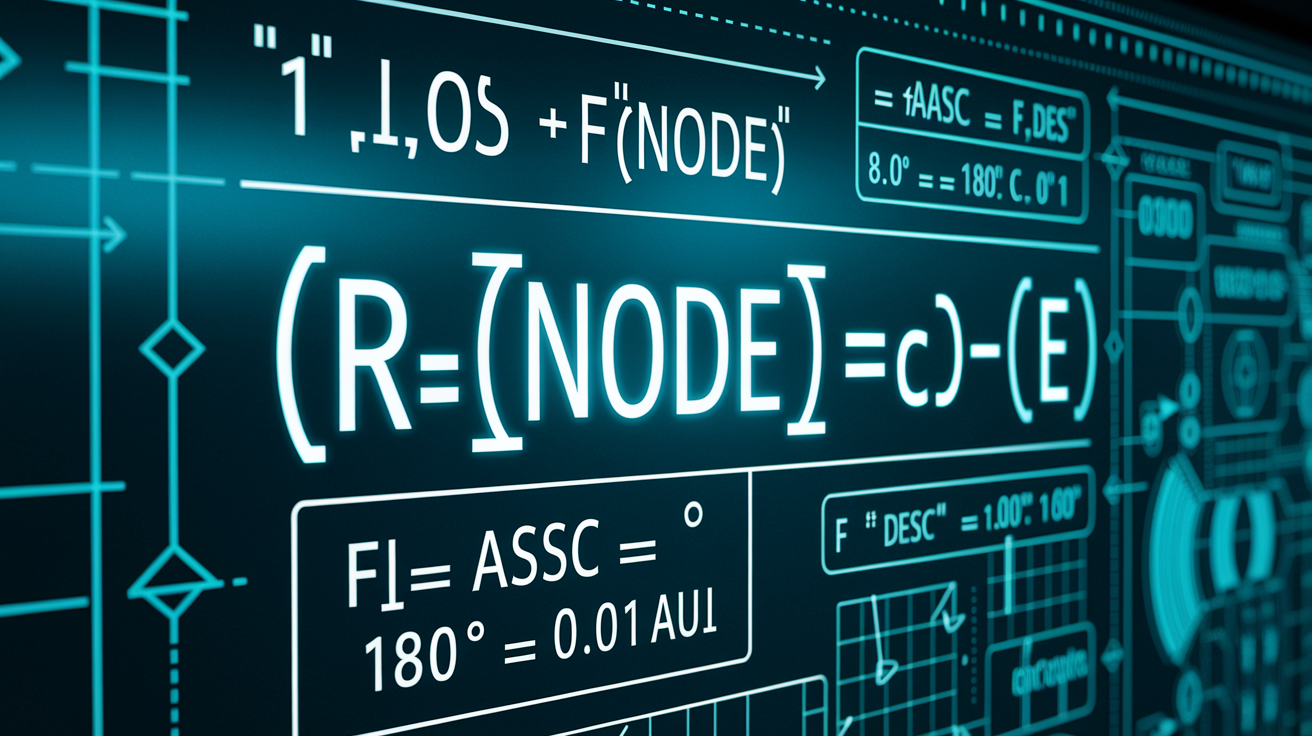
The core question is whether Earth’s orbit (a circle at 1 AU) comes close enough to the stream’s orbit at the node to scoop up particles.
At the ascending node, the stream’s true anomaly f is −ω (modulo 360°). At the descending node, f equals 180° − ω. Once you know f at the node, compute the stream’s heliocentric distance there using the polar orbit equation: rnode = a(1 − e²)/(1 + e cos fnode). If r_node is close to 1 AU and the vertical offset is tiny, Earth can collect meteoroids.
After computing rnode, convert that position into ecliptic coordinates to find the longitude λnode where the stream crosses the plane. Calculate x = r cos(Ω + ω + f) and y = r sin(Ω + ω + f) in the ecliptic frame, then take λ = arctan(y / x). If Earth’s orbital longitude passes through λnode at some point during the year, an intersection is possible. The closer rnode is to 1 AU, the higher the chance of a strong shower.
The threshold distance for visible activity is about 0.01 AU (roughly 1.5 million kilometers) in the vertical direction. Streams farther than that rarely deliver enough particles to Earth’s upper atmosphere.
Here’s a summary of the key formulas:
| Formula | Purpose |
|---|---|
| fasc = −ω; fdesc = 180° − ω | True anomaly at ascending and descending nodes |
| rnode = a(1 − e²) / (1 + e cos fnode) | Heliocentric distance of the stream at the node |
| Δ < 0.01 AU | Vertical‑offset threshold for detectable meteor activity |
Radiant Geometry and Apparent Sky Direction
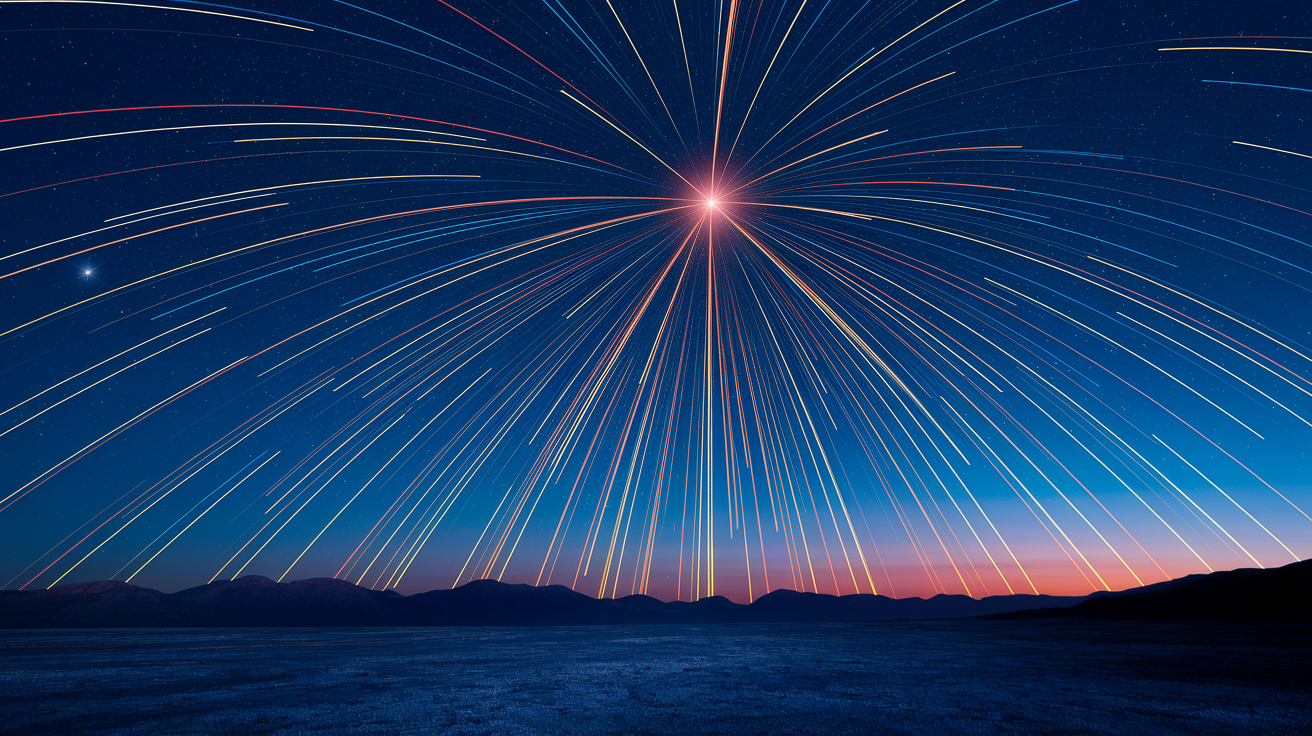
When meteoroids hit Earth’s atmosphere, they appear to radiate from a single point in the sky. We call this the radiant. It’s an illusion caused by perspective. All particles in a stream move on nearly parallel paths through space, but from Earth’s viewpoint they seem to fan out from a vanishing point. Like railroad tracks appearing to converge at the horizon.
The radiant’s celestial coordinates (right ascension and declination) depend on the geocentric velocity vector of the stream particles. That’s the difference between the stream’s heliocentric velocity and Earth’s velocity.
The radiant’s position slowly drifts across the sky during a shower. The stream’s heliocentric velocity changes along its elliptical orbit. As Earth moves through different parts of the stream, the relative velocity vector shifts slightly, nudging the radiant by a few degrees over several days. This drift is more obvious for streams with high eccentricity. The Perseids radiant, for instance, moves steadily northward in Perseus each August as Earth progresses through the broader stream cross‑section.
Computing the Geocentric Velocity Vector
To calculate the radiant, first find the stream’s heliocentric velocity at the intersection point using Kepler’s laws. Then subtract Earth’s velocity vector (about 30 km/s directed along its orbital motion). The resulting geocentric vector points from Earth toward the apparent source in the sky.
Convert that vector to right ascension and declination using standard coordinate transformations. The radiant’s location confirms the intersection. Each shower has a characteristic radiant tied to its parent body’s orbit. If your nodal crossing calculation predicts a radiant at RA 48°, Dec +58°, and observers report meteors converging at that spot in Perseus on the predicted night, the model checks out.
Computational Methods for Predicting Crossing Dates
There are two main approaches: analytical and numerical.
The analytical method uses closed‑form expressions to solve for the date when Earth’s ecliptic longitude matches the stream’s node longitude. You convert the node longitude into a calendar date by inverting Earth’s orbit formula or using an ephemeris. This works well for stable streams with slowly changing nodes. But it ignores gravitational perturbations and assumes the stream’s orbit stays fixed. For long‑lived showers like the Perseids, analytical predictions are accurate to within hours or days.
Numerical integration is more powerful. It models thousands or millions of individual meteoroid particles as test bodies and propagates their orbits forward in time with an N‑body integrator. You include gravitational forces from the Sun, planets, and sometimes the Moon. Plus non‑gravitational forces like radiation pressure (which pushes small particles outward) and Poynting–Robertson drag (which slowly spirals them inward). Each particle carries a size and mass. The simulation records when and where each particle’s orbit crosses Earth’s path, building up a time‑resolved profile of potential meteor activity.
Modern forecasts combine both methods. Analytical formulas provide the rough date and sanity‑check the numerical output. Then numerical integration refines the timing, accounts for trail structure, and predicts intensity.
The workflow:
- Ingest orbital elements for the parent body and generate a swarm of ejected particles with realistic velocity distributions.
- Apply perturbation models (planetary gravity, radiation forces) and integrate the particle orbits over decades or centuries.
- Solve for nodal evolution by tracking when each particle’s orbit crosses Earth’s heliocentric distance at the ecliptic plane.
- Predict the crossing date by identifying the moments when Earth’s longitude matches particle node longitudes, then sum contributions to estimate peak time and intensity.
Case Studies: Perseids and Leonids
The Perseids are one of the most reliable annual showers. They peak every year around August 12–13. They come from comet 109P/Swift–Tuttle, which orbits the Sun every 133 years and last returned in 1992. The comet sheds dust each time it rounds the Sun, spreading particles along its orbit. Over centuries, those particles disperse into a broad, stable stream.
Earth crosses the Perseid stream’s descending node in mid‑August when the node longitude is around 140°. Because the stream is old and well‑mixed, the activity profile is smooth. Activity rises gradually to a peak zenithal hourly rate near 100 meteors per hour under dark skies, then tapers off over several days.
The Leonids tell a different story. They come from comet 55P/Tempel–Tuttle, which has a 33‑year orbital period. Each return leaves a dense dust trail that takes decades to spread out. When Earth crosses a fresh trail, observers see a meteor storm with thousands of meteors per hour. This happened in 1833, 1866, 1966, and again in 1999–2001.
Between storms, the Leonids produce modest annual rates around 10–20 per hour in mid‑November. The difference is resonance. Tempel–Tuttle’s orbit is locked in a 13:2 resonance with Jupiter, which keeps certain dust trails aligned with Earth’s path for a few consecutive years, then shifts them away. Calculating Leonid storm years requires integrating each trail separately and checking which ones Earth will hit.
| Shower | Parent Body | Nodal Crossing Date Range |
|---|---|---|
| Perseids | 109P/Swift–Tuttle | July 17 – August 24 (peak ~August 12–13) |
| Leonids | 55P/Tempel–Tuttle | November 6 – November 30 (peak ~November 17–18) |
| Geminids | (3200) Phaethon (active asteroid) | December 4 – December 17 (peak ~December 13–14) |
Final Words
We matched Earth’s path to a stream’s node, checked key orbital elements like Ω and i, used the nodal distance equation, and turned that math into a predicted date and sky direction.
That chain (orbital intersection, nodal geometry, radiant confirmation, and numerical integration) is the core of calculating Earth’s nodal crossing with meteoroid streams.
With decent data and a bit of patience, you’ll move from orbits on a chart to meteors in the sky. Worth the wait.
FAQ
Q: What happens when the Earth crosses the dust stream left by a comet?
A: When Earth crosses a comet’s dust stream or its orbital path, it encounters tiny particles that burn in the upper atmosphere and create a meteor shower. Denser trails produce higher rates and possible outbursts.
Q: What is a meteoroid called if it lands on the Earth’s surface?
A: A meteoroid that lands on Earth’s surface is called a meteorite, and it’s studied for composition and clues about the parent comet or asteroid.
Q: Where does a meteor shower occur?
A: A meteor shower occurs in Earth’s upper atmosphere when the planet passes through a stream of dust and small particles, producing visible streaks across the sky.