

Could planets inherit the ingredients for life before they even form?
ALMA (the Atacama Large Millimeter/Submillimeter Array) has started finding complex organic molecules—carbon-rich compounds with six or more atoms—inside protoplanetary disks, the dusty rings where planets grow.
This matters because those molecules are the raw materials that can end up in comets, planetesimals, and later in planetary atmospheres or on surfaces.
In this post I’ll explain how ALMA detects these faint molecular fingerprints, what counts as a “complex” molecule, and why their locations in disks shape the chemistry future planets inherit.
Clear Breakdown of ALMA’s Detection of Complex Molecules in a Protoplanetary Disk
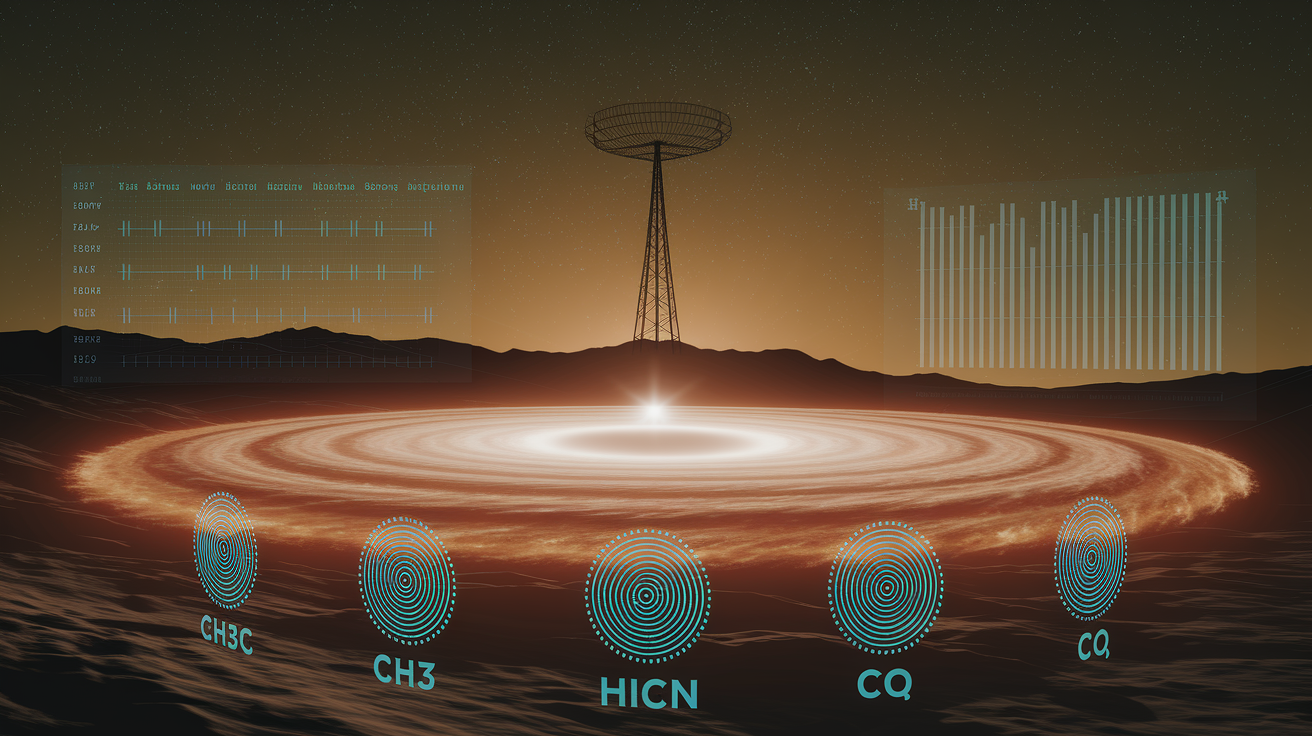
ALMA (the Atacama Large Millimeter/Submillimeter Array) picks up molecules in protoplanetary disks by recording millimeter and submillimeter radio waves that get released when molecules rotate inside cold gas clouds. Each molecule has its own unique set of rotational energy levels. When these molecules spin, they spit out photons at specific frequencies, kind of like a fingerprint. ALMA’s 66 radio dishes team up using interferometry to build high-resolution maps showing which molecules exist, where they’re concentrated, and how fast the gas is moving. Take methyl cyanide (CH3CN) spinning in a disk around a young star. It releases radiation at a wavelength you can predict, ALMA grabs that wavelength, and boom—you’ve got a map showing where CH3CN sits in the disk.
Complex organic molecules (COMs) are molecules with six or more atoms, usually built around carbon. They’re scientifically important because they represent the chemical building blocks available to forming planets. When ALMA finds nitriles like hydrogen cyanide (HCN) or larger species like CH3CN in a disk, it’s showing you the disk holds raw material linked to prebiotic chemistry. The MAPS survey mapped 18 molecules across five disks, including nitriles and HCN. A separate spectral survey of two disks detected 14 species and reported CH3CN as the most complex molecule securely identified. These inventories matter because the molecules a disk contains directly influence what a young planet can grab, defining the volatile and organic composition delivered to planetesimals and later to planetary surfaces and atmospheres.
Where complex molecules show up and how they’re distributed reveals chemical environments shaped by temperature, radiation, dust evolution, and whether planets are forming nearby. Disks with warmer gas keep carbon monoxide (CO) and its derivatives in gas form. Colder disks freeze CO onto grain surfaces, changing which species you can still detect. Each disk surveyed shows distinct “chemical substructures.” Some display double-ring patterns of organics, others concentrate gas in pressure maxima, and all reflect the local conditions controlling planet formation. Detecting COMs with ALMA maps not only chemistry but also the physical processes controlling how, where, and with what ingredients planets assemble.
ALMA’s detection workflow for complex molecules:
- Spectral line identification – Compare observed frequency peaks to laboratory catalogs (JPL, CDMS) of known molecular transitions.
- Interferometric imaging – Combine signals from many dish pairs to reach sub-arcsecond spatial resolution, revealing where molecules live.
- Velocity-resolved channel maps – Split data into narrow frequency bins to track gas motion and separate overlapping lines.
- Continuum subtraction – Remove broad background emission from dust to isolate faint molecular spectral lines.
- Matched filtering – Apply Keplerian rotation templates to boost weak signals from orbiting gas, improving sensitivity to faint species.
ALMA’s Capabilities for Detecting Complex Molecules in Disk Environments
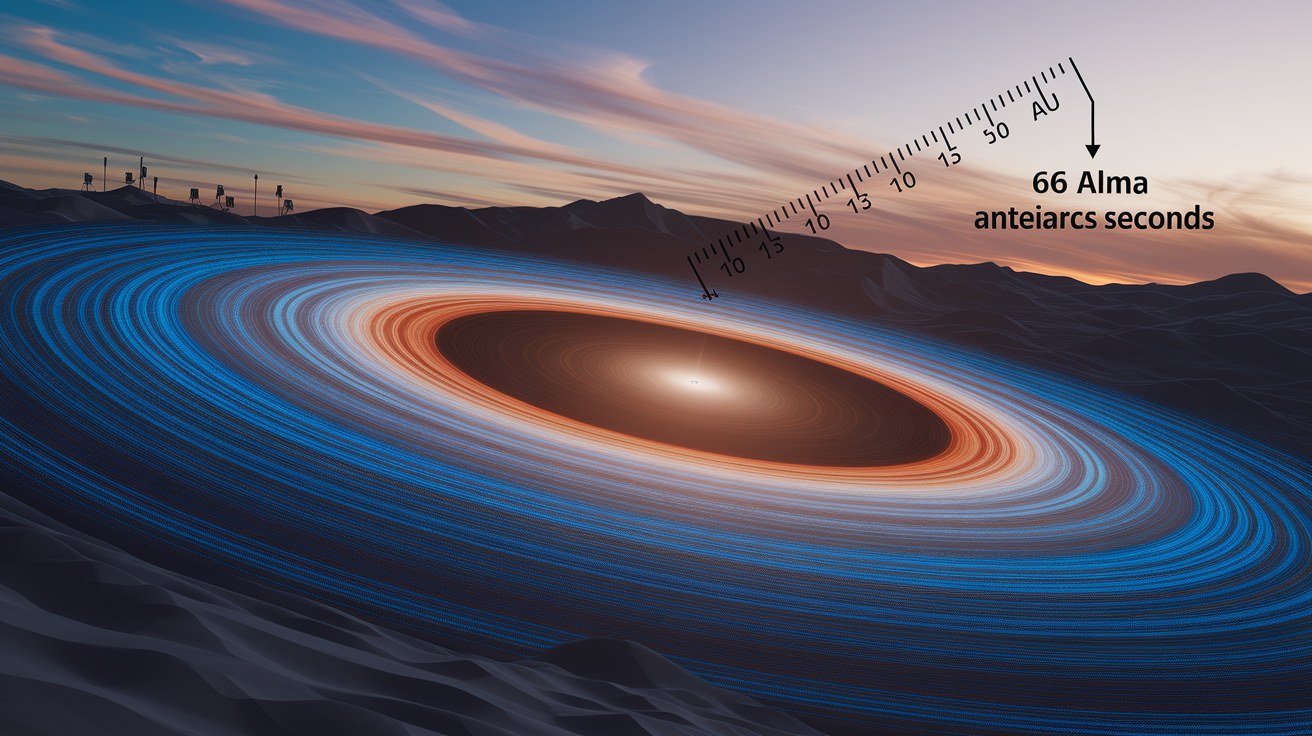
ALMA’s 66 antennas sit in the high-altitude Atacama Desert in Chile, forming the world’s most sensitive millimeter/submillimeter interferometer. By moving the dishes into different configurations, ALMA can reach angular resolution down to tens of milliarcseconds, sharp enough to resolve structures smaller than 10 astronomical units (AU) in nearby star-forming regions roughly 520 light-years away. Interferometry works by recording how radio waves from a distant source arrive at pairs of dishes at slightly different times. When signals from all baselines combine, you get an image with resolution set by the maximum dish separation, not by the size of a single antenna. This design lets ALMA map emission from individual molecules in narrow rings, gaps, and spirals within protoplanetary disks. High spectral resolution, splitting the signal into thousands of narrow frequency channels, allows ALMA to measure gas velocities accurate to a few hundred meters per second and to disentangle overlapping molecular lines that would otherwise blur together.
Sensitivity is the limit. Detecting complex organics requires collecting photons from faint spectral lines emitted by molecules present at low abundances or concentrated in small regions. ALMA’s large collecting area and cryogenic receivers reduce thermal noise, but even so, mapping a weak COM often requires hours of integration time and careful removal of imaging artifacts. Two main imaging pipelines are used: CLEAN, the standard radio-astronomy deconvolution algorithm, and RML (regularized maximum likelihood), which applies probabilistic noise modeling to reduce false features. A new alignment method developed for the exoALMA program removes systematic offsets between different spectral windows, preventing velocity artifacts that could be mistaken for real kinematic signatures. Noise-aware analysis tools and forward-modeling workflows further improve reliability by testing whether a candidate detection lines up with hydrodynamic simulations and radiative-transfer predictions or whether it could arise from random noise fluctuations.
| Parameter | Role in Molecular Detection |
|---|---|
| Spatial resolution (down to ~10 AU) | Resolves chemical substructure, rings, gaps, and localized organic concentrations within disks |
| Spectral resolution (narrow channel widths) | Separates overlapping lines, measures Doppler velocities, identifies molecules by frequency fingerprints |
| Sensitivity (low noise, long integrations) | Detects faint emission from low-abundance COMs and enables matched-filter techniques to boost weak signals |
| Interferometric baseline range | Controls maximum resolution and filters out extended emission, isolating compact disk structures |
Molecular Inventories in Protoplanetary Disks and What Counts as “Complex”
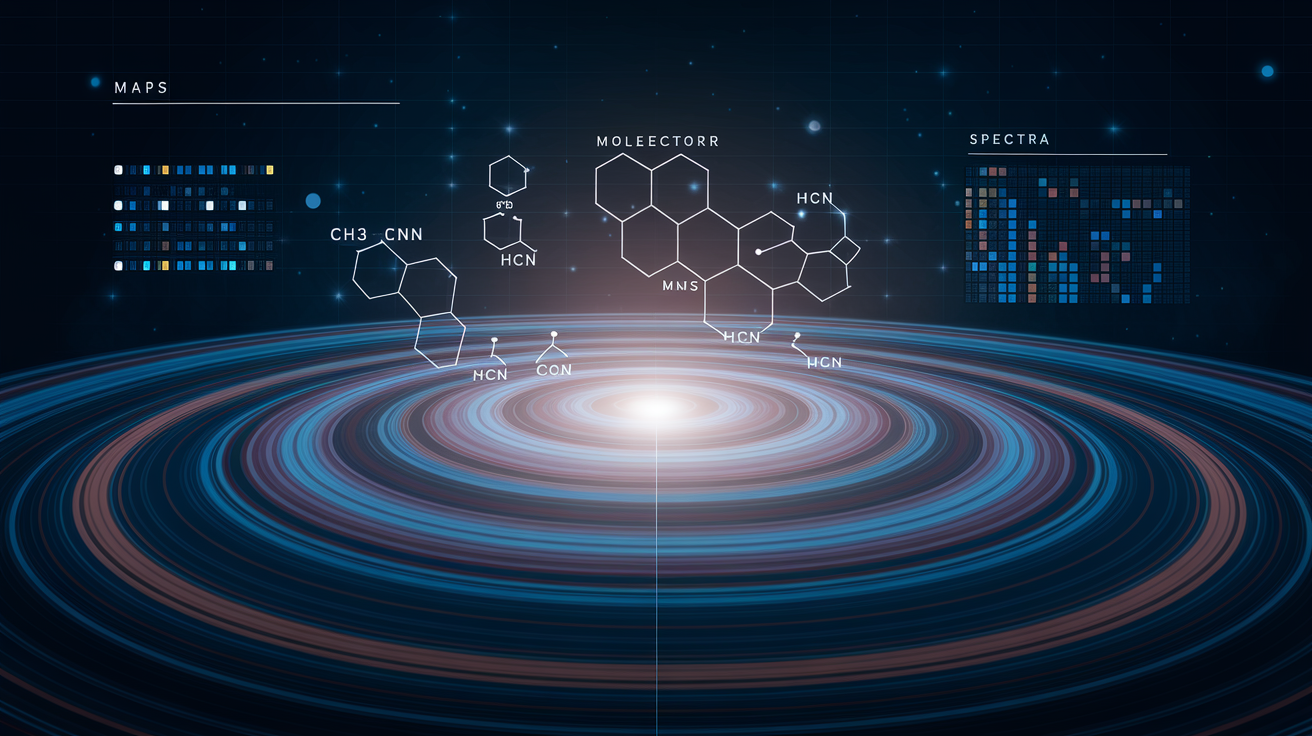
In astrochemical taxonomy, a “complex organic molecule” (COM) typically refers to a carbon-bearing molecule with six or more atoms, larger than simple diatomics like CO or small radicals like CN. Methanol (CH3OH), methyl cyanide (CH3CN), formaldehyde (H2CO), and methyl formate are classic examples. Molecules with fewer atoms, such as hydrogen cyanide (HCN), carbon monosulfide (CS), and isotopologues of CO, are considered “simple” even if they’re chemically important. The distinction matters because COM formation often requires grain-surface chemistry, reactions occurring when atoms and small molecules stick to cold dust grains, meet, and bond, or warm gas-phase pathways that are only active in specific disk regions. Detecting COMs signals environments where ice chemistry has occurred or where warm gas enables complex reactions, and it provides clues to the chemical inventory available when planetesimals and comets form.
Observed molecular inventories vary strongly from disk to disk. The MAPS survey detected emission from 18 molecules, including nitriles and HCN, across five systems. The unbiased spectral survey of LkCa 15 and MWC 480 found 14 molecules, with five species (C34S, ¹³CS, H2CS, DNC, and C2D) detected in protoplanetary disks for the first time. Notably, larger expected COMs like methanol weren’t detected in that survey. Only CH3CN was securely identified as the most complex molecule present. The exoALMA Focus Issue concentrated on small molecules (¹²CO, ¹³CO, CS, N2H+) and didn’t report a catalog of complex organics, instead emphasizing isotopologue measurements to constrain gas masses and kinematic structures. These differences reflect both observational design (exoALMA prioritized kinematic analysis over COM surveys) and the physical reality that COM emission may be systematically weaker in disks than theoretical models predict, possibly due to depletion onto grains, photodestruction, or limited warm regions where COMs can exist in the gas phase.
How complex organics form in disks:
- Grain-surface hydrogenation – Atoms like carbon and oxygen freeze onto cold dust grains and react with hydrogen to build methanol, water ice, and other ices. Warming later releases these molecules into the gas.
- Gas-phase ion-molecule reactions – In warm or ionized regions, ions drive rapid chemistry that assembles nitriles, cyanopolyynes, and other carbon chains.
- Photochemistry in disk surfaces – Ultraviolet light from the central star breaks simple molecules and triggers reactions that can create or destroy organics depending on local conditions.
- Shock-driven processing – Spiral density waves or planet-induced shocks heat gas and dust, liberating ices and enabling high-temperature gas reactions.
- Inheritance from the molecular cloud – Some COMs may survive from the interstellar medium that collapsed to form the disk, preserving prestellar chemistry if regions remain cold enough.
Case Studies of ALMA Complex-Molecule Detections in Multiple Disks
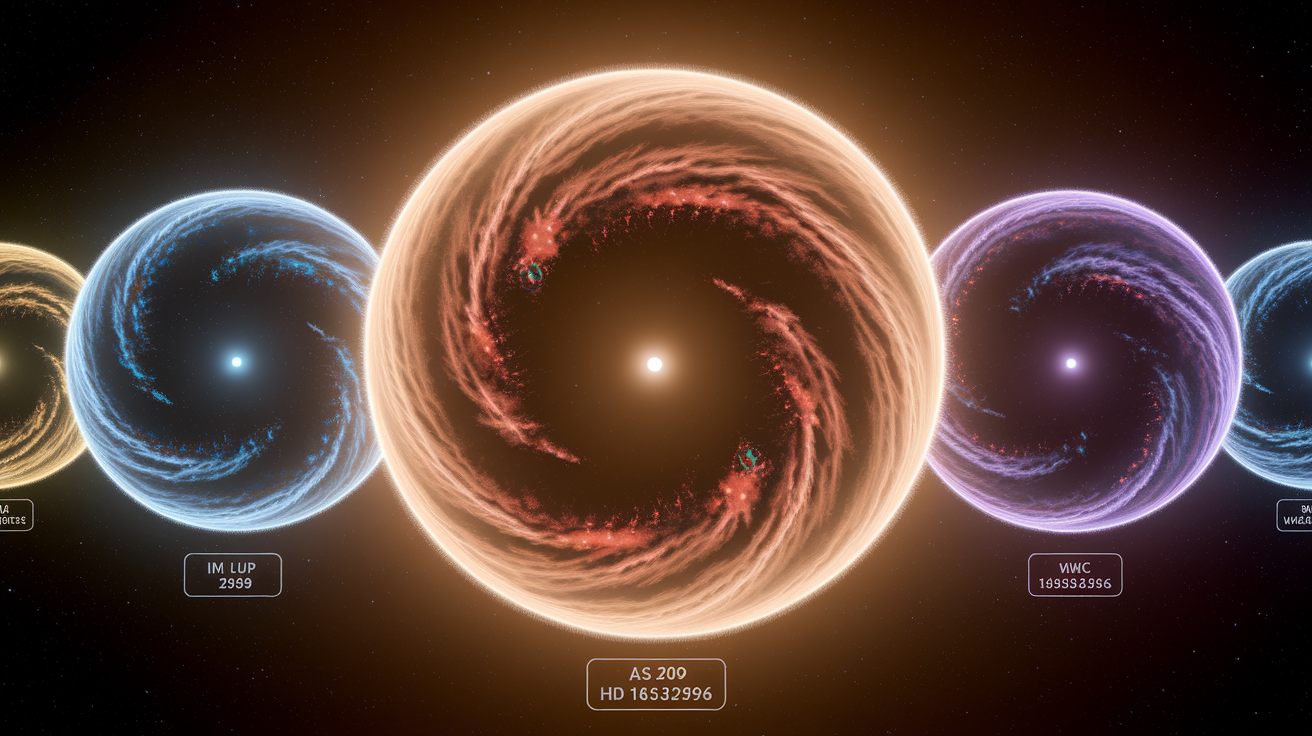
MAPS Survey Examples
The Molecules with ALMA at Planet-forming Scales (MAPS) program observed five protoplanetary disks: IM Lup, GM Aur, AS 209, HD 163296, and MWC 480. They used ALMA observations taken in 2018 and 2019. Eighteen different organic and inorganic molecules were mapped across the sample, with spatial resolution down to approximately 10 AU. Nitriles, including hydrogen cyanide (HCN), appeared in multiple systems, demonstrating that disks commonly host prebiotically relevant species. Each disk exhibited unique chemical substructures: different molecules concentrated in different radial zones, some disks showed double-ring emission patterns, and organic abundances varied by factors of several between otherwise similar systems. Velocity-resolved maps revealed that chemical distributions aren’t static but coupled to gas dynamics. Molecules trace pressure maxima, temperature steps, and ionization fronts, all of which influence where planets can access specific volatiles during formation.
The MAPS dataset also identified embedded, Jupiter-like protoplanets in two disks (HD 163296 and MWC 480) by detecting small deviations from smooth Keplerian rotation in molecular line emission. These velocity perturbations, up to 15% different from expected orbital speeds, mark locations where a massive planet’s gravity perturbs the surrounding gas. The chemical maps show that these planet-hosting regions have distinct molecular compositions compared to unperturbed disk areas, illustrating how forming planets shape and are shaped by local chemistry. The diversity of molecular inventories across the five MAPS targets underscores that “a protoplanetary disk” isn’t a single chemical environment but a collection of microenvironments, each with its own temperature, ionization, dust properties, and molecular budget. Two planets forming in the same disk but at different radii can start with very different raw materials.
LkCa 15 and MWC 480 Survey
An unbiased ALMA spectral survey spanning 275 to 317 GHz (a 36 GHz range) targeted two Taurus protoplanetary disks, LkCa 15 and MWC 480, both located roughly 520 light-years away. Fourteen different molecules were detected at high signal-to-noise, and five of those (C34S, ¹³CS, H2CS, DNC, and C2D) were reported in protoplanetary disks for the first time. MWC 480, a warmer Herbig Ae disk around a more massive and luminous star, showed 11 molecular detections and strong ¹³C¹⁸O emission indicating a large gas-phase CO reservoir. LkCa 15, a cooler T Tauri disk, showed 9 detections and notably lacked ¹³C¹⁸O, suggesting much of its CO is frozen onto grains. The most complex molecule securely detected in the survey was methyl cyanide (CH3CN), found only in MWC 480. Larger expected organics like methanol (CH3OH) were absent, implying that COM emission in disks is weaker or more localized than models anticipated.
Spatially, LkCa 15 displayed double-ring emission in several species including N2H+, H2CO, and DCO+. The inner ring aligns with the edge of a known dust cavity, and the outer ring sits near the boundary of the millimeter dust disk. This pattern suggests that dust evolution, grain growth and radial drift, exposes outer disk ice to starlight, warming it enough to return CO to the gas phase and driving a cascade of gas-phase chemistry in the outer ring. MWC 480’s warmer environment retains more CO in the gas throughout, enabling continuous chemistry that produces nitriles and other carbon-chain species. The contrast between these two disks illustrates how stellar mass, luminosity, and resulting disk temperature stratification control which molecules appear, where they concentrate, and whether complex organics remain detectable in the gas or are hidden in ice mantles on dust grains.
The variability seen across disk surveys (18 molecules in MAPS, 14 in the LkCa 15/MWC 480 study, and the exoALMA emphasis on smaller tracers) demonstrates that molecular inventories depend on observational bandwidth, target selection, disk temperature, and the specific chemical pathways active in each system. No two disks are chemically identical, and the presence or absence of a given COM reflects a combination of formation history, current physical conditions, and observational sensitivity.
How ALMA Identifies Molecular Lines: Spectral Line Extraction Explained

ALMA surveys collect data across broad frequency ranges. Some span 36 GHz or more, recording emission at thousands of individual frequency channels. Each channel captures a narrow slice of the spectrum, typically a few kilohertz wide, and the full dataset forms a three-dimensional data cube: two spatial dimensions plus one frequency (or velocity) dimension. To identify molecular lines, observers compare the observed spectrum against laboratory catalogs such as the Jet Propulsion Laboratory (JPL) molecular spectroscopy database and the Cologne Database for Molecular Spectroscopy (CDMS), which list the rest frequencies of rotational transitions for hundreds of molecules. When a peak in the observed spectrum matches a cataloged frequency to within the measurement uncertainty, and the line strength and spatial distribution are consistent with disk conditions, the molecule is considered detected. Multiple transitions from the same molecule strengthen confidence, and isotopologue detections (for example, detecting both ¹²CO and ¹³CO) provide additional confirmation and chemical constraints.
Continuum emission from dust produces a broad background signal that must be subtracted before faint molecular lines become visible. ALMA pipelines fit and remove this continuum using line-free channels, isolating the spectral-line emission. Matched-filtering techniques then amplify weak signals by applying Keplerian rotation templates, models of how gas velocity should vary with radius in a disk orbiting a star. By shifting and averaging emission along expected velocity curves, matched filtering boosts real disk signals while averaging down random noise, improving sensitivity to molecules present at low abundances. This method was central to the LkCa 15 and MWC 480 survey, where it revealed faint lines that would otherwise be lost in noise. Imaging pipelines like CLEAN and RML reconstruct spatial maps from the interferometric visibilities, and recent alignment techniques correct for small frequency-dependent pointing offsets that can introduce artificial velocity shifts and mimic kinematic features.
Steps in ALMA spectral line extraction:
- Calibration – Apply antenna-based phase and amplitude corrections, remove atmospheric and instrumental effects, and flag bad data.
- Continuum removal – Fit emission in line-free channels, subtract the smooth dust continuum, leaving only spectral-line signal.
- Line identification – Match observed frequency peaks to laboratory catalogs (JPL, CDMS), confirm with multiple transitions and isotopologues.
- Velocity mapping – Convert frequency to Doppler velocity, build channel maps showing emission at each velocity step, and integrate over line profiles to create intensity maps.
Spatial Distribution of Organics and What It Reveals About Disk Structure
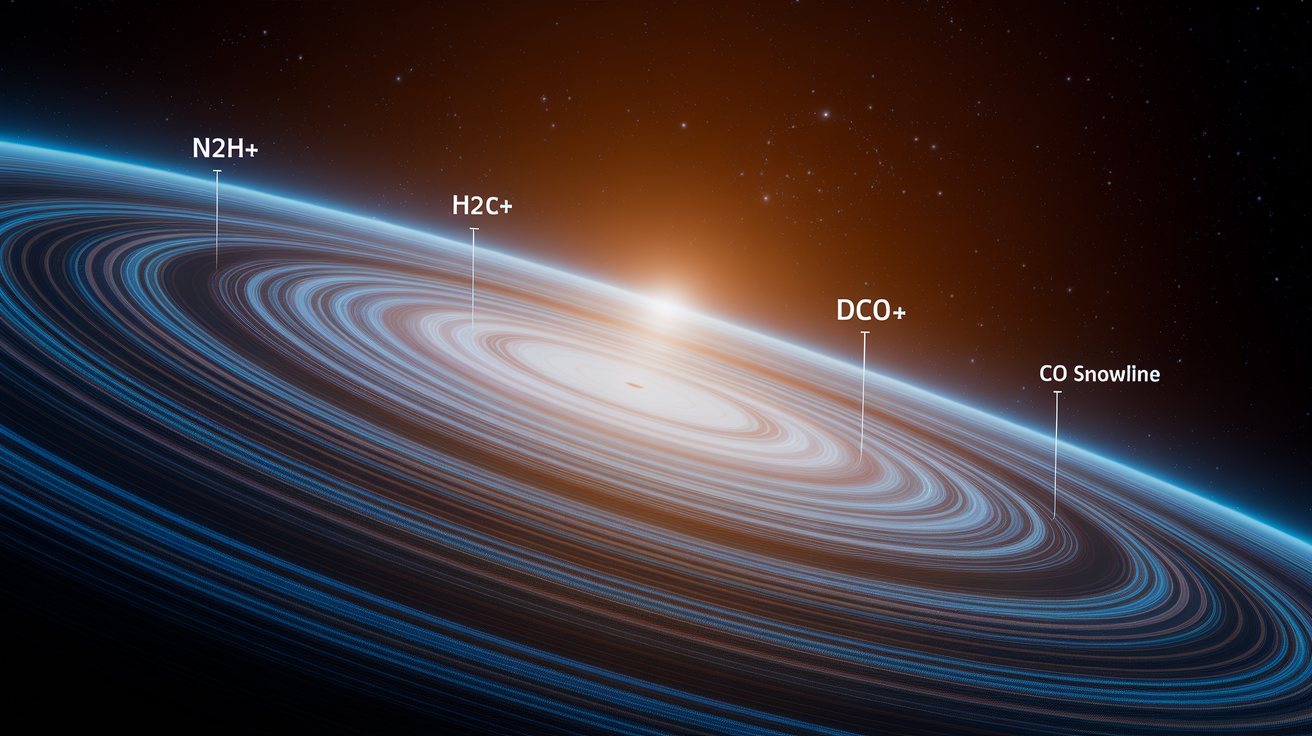
Chemical maps from ALMA show that molecules don’t spread uniformly across disks but instead concentrate in rings, arcs, and localized peaks. The MAPS survey revealed distinct organic distributions at roughly 10 AU scales, with different species peaking at different radii. LkCa 15’s double-ring morphology in N2H+, H2CO, and DCO+ emission marks transitions in temperature and ionization: the inner ring traces the dust-cavity edge where temperature drops and CO begins to freeze out, while the outer ring corresponds to the outer edge of the millimeter dust disk where ice-covered grains are exposed to stellar ultraviolet light. When ice warms or photodesorbs, CO returns to the gas phase, driving secondary chemistry that produces the observed molecular rings. In warmer disks like MWC 480, organics remain in the gas across a broader radial range, producing more extended emission without sharp ring boundaries.
Molecular tracers also reveal vertical structure. Carbon monoxide isotopologues (¹²CO, ¹³CO) emit from the upper disk atmosphere where gas is warmer and optically thin enough for photons to escape, while species like CS and N2H+ trace cooler, denser layers closer to the midplane. Measuring emission height as a function of radius constrains disk temperature and gas surface density, and comparing maps of different molecules shows how chemical layering evolves with distance from the star. Rings and gaps in molecular emission often align with features in the dust continuum: gaps carved by planets, pressure maxima that trap millimeter-sized particles, and asymmetries like crescents or spirals. The alignment between dust rings and gas pressure maxima, confirmed in disks like RX J1604.3−2130 A, demonstrates that gas dynamics concentrate solids, creating the high-density environments needed for planetesimal formation.
| Feature | Chemical Indicator | Scientific Interpretation |
|---|---|---|
| Double molecular rings | N2H+, H2CO peaks at inner and outer radii | Marks dust-cavity edge (inner) and CO ice-line or dust-disk edge (outer); ice exposure drives gas-phase chemistry |
| CO snowline | Transition from ¹²CO-rich to CO-depleted emission | Locates temperature boundary (~20 to 30 K) where CO freezes onto grains; affects volatile delivery to planets |
| Pressure maximum aligned with dust ring | Gas surface-density peak + continuum brightness peak | Pressure trap concentrates solids, enabling rapid planetesimal growth; gas-to-dust ratio constrains trap efficiency |
| Asymmetric crescent or arc | Localized COM or nitrile enhancement | May indicate vortex trapping dust and volatiles, or a recent impact/outburst releasing ices |
| Velocity kink in channel maps | Deviation from Keplerian rotation in CO or CS | Signature of embedded planet perturbing gas; chemical map shows planet’s local environment |
| Vertical chemical layering | ¹²CO in upper layers; CS, N2H+ near midplane | Reflects temperature and ionization gradients; probes disk vertical structure and UV penetration depth |
Chemical Processes Shaping Complex Organics in Disks
The abundance and distribution of complex molecules in a protoplanetary disk depend on a balance between formation, destruction, and transport. In cold disk regions (typically beyond the CO snowline at radii greater than ~20 to 30 AU) most volatiles freeze onto dust grains, forming ice mantles. Simple species like CO, H2O, and NH3 freeze first, followed by more volatile organics. On these icy grain surfaces, atoms and radicals meet and react, building up complex molecules through successive hydrogenation and carbon-addition reactions. For example, CO + H → HCO → H2CO (formaldehyde) → CH3OH (methanol). These processes occur slowly over millions of years, but because grain surfaces concentrate reactants, they’re efficient. When a disk region warms due to increased stellar radiation, a shock from a spiral density wave, or a planet-induced pressure perturbation, ices sublimate and release molecules back into the gas. If the warming is sudden, the gas-phase abundance of organics can spike, producing bright molecular emission detectable by ALMA.
Gas-phase chemistry also operates, especially in warmer inner-disk regions or in the upper atmosphere where ultraviolet light penetrates. Ion-molecule reactions driven by cosmic rays or X-rays from the young star can rapidly assemble carbon chains and nitriles. For instance, reactions starting from C+ or CH+ can build up to HCN, HC3N, and eventually more complex nitriles. Photochemistry can create or destroy organics: ultraviolet photons break C to H and C to C bonds, fragmenting large molecules, but they also generate radicals that recombine into new species. The net effect depends on the local radiation field, gas density, and the availability of shielding by dust and H2. CO depletion, the observation that gas-phase CO abundances in many disks are lower than interstellar-medium values, indicates that CO is either locked in ice, converted to other carbon-bearing species, or sequestered in larger grains and planetesimals. This depletion directly impacts which molecules can form: less gas-phase CO means fewer carbon atoms available for building COMs in warm regions.
Dust evolution and radial drift further shape chemistry. As grains grow and drift inward, they carry ices with them, altering the radial distribution of volatiles. Pressure maxima created by gaps or rings can halt drift and concentrate both dust and ice, creating chemical “hot spots” where desorption and gas-phase reactions are enhanced. In the LkCa 15 disk, the outer molecular ring aligns with the edge of the dust disk, suggesting that radial drift has piled up icy grains at that location and subsequent UV irradiation sublimates the ice, releasing CO and driving the observed N2H+ and H2CO emission.
Key chemical drivers in protoplanetary disks:
- Freeze-out and ice formation – Volatiles condense onto cold grains beyond snowlines, removing them from the gas and enabling grain-surface reactions.
- Thermal desorption – Warming (by stellar radiation, shocks, or accretion heating) sublimates ices, returning molecules to the gas phase.
- Photochemistry – Ultraviolet light breaks bonds and generates radicals; net effect depends on shielding and local gas density.
- Ion-molecule gas-phase reactions – Cosmic-ray and X-ray ionization drive rapid chemistry in warm or ionized layers, building nitriles and carbon chains.
- Dust evolution and transport – Grain growth, drift, and trapping redistribute ices and alter local gas-phase abundances, coupling chemistry to disk dynamics.
Kinematic and Structural Clues to Planet Formation Linked to Chemistry

Molecular emission lines encode not only chemical information but also gas kinematics, how fast and in what direction the gas is moving. In an unperturbed disk, gas orbits the star in nearly circular, Keplerian paths, and the velocity at each radius follows a predictable curve: faster close in, slower farther out. ALMA’s velocity-resolved channel maps reveal deviations from this smooth pattern, and these deviations trace the gravitational influence of embedded planets, large-scale pressure gradients, or turbulent motions. The exoALMA program found velocity perturbations up to 15% of the local Keplerian speed in some disks, interpreted as signatures of hidden, Jupiter-like planets. When a massive planet orbits within a disk, it launches spiral density waves that compress and heat the gas, creating pressure perturbations that alter orbital velocities. Molecular lines trace these perturbations with high fidelity because different molecules emit from different heights and temperatures, providing a three-dimensional view of the planet’s impact on the disk.
Velocity kinks, sharp changes in gas velocity confined to a narrow radial zone, are particularly strong evidence for an embedded planet. Planetary wakes, visible as arc-shaped features in filtered channel maps, mark regions where the planet’s gravity has deflected streamlines. Aligning chemical maps with kinematic maps shows whether a planet sits in a region rich in organics or depleted in volatiles, directly constraining the chemical environment in which the planet is assembling its atmosphere and solid core. For example, the MAPS survey detected embedded planets in HD 163296 and MWC 480 and simultaneously mapped 18 molecules in those disks. The chemical substructures near the inferred planet locations reveal which species the planet is likely accreting, providing observational input for models of planetary atmospheric composition and volatile delivery.
Pressure maxima and dust traps further link chemistry and dynamics. A dust ring appears in the continuum when millimeter-sized grains pile up at a pressure maximum, often the outer edge of a gap carved by a planet. Gas-phase molecules also respond to pressure gradients: species like N2H+, which forms efficiently in cold, CO-depleted gas, brighten at pressure maxima because the increased density boosts reaction rates. Detecting pressure-broadened line wings, where thermal and turbulent motions widen spectral lines, provides a direct measurement of gas surface density. In the disk RX J1604.3−2130 A, such wings were detected, and the derived surface density at the dust ring implies a gas-to-dust ratio lower than expected if all solids were still fine dust, suggesting either planetesimal formation has already locked solids into larger bodies or that dust trapping is less efficient than simple models predict.
How Kinematics Help Confirm Chemistry
Kinematic analysis validates chemical detections and rules out imaging artifacts. If a molecular line shows an apparent velocity kink, checking whether the feature appears consistently across multiple transitions, in independently reduced datasets, and in both CLEAN and RML images confirms it’s real. Comparing observed velocity fields to forward models (hydrodynamic simulations of disks with embedded planets, processed through radiative-transfer codes to produce synthetic channel maps) tests whether the observed kinematics and chemistry are mutually consistent. The exoALMA program used five hydrodynamic models and two radiative-transfer codes, finding good agreement and demonstrating that kinematic planet detections are robust. Chemical maps add context: if a velocity kink coincides with a change in molecular abundance or a ring in dust emission, the combined evidence strengthens the planet hypothesis and narrows the range of possible planet masses and orbital radii. This multi-tracer approach, using dust, gas kinematics, and chemistry together, reduces false positives and provides a richer picture of how planets and disks co-evolve.
Implications for Prebiotic Chemistry and Planet Habitability
The molecular inventory of a protoplanetary disk sets the chemical starting conditions for planets, moons, asteroids, and comets that form within it. When ALMA detects nitriles like HCN or complex organics like CH3CN, it reveals that the disk contains carbon to nitrogen bond chemistry, a family of reactions central to amino-acid precursors, nucleobases, and other prebiotic molecules. The MAPS survey found nitriles in multiple disks, showing that prebiotically relevant species are common, not rare. The spatial distribution of these molecules matters: a planet forming in a nitrile-rich ring will accrete gas and ice with a different organic budget than a planet forming in a CO-dominated region. This chemical diversity implies that even planets within the same disk can start with very different inventories of volatiles and organics, influencing their potential for later habitability.
CO depletion, observed in many disks including the exoALMA sample, affects the total carbon and oxygen budget available to forming planets. If CO is sequestered in ice or locked into larger solids, less carbon remains in the gas to build complex molecules or to be delivered to planetary atmospheres. Conversely, regions where CO ice sublimates can experience bursts of gas-phase chemistry, producing a spike in organics that a forming planet might capture. The double-ring structure in LkCa 15, where outer-disk ice exposure drives CO release, illustrates how dust evolution and radial transport create localized chemical environments. A planet migrating through such a disk would sample different chemical zones over time, potentially acquiring a layered volatile composition.
Dust traps aligned with pressure maxima concentrate not only solids but also the ices coating those solids. High-resolution ALMA observations show that dust rings and molecular rings often overlap, meaning the same physical process (pressure trapping) controls both the availability of building blocks for planetesimals and the local volatile abundance. Efficient trapping accelerates planetesimal growth and may trigger runaway accretion, forming planetary cores within the disk’s lifetime of a few million years. The chemical composition of those planetesimals depends on what ices were present when they formed, which in turn depends on the disk’s temperature structure, ionization, and the history of dust drift and trapping.
How organics in disks influence emerging planetary systems:
- Volatile delivery to planets – Molecules accreted during planet formation supply atmospheres, oceans, and surface chemistry; nitriles and organics provide prebiotic raw material.
- Chemical diversity between planets – Spatially varying molecular abundances mean adjacent planets can have different C/O ratios, nitrogen content, and organic inventories, affecting habitability potential.
- Timing of volatile capture – Planets forming early, while the disk is rich in gas-phase organics, may accrete different species than late-forming planets after much of the gas has dispersed or frozen out.
- Link to Solar System bodies – Comets and asteroids in our Solar System show chemical signatures (deuterium ratios, organic abundances) that trace their formation locations; ALMA observations of other disks test whether similar chemical zoning is universal.
Challenges and Limitations in Detecting COMs with ALMA
Detecting complex organic molecules in protoplanetary disks pushes ALMA to its sensitivity limits. COMs are typically present at lower abundances than simple species like CO or CS, and their emission is spread over many weak rotational transitions rather than concentrated in a few bright lines. This means each individual COM line is faint, requiring long integration times (often tens of hours per target) to reach the signal-to-noise needed for a secure detection. Observational bandwidth is also a constraint: a single ALMA spectral setup covers only a few gigahertz at once, so detecting multiple COM transitions to confirm a molecule’s presence requires multiple observing sessions or careful frequency planning. The exoALMA Focus Issue prioritized small molecules and kinematic analysis over COM catalogs, partly because detecting a full suite of organics would have required additional bandwidth and integration time.
Line confusion, overlapping transitions from different molecules, complicates identification. In a rich spectral survey, dozens or hundreds of lines may appear, and distinguishing a real COM detection from a blend of weaker lines or noise spikes demands careful cross-referencing with laboratory databases and checks for spatial and velocity coherence. Imaging artifacts introduced by incomplete sampling of the interferometric Fourier plane or by calibration errors can mimic spectral features, and these artifacts may vary with frequency, creating false velocity kinks or spurious emission peaks. The RML imaging pipeline and alignment methods developed for exoALMA reduce such artifacts, but they don’t eliminate them entirely, and any candidate COM detection must survive multiple independent tests (different imaging algorithms, different visibility weightings, and comparison to forward models) before it’s considered robust.
Limiting factors in ALMA COM detection:
- Low molecular abundances – COMs are often 100 to 10,000 times less abundant than CO, producing weak lines near the noise floor.
- Line spread over many transitions – Emission divided among dozens of weak lines rather than one strong feature reduces per-line signal-to-noise.
- Frequency coverage gaps – ALMA’s receiver bands have gaps; some key COM transitions fall between bands or require special tuning.
- Imaging artifacts and calibration errors – Sidelobes, phase errors, and continuum-subtraction residuals can create false peaks or hide real weak lines.
- Requirement for deep integrations – Securely detecting a COM typically requires multi-hour observations, limiting sample size and the number of molecules surveyed per disk.
Modeling Tools Used to Interpret ALMA Molecular Detections
Interpreting ALMA molecular maps requires translating observed emission into physical and chemical properties: gas temperature, density, molecular abundance, ionization fraction, and disk structure. This translation relies on forward modeling: researchers build a physical model of the disk (often using hydrodynamic simulations that include planets, magnetic fields, or turbulence), compute how molecules populate energy levels and emit radiation (via radiative-transfer codes), and generate synthetic ALMA observations (including realistic noise, beam convolution, and interferometric sampling). Comparing synthetic channel maps and spectra to real data tests whether the model is consistent with observations and constrains parameters like planet mass, disk gas mass, and molecular abundance.
The exoALMA program used five different hydrodynamic models and two radiative-transfer codes to create synthetic CO observations and locate embedded planets. The models agreed well, showing that the detection of velocity perturbations is robust across different numerical methods. Radiative transfer solves the equations of radiation transport, accounting for how photons emitted by molecules scatter, absorb, and escape the disk. This step is essential because optically thick lines (like ¹²CO) probe only the disk surface, while optically thin lines (like ¹³CO or rarer isotopologues) trace deeper layers. Chemical models, ranging from simple assumptions of local thermodynamic equilibrium to full time-dependent chemical networks with hundreds of reactions, predict which molecules should be present and in what abundance given a disk’s temperature, density, and radiation field. Noise-aware and probabilistic analysis tools, applied to the observed data, produce statistical measures of detection confidence and parameter uncertainties, reducing the risk that random noise or imaging artifacts are misinterpreted as real features.
| Model Type | Purpose in Disk Studies |
|---|---|
| Hydrodynamic simulations | Compute gas and dust dynamics, planet to disk interactions, spiral waves, and gap formation |
| Radiative-transfer codes | Calculate molecular line emission, absorption, and scattering; produce synthetic spectra and images |
Chemical network models
Final WordsALMA picks out faint rotational lines across millimeter wavelengths, letting us identify species like CH3CN, nitriles, and HCN and map where they sit in rings and gaps. The article ran through how spectral extraction and imaging work, showed MAPS and LkCa 15 examples, and connected chemistry to disk structure, kinematics, and planet formation. The ALMA detection of complex molecules in a protoplanetary disk explained here shows disks host varied organic inventories — and with deeper observations and better models, we’ll learn what planets inherit. FAQQ: How does ALMA detect complex molecules in protoplanetary disks?A: ALMA detects complex molecules in protoplanetary disks by measuring their rotational spectral lines at millimeter wavelengths, combining 66 antennas for high sensitivity, spectral resolution, and spatially resolved maps of emission. Q: Which complex organic molecules has ALMA found in disks?A: ALMA has found molecules such as CH3CN, HCN, nitriles, and H2CO; COMs (complex organic molecules) like CH3OH are less common and usually require deeper, targeted observations to confirm. Q: Why do complex organic molecules in disks matter for astrobiology?A: Complex organic molecules in disks matter for astrobiology because they provide prebiotic ingredients to forming planets, influencing volatile delivery, initial chemistry, and possible pathways toward life during planet assembly. Q: How does ALMA identify spectral lines and avoid confusion?A: ALMA identifies spectral lines by removing continuum emission, using matched filters with Keplerian rotation templates, and matching features to laboratory catalogs (JPL/CDMS) to resolve overlaps and confirm line IDs. Q: What ALMA capabilities make COM detection possible?A: ALMA’s capabilities that enable COM detection include 66 antennas for sub‑arcsecond imaging, fine spectral channels for velocity information, broad bandwidth to cover many lines, and low noise for deep integrations. Q: What limits ALMA’s ability to detect complex molecules?A: ALMA’s limits include sensitivity thresholds, line blending in crowded spectra, finite bandwidth in some setups, imaging artifacts, and the need for long integrations or stacking to boost faint signals. Q: How do molecular detections tell us about disk physical conditions?A: Molecular detections tell us about disk temperature, density, freeze‑out zones, and UV exposure; specific species and ringed emission patterns map warm versus cold regions and locate snowlines and pressure traps. Q: How are complex molecules formed in disks?A: Complex molecules in disks form via grain‑surface reactions on icy dust, gas‑phase chemistry, UV‑driven photochemistry, thermal desorption, and occasional shocks that liberate ices into the gas phase. Q: What do variations between disks tell us about planet formation?A: Variations between disks show diverse chemical starting points: some retain organics in ices, others keep gas‑phase organics, affecting volatile delivery, planet composition, and the range of potential habitability outcomes. Q: How do models help interpret ALMA molecular data?A: Models help by converting observed line strengths into molecular abundances and vertical structure using radiative transfer, chemistry, and hydrodynamics while accounting for noise and imaging effects. Q: How do kinematic signatures link chemistry to planet formation?A: Kinematic signatures like velocity kinks or deviations from Keplerian rotation signal embedded planets; those disturbances reshape gas and dust, creating localized chemical environments that alter molecular abundances. Q: What future steps will help detect more complex molecules with ALMA?A: Future steps include deeper integrations, wider bandwidths, higher spectral resolution, matched‑filter techniques, and coordinated observations with JWST and other facilities to push detections of larger COMs. |