

Can astronomers really predict the hour a meteor shower will peak—or is it guesswork?
They do it by treating comet dust like a river and finding where Earth crosses the thickest flow.
Orbital science maps past dust ejections, runs each grain forward under gravity and sunlight, then finds when our orbit hits the densest filament.
Modelers convert that crossing into ZHR (Zenithal Hourly Rate) so you know roughly how many meteors a dark-sky watcher could see.
Here’s a clear walk-through of the models, the data that calibrates them, and a few watching tips that actually matter.
Core Process Behind Predicting Meteor Shower Peak Activity
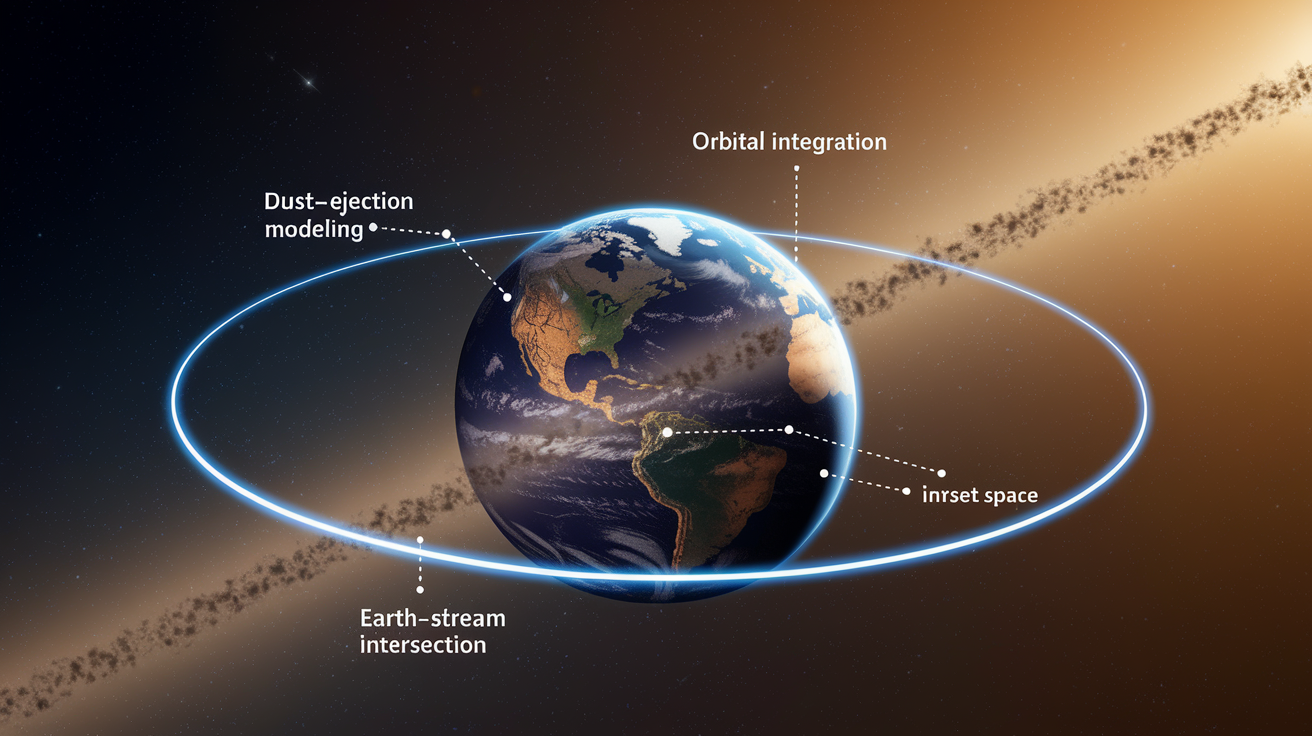
Astronomers figure out when a meteor shower peaks by finding the exact moment Earth cuts through the thickest part of a meteoroid stream. That intersection point is everything. They get there by comparing Earth’s path with maps showing where particles cluster, maps built from the parent body’s orbit and its dust-release history. Once they’ve nailed down the crossing point, they convert the expected particle count into something observers can use: Zenithal Hourly Rate, or ZHR, which tells you how many meteors per hour you’d see under perfect dark skies with the radiant straight overhead.
Step one is always identifying the parent body (usually a comet, sometimes an asteroid) that left debris along a specific orbital path. When a comet swings close to the Sun at perihelion, solar heat vaporizes ice and kicks out dust grains at different speeds and angles. Those grains keep orbiting the Sun, spreading into a stream that follows the parent’s track. Earth runs into the stream every year when our orbit crosses that same patch of space, and the peak happens where the stream is densest. Different comet visits released different amounts of material, so knowing which dust clouds came from which historical passes helps pinpoint where the thickest ribbons will be when Earth arrives.
ZHR gives you a standardized measure that strips out radiant height and light pollution, so models and real observations can be compared directly. The radiant rises and sets like a star, which means someone watching before dawn (when it’s high) will see way more meteors than someone watching early evening. ZHR corrects for that geometry. When a forecast says “ZHR 100,” it means an observer at a dark site with the radiant overhead should expect roughly a hundred meteors per hour at the predicted peak.
The full prediction workflow looks like this:
- Dust-ejection modeling – Calculate when and how fast particles got thrown off during past perihelion passes, using the parent’s orbit and estimated activity level.
- Orbital integration – Run each particle’s path forward through time under gravitational forces from the Sun, planets, and (for small grains) radiation pressure and drag.
- Earth–stream intersection timing – Compare Earth’s position with the computed particle cloud to find when our planet slices through the densest region.
- Density estimation – Estimate how many particles per cubic kilometer sit in the intersection zone at the predicted crossing time.
- ZHR conversion – Turn that spatial density into expected meteors per hour, accounting for Earth’s speed through the stream and the fraction of particles big enough to make visible trails.
Orbital Mechanics Governing Meteoroid Stream Evolution
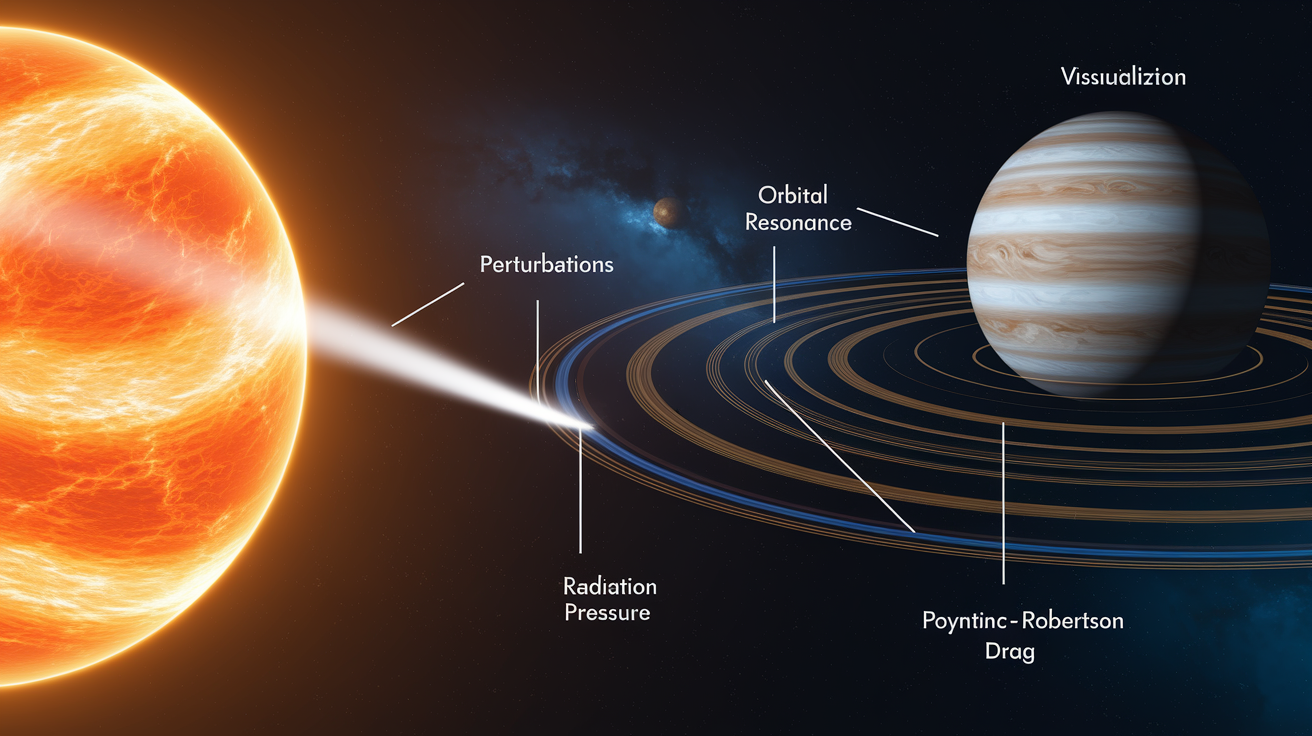
Meteor streams trace the elliptical orbit of their parent comet, with dust concentrated along the same path the comet follows around the Sun. When ice evaporates near perihelion, ejected grains inherit the comet’s speed plus a small push from escaping gas. Ejection velocity and particle mass decide how much the grain’s orbit differs from the comet’s trajectory. Bigger, heavier grains stay closer to the parent’s path. Tiny specks get nudged into slightly different ellipses. Over many orbits, this spread turns a single dust release into a broad ribbon.
Forces that reshape meteoroid streams:
Planetary perturbations pull on particle orbits through gravity, gradually shifting node locations and crossing times. Jupiter’s the big player here.
Orbital resonance happens when a particle’s period is a simple fraction of Jupiter’s. Repeated encounters can lock the particle into a resonant pattern, clustering debris in certain regions.
Radiation pressure from sunlight pushes on small grains, slightly expanding their orbits and spreading the stream over time.
Poynting–Robertson drag comes from absorbed and re-emitted sunlight, creating a tiny braking force that makes small particles spiral slowly inward toward the Sun.
These forces mean old streams become broad and diffuse, while young streams still contain dense filaments tied to specific comet returns. A filament ejected during one perihelion passage might stay concentrated for decades or even centuries before gravitational stirring spreads it thin. Planetary pulls also shift where the stream’s node crosses Earth’s orbit, so the intersection date can drift by hours or even days over long timescales. When a forecast pins a peak to within a few hours, it’s usually because modelers identified a narrow filament from a known comet passage and tracked how perturbations moved that filament to Earth’s path in the target year.
Computational Modeling Techniques Used to Estimate Peak Times

Modern peak predictions run on numerical simulations that start with the parent body’s historical orbit and step forward through time, particle by particle. Researchers pick several past perihelion passages and define how much mass the comet ejected during each return. Dust grains get assigned a range of sizes and ejection velocities based on lab measurements, comet observations, and fits to past meteor data. Each simulated particle receives initial orbital elements combining the comet’s trajectory with the small velocity kick from outgassing.
With thousands (or sometimes millions) of test particles generated, the next step is n-body integration. Software solves the equations of motion under gravitational influence from the Sun, planets, and sometimes the Moon, stepping each particle’s position and velocity forward in small time increments. For streams that have existed for centuries, integration must cover hundreds of orbits to accumulate the full effect of planetary encounters and resonances. Non-gravitational forces like radiation pressure get included for grains smaller than a few millimeters, because those particles experience measurable orbit changes over decades. The output is a time-stamped catalog of particle positions, which lets researchers build a three-dimensional density map of the stream at any chosen moment.
To forecast a specific shower peak, modelers pull Earth’s position from a high-precision ephemeris and scan through the predicted particle cloud to find the moment of maximum density along Earth’s trajectory. Streams contain clumpy filaments, so the peak often corresponds to Earth passing through a narrow ribbon rather than a smooth, broad cloud. The computed flux (particles per square kilometer per second) gets converted to ZHR by multiplying by Earth’s cross-sectional area, the encounter speed, and visibility factors (fraction of meteors bright enough to see, correction for radiant height). Different research groups use different particle-size distributions and ejection models, which is why published ZHR forecasts for the same shower sometimes disagree by 20 or 30 percent.
Numerical Integration and Filament Mapping
Gravitational perturbations get resolved using integration methods that track each particle’s six orbital elements (semi-major axis, eccentricity, inclination, longitude of ascending node, argument of perihelion, and mean anomaly) through small time steps, typically days or weeks. When a particle passes near a planet, the code computes the instantaneous acceleration and updates the velocity vector. Over many orbits, these tiny nudges add up. Jupiter’s gravity can shift a particle’s node longitude by several degrees over a century, moving the intersection point along Earth’s orbit and changing the calendar date of the peak by hours or even a full day.
Filament mapping focuses on identifying clumps of particles that share similar node crossings. When a comet sheds dust during a single perihelion, those grains form a coherent ribbon. Subsequent planetary encounters can spread the ribbon or compress it into a tighter band, depending on resonance conditions. Researchers overlay the computed particle distribution with Earth’s position to see which filaments will intersect our planet in a given year. A sharp, intense peak gets predicted when Earth threads through a young, dense filament. Broader, weaker peaks occur when the stream has aged and dispersed. Some showers, like the Leonids, have well-documented filaments tied to specific nineteenth and twentieth-century comet passages, and models routinely predict short-lived “outbursts” when Earth encounters one of those ribbons.
Historical Observation Data Used to Refine Peak Time Forecasts
Long-running records from visual observers, radar sensors, and photographic surveys supply the empirical foundation that turns theoretical models into reliable forecasts. Visual counts (collected by volunteers who sit under dark skies and tally meteors) have been archived for more than a century, providing peak dates and ZHR estimates for dozens of showers. Radar detectors bounce radio waves off ionized meteor trails, operating day and night and measuring even faint meteors invisible to the eye, giving a continuous activity profile across several days. Photographic and video networks capture meteor trajectories, allowing researchers to back-calculate orbits and confirm which particles belong to a given stream. All these data sets help calibrate the uncertain parameters in ejection models (such as how much dust a comet releases per orbit) and validate the timing and intensity of predicted peaks.
Historical extreme events show how observations refine understanding. The Leonid storms of 1833 and 1966 produced rates of thousands of meteors per hour, far above the typical handful seen in most years. Those outbursts were later traced to dense filaments ejected by comet 55P/Tempel–Tuttle during specific perihelion passages. By matching observed storm years to modeled filament positions, researchers confirmed ejection rates and refined integration parameters. The steady annual performance of the Perseids and Geminids provides baseline data. Year after year, observers report peaks around the same dates with ZHRs in predictable ranges, letting modelers validate that their stream maps correctly reproduce both timing and intensity.
| Shower | Typical Peak Date | Typical ZHR |
|---|---|---|
| Perseids | August 12–13 | 60–100 |
| Geminids | December 13–14 | 100–150 |
| Leonids | November 17–18 | 10–20 (storms can reach thousands) |
Radiant Point Geometry and Its Role in Predicting Peak Activity

The radiant marks the direction from which meteors appear to stream across the sky, and its position directly affects how many meteors you can see. When Earth plows into a meteoroid stream, particles strike the atmosphere along parallel paths, but perspective makes those trails seem to radiate from a single point (just as parallel train tracks appear to converge at the horizon). The radiant’s altitude above the horizon determines the fraction of sky where meteors can appear. If the radiant sits on the horizon, meteors skim along the edge of the atmosphere and only a small wedge of sky is active. When the radiant climbs overhead, the entire sky becomes accessible, and hourly counts jump.
Models convert the raw particle flux into ZHR by assuming the radiant is at the zenith, which provides a standardized reference. In practice, the radiant rises and sets with the stars, so its elevation changes through the night. For showers like the Perseids, the radiant in Perseus stays below the horizon during early evening and climbs higher after midnight, which is why peak activity usually shows up in the hours before dawn. Forecasts often include radiant coordinates (right ascension and declination) so observers know where to look. The crossing geometry also matters. If Earth cuts through the stream at a shallow angle, the encounter lasts longer and the peak is broader. A near-perpendicular crossing produces a sharp, brief maximum.
Factors That Limit Accuracy in Meteor Shower Peak Time Predictions
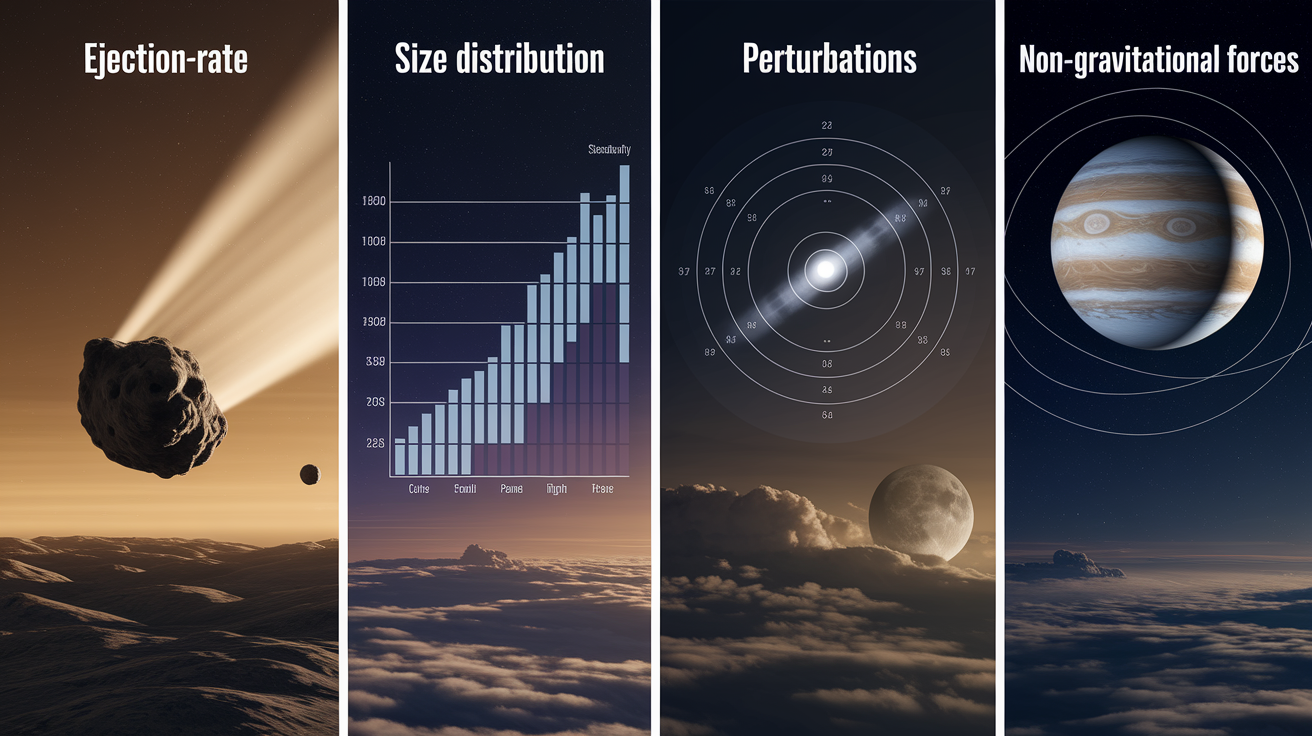
Prediction error starts with uncertain dust-ejection rates. Comets vary in how much material they release from one perihelion to the next, and direct measurements of dust production are rare. Models rely on indirect estimates (brightness changes, gas production rates, or fits to past meteor counts) which can differ by factors of two or more. Particle-size distribution adds another layer of guesswork. Small grains dominate the mass but produce faint meteors. Larger pebbles are rarer but create bright fireballs. Without precise knowledge of how many particles fall into each size bin, converting spatial density to visible meteor counts stays approximate.
Gravitational perturbations introduce timing shifts that accumulate over centuries. Even small errors in the assumed ejection moment or initial velocity can move a filament’s predicted intersection by several hours after a few hundred orbits. Planetary encounters are sensitive to initial conditions, and resonance effects can amplify small differences. Non-gravitational forces (radiation pressure and Poynting–Robertson drag) depend on particle size, composition, and surface properties, all of which vary within a stream. Modelers use average values, but real particles span a range, so the computed evolution is always a statistical approximation.
Local observing conditions change the number of meteors actually seen, even when the forecast is correct. Moon brightness washes out faint meteors, cutting observed rates by half or more during a bright lunar phase. Weather and clouds can block the view entirely. Light pollution reduces the limiting magnitude, hiding fainter meteors and lowering counts. Radiant altitude varies with observer latitude and time of night, so a predicted ZHR of 100 might translate to 70 visible meteors per hour at a dark site with the radiant halfway up, or 30 per hour under moderately light-polluted skies.
Main sources of uncertainty:
- Ejection-rate variability – How much dust the comet released during past returns is often poorly known.
- Particle-size distribution – The mix of grain sizes determines which meteors are visible and affects flux-to-ZHR conversion.
- Planetary perturbations – Small orbit changes accumulate over time, shifting filament positions by hours.
- Non-gravitational forces – Radiation pressure and drag vary with particle properties, complicating long-term evolution.
- Observational biases – Moon phase, weather, light pollution, and radiant height all change visible counts independent of the actual stream density.
How Peak Predictions Are Communicated to the Public

Organizations that monitor meteor showers package forecasts in formats designed for amateur observers. A typical prediction includes the peak UTC date and time, often given as a narrow window (“peak expected around 14:53 UTC on August 13”), along with an activity window spanning several days before and after. Expected ZHR provides an intensity estimate, sometimes accompanied by qualifiers like “above average” or “outburst possible.” Radiant coordinates and constellation names help observers know where to look, and notes about Moon phase warn whether bright moonlight will reduce visible counts.
Major annual showers have well-established calendars. The Perseids are active from mid-July through early September, with the peak reliably falling around August 12 or 13 each year. The Geminids peak near December 13 or 14, and the Leonids around November 17 or 18. Because Earth returns to the same point in its orbit every year, these dates shift by only a few hours from one year to the next unless long-term perturbations move the stream node. Forecasts highlight years when conditions are especially favorable (moonless skies, a predicted filament encounter, or an outburst) and caution observers when the Moon will be bright or rates are expected to be below average.
Public forecasts typically include:
- Peak UTC time and date – The predicted moment of maximum activity, sometimes given as a range spanning a few hours.
- Expected ZHR or intensity note – A number (e.g., “ZHR ≈ 90”) or relative descriptor (“strong,” “average,” “weak”).
- Observing guidance – Radiant location, best viewing hours, Moon-phase impact, and local sky-condition advice.
Example Case: Applying Prediction Principles to a Major Meteor Shower
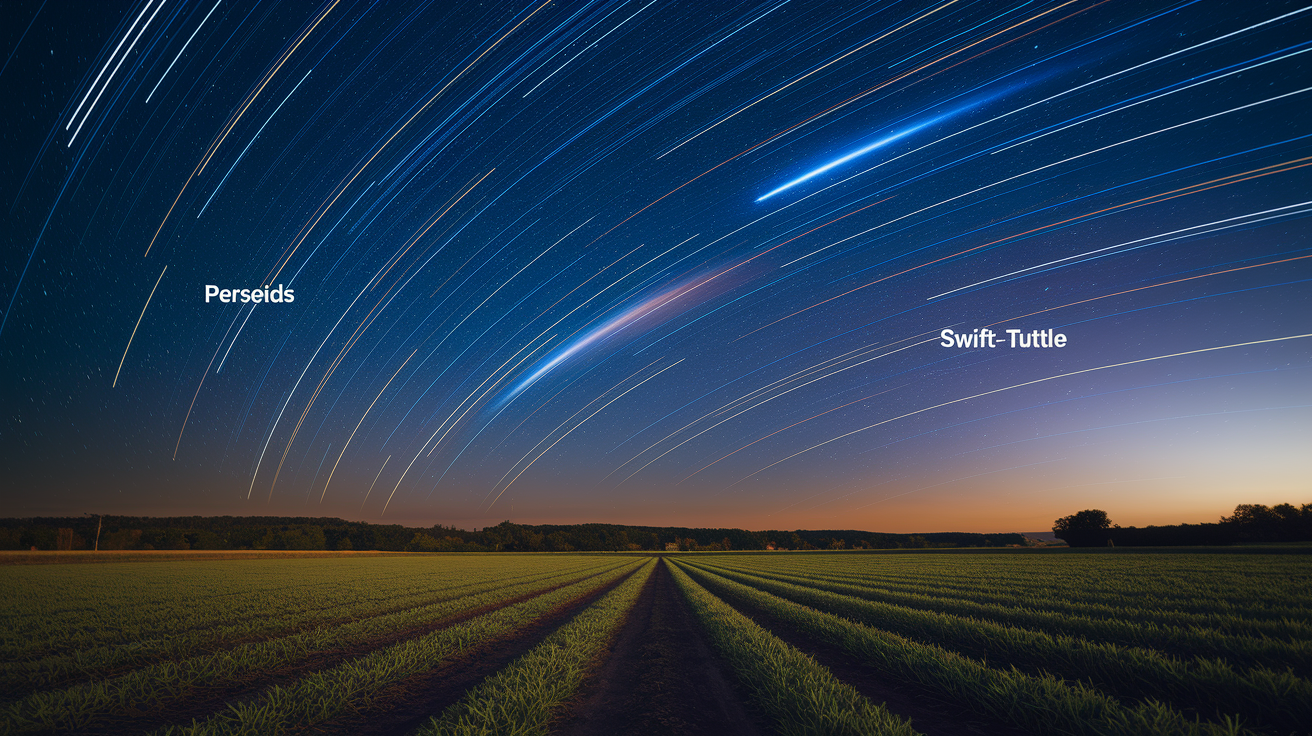
The Perseids provide a clear illustration of the full prediction process. Comet 109P/Swift–Tuttle orbits the Sun roughly every 133 years, leaving a dense dust trail near its perihelion. Historical records show the comet’s 1862 return produced a strong dust release, and earlier passages in 1479 and 1737 also contributed material. Modelers simulate dust ejection from these known perihelion dates, assigning each simulated particle an initial orbit based on the comet’s trajectory and a range of ejection velocities. N-body integration steps those particles forward to the present, accounting for gravitational pulls from Jupiter and Saturn and radiation forces on small grains.
Earth crosses the Perseid stream annually around August 12 or 13, when our orbit intersects the densest part of the dust cloud. By comparing Earth’s position to the computed particle density map, researchers identify the exact UTC hour when the planet passes through the peak concentration. That moment becomes the predicted peak time (for example, 14:53 UTC on August 13, 2026). Radiant coordinates place the apparent origin in Perseus, near the Double Cluster, which rises after midnight and climbs highest before dawn. ZHR forecasts for the Perseids typically range from 60 to 100 under ideal conditions, reflecting both the stream’s consistent density and the fraction of particles large enough to produce visible meteors.
The Geminids follow a similar workflow but with an asteroid parent, 3200 Phaethon, which releases dust near perihelion despite lacking the ice-driven outgassing seen in comets. Models treat the ejection mechanism as thermal fracturing or surface disruption rather than sublimation, but the orbital integration and density mapping steps stay the same. The Geminids peak around December 13 or 14 with ZHRs reaching 100 to 150, making them one of the year’s most reliable displays. The Leonids differ because their parent, comet 55P/Tempel–Tuttle, has produced well-documented filaments that cause brief, intense storms in certain years. In 1966, observers counted thousands of meteors per hour when Earth passed through a dense ribbon ejected in 1899. Modelers identified that filament, integrated its evolution, and successfully predicted weaker but still enhanced Leonid activity in 1999, 2001, and 2002 when Earth grazed other historical dust trails.
Prediction principles applied to these showers:
- Parent identification and ejection epochs – Determine which comet or asteroid released the material and when, using historical records and orbital fits.
- Particle trajectory integration – Step each grain’s orbit forward under gravity and non-gravitational forces to map present-day stream structure.
- Earth intersection timing – Match the particle cloud with Earth’s position to find the crossing moment and compute flux at that time.
- ZHR estimation and observing guidance – Convert flux to expected meteors per hour, note radiant behavior, and flag favorable or unfavorable conditions (Moon phase, filament encounters).
Final Words
We traced the workflow in action: identify the parent body, model dust ejection, run orbital integrations, and pinpoint the moment Earth crosses the stream’s highest particle density.
We also covered orbital forces, filament mapping, historical records, radiant geometry, and how those feed into ZHR estimates and timing windows.
Use the published peak UTC, radiant coordinates, and ZHR as a guide, but expect local effects like moonlight and weather.
This is exactly how astronomers predict meteor shower peak times, and with a clear sky you’ll have a good shot at seeing it.
FAQ
Q: How do astronomers predict meteor showers?
A: Astronomers predict meteor showers by mapping the parent comet or asteroid orbit, modeling dust ejection, numerically integrating particle paths, and timing when Earth crosses the stream’s densest filament, then estimating ZHR and radiant coordinates.
Q: Why didn’t NASA see the meteor?
A: NASA didn’t see the meteor because satellites and ground sensors may have missed a small, short-lived event; coverage gaps, sensor orientation, detection thresholds, or the meteor burning up before reaching instruments often explain non-detections.
Q: What time is the peak hour for the meteor shower?
A: The peak hour for the meteor shower is the moment Earth intersects the stream’s maximum particle density; forecasts give a UTC peak you convert to local time, but visible rates depend on radiant elevation and usually span a few hours.
Q: What does the Bible say about meteor showers?
A: The Bible doesn’t discuss meteor showers as scientific events; it mentions falling stars and celestial signs metaphorically in passages like Revelation, using them for imagery, judgment, or prophecy rather than astronomy.