

It’s controversial that one of the strongest annual meteor showers happens when the Sun is up, so most skywatchers never see it.
The Arietid meteor shower peaks in early June, but its radiant sits very close to the Sun, which wipes out faint meteors during the day.
Radar and radio pick the shower up easily, while visual sightings are limited to a tiny pre-dawn window.
This post shows how those detection methods work, gives practical listening and observing tips, and sets realistic expectations for what you can actually detect.
Key Facts and Peak Timing for the Arietid Meteor Shower
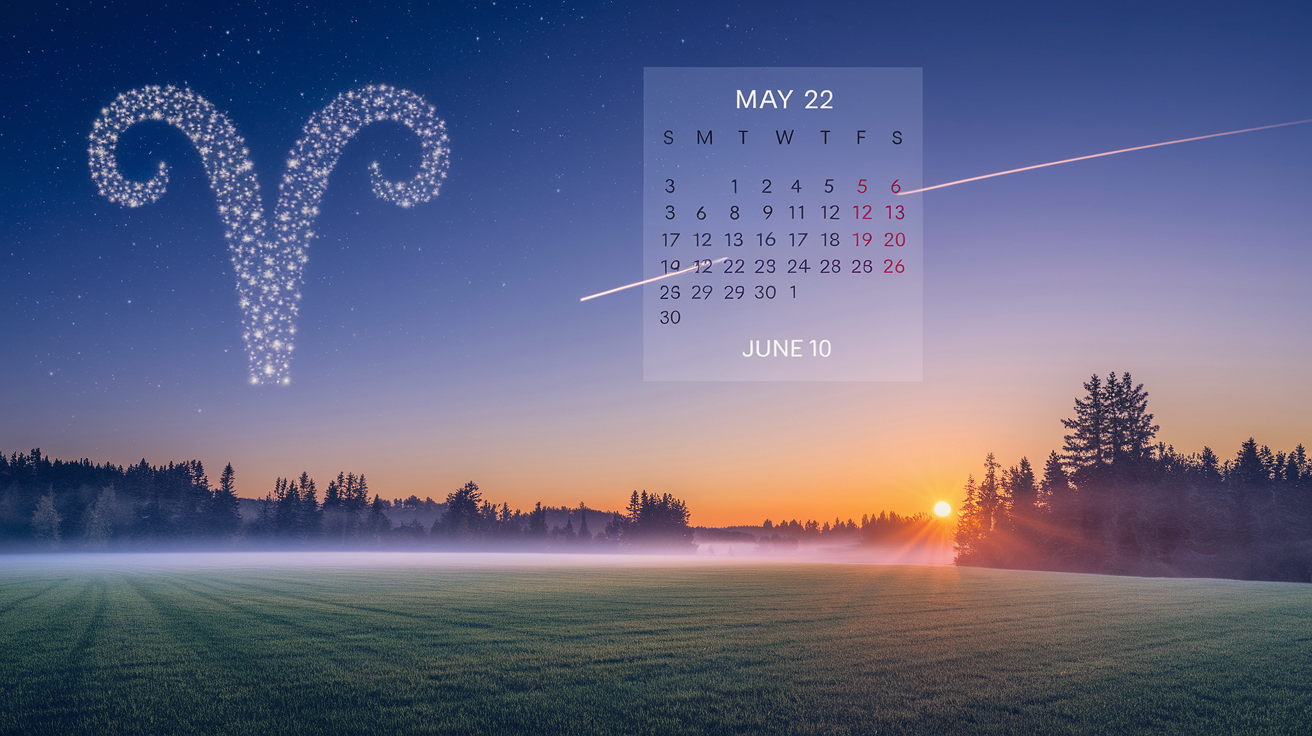
The Arietid meteor shower runs roughly from May 22 through early July, with the strongest activity packed into June 7–10. For 2026, expect the peak on the morning of June 10, give or take a day. But here’s the catch: the Arietids reach maximum activity when their radiant sits very close to the Sun. That makes this a daytime meteor shower, and you can’t observe it the way you would the Perseids or Geminids.
The radiant lies in Aries, about 30° from the Sun. When the radiant is overhead, so is the Sun, and the sky is bright. Catalog coordinates usually fall near right ascension 2 to 3 hours and declination +18° to +24°. This geometry shoves almost all peak activity into daytime, leaving only a narrow window before astronomical twilight when the radiant has just climbed above the eastern horizon.
Zenithal Hourly Rate estimates from radar and radio surveys suggest activity around 60 meteors per hour, with some datasets reporting peaks between 80 and 200 meteors per hour under perfect geometric conditions. Those numbers come from instruments that detect meteors in full daylight. The standard ZHR assumes a dark sky, a radiant at zenith, and a limiting magnitude of 6.5. Those conditions never occur during the Arietid peak, so visual observers will never confirm those rates by counting.
- Active window: May 22 to early July
- Peak date (2026): morning of June 10 ±1 day
- Radiant location: Aries, RA ~2–3 h, Dec ~+18° to +24°
- ZHR range: ~60 to 200+ meteors/hour (radar/radio only)
Radiant Geometry and Why the Arietids Emerge from Aries
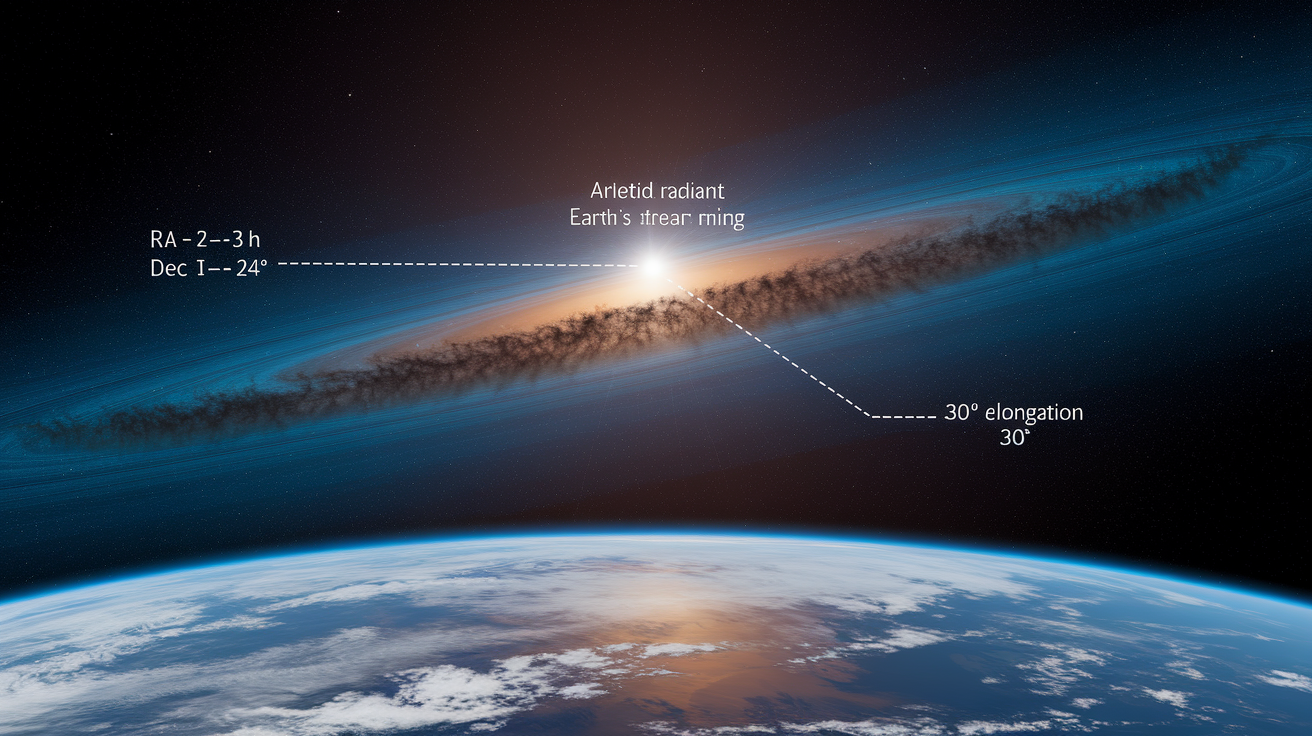
The Arietid radiant sits in the eastern part of Aries, which puts it in the same general direction as the Sun during early June. The 30° elongation means that when the radiant is high in the sky (when you’d normally expect the best meteor rates), the Sun is also high, flooding the atmosphere with scattered sunlight and rendering faint meteors invisible. Meteors radiate outward from this point because Earth is plowing through a stream of dust particles whose orbits intersect our planet at a specific angle. That intersection direction is what we call the radiant.
The geometry is straightforward. The meteoroid stream’s orbit lies nearly in the plane of the solar system, and when Earth crosses it in early June, the incoming particles appear to diverge from a spot near the Sun. That shallow solar elongation isn’t a coincidence. It reflects the stream’s own orbit, which brings debris close to the inner solar system and keeps the radiant perpetually near the Sun from our viewpoint on Earth.
Radiant Drift
Over the shower’s active period, the radiant drifts slightly eastward against the background stars. Normal effect. As Earth moves along its orbit, the intersection geometry shifts. From late May through mid-June, the radiant advances a few degrees in right ascension, and its elongation from the Sun also changes by a degree or two. By early July, the radiant has shifted farther from the Sun, but activity has already dropped to near zero. The improved elongation doesn’t translate into better visual observing conditions.
Why the Arietid Meteor Shower Is Mostly a Daytime Event
When the radiant is overhead (the position that would normally maximize meteor rates), it’s mid-morning and the sky is bright blue. Daylight scatter eliminates all but the brightest fireballs. Sunlight scattered by air molecules raises the background brightness to levels thousands of times higher than a dark night sky. Only meteors brighter than about magnitude –4 have any chance of being seen, and even those are difficult against the glare. The vast majority of Arietid meteors are faint, falling well below visual detection thresholds during the day.
When the sky is truly dark and faint stars are visible, the radiant is below the horizon. A radiant below the horizon means that meteors, if any, would have to streak upward from below the observer’s line of sight. Geometrically impossible. The narrow pre-dawn window when the radiant has just risen but astronomical twilight hasn’t yet begun offers the only chance for visual detection. Even then the radiant is low, the zenithal correction is severe, and the number of visible meteors is a small fraction of the radar total.
This mismatch between radiant elevation and sky darkness is why visual meteor counts for the Arietids are so low compared to radio and radar datasets. Radar systems detect ionization trails regardless of sunlight, so they record the full activity profile. Visual observers, constrained by biology and physics, see only the tip of the iceberg. The occasional bright meteor that sneaks into the twilight sky before the Sun rises high enough to wash it out completely.
How to Observe the Arietid Meteor Shower (Visual and Radio Methods)
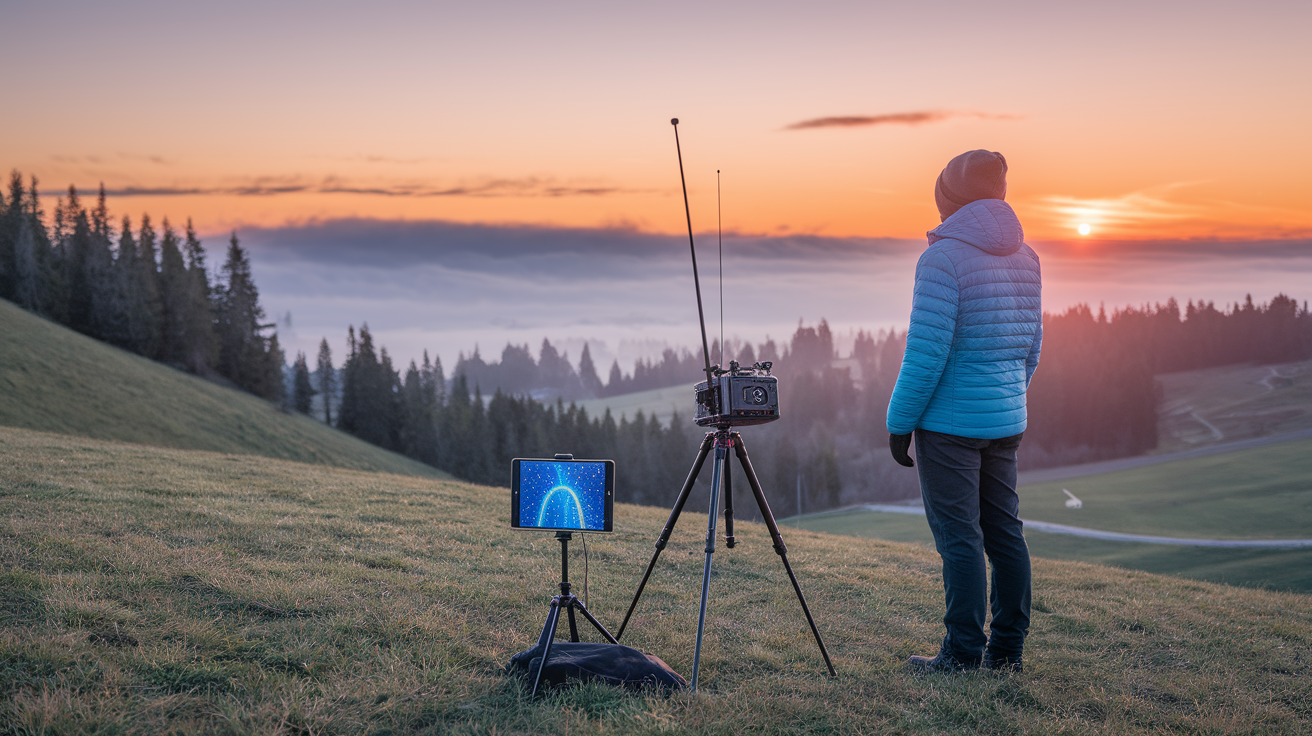
The visual observation window for the Arietids is extremely short. Plan to be outside one to two hours before sunrise, when the radiant in Aries has climbed a few degrees above the eastern horizon but the Sun is still far enough below the opposite horizon that the sky remains dark. Once astronomical twilight begins (defined as the Sun’s center reaching 18° below the horizon), background brightness rises quickly, and meteor visibility drops.
- Face east and scan the horizon up to about 30° altitude. Most meteors will appear to move away from the low radiant.
- Scan the horizon continuously rather than staring at one spot. Shallow-angle meteors cover more sky.
- Block moonlight if the Moon is up. Position yourself so a building, hill, or tree blocks the Moon’s direct glare without obstructing your eastern view.
- Know your twilight definitions. Astronomical twilight starts when the Sun is 12° to 18° below the horizon. Once it begins, your window is closing.
- Observe for at least 30 minutes. A few bright meteors may appear, but don’t expect continuous activity.
- Stay safe. If observing near a road or in an area with limited visibility, bring a red flashlight and remain aware of your surroundings.
Radio Detection Basics
Radio detection offers a practical way to monitor the Arietids when visual observation fails. Tune an FM radio receiver to a quiet frequency between active stations, somewhere in the 88 to 108 MHz band. When a meteor burns up, it leaves a short-lived trail of ionized gas in the upper atmosphere that can briefly reflect distant FM broadcast signals, causing a sudden burst of audio or a spike in signal strength. These reflections last only a second or two, but they’re unmistakable when you hear them.
Expect the highest reflection counts around your local morning hours, when the geometry between distant transmitters, the meteor shower radiant, and your receiver aligns favorably. Recording your session lets you count reflections later and compare your results to published radar data.
Arietid Meteor Characteristics: Speed, Brightness, and Earth-Grazers
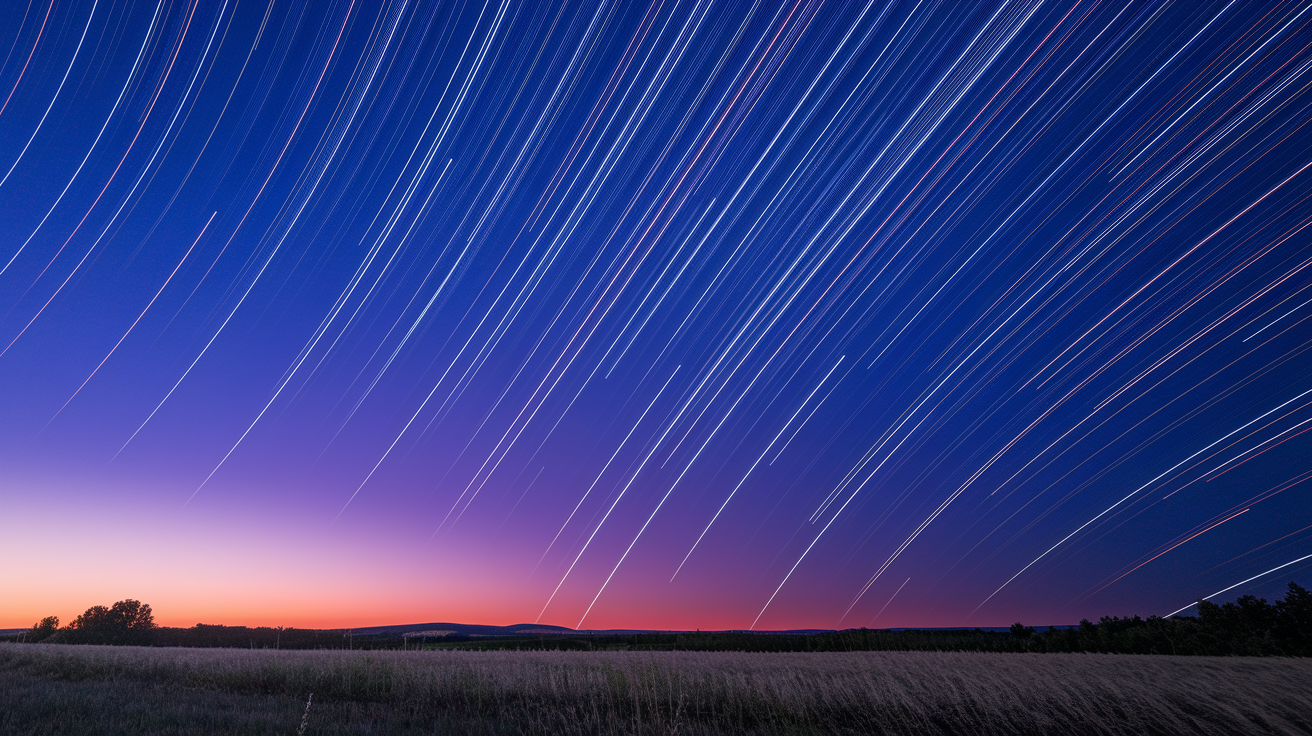
Arietid meteors strike Earth’s atmosphere at a geocentric velocity of about 39 kilometers per second. Moderate speed compared to the fastest showers. That velocity is high enough to produce bright ionization and visible light, but not so extreme that meteors burn out instantly. The combination of speed and shallow entry angles near the horizon can produce long, slow-moving trails that last longer than typical high-radiant meteors.
Because the radiant sits low during the brief visual window, many meteors approach at shallow angles, skimming the upper atmosphere in what are called earth-grazers. These meteors can appear relatively slow and may travel a long angular distance across the sky before fading. Bright fireballs are possible, especially during the peak. A fireball appearing in deep twilight can be a memorable sight even if the overall visual count is low.
| Characteristic | Typical Arietid Value or Behavior |
|---|---|
| Entry velocity | ~39 km/s (geocentric) |
| Brightness | Mostly faint; occasional fireballs in twilight |
| Earth-grazers | Common when radiant is near horizon; long, slow trails |
| Fireball potential | Low overall rate, but bright events recorded during peak |
Scientific Significance and Parent Body Candidates for the Arietids
The Arietid meteor shower was first detected in 1947 using radio techniques at Jodrell Bank Observatory in England. Before radar and radio meteor detection became routine, daytime showers were invisible to observers. Their discovery had to wait for technology that could “see” meteors by their ionization rather than their light. Early radio observations revealed a strong, consistent signal in early June, and subsequent radar campaigns confirmed the shower’s high activity and daytime nature.
Photographic confirmation came later, with a few bright Arietid meteors captured on all-sky cameras during twilight. Those images helped refine the radiant position and showed that the shower was real, not an artifact of radio noise. By the 1950s and 1960s, the Arietids were recognized as one of the strongest annual meteor streams, even though most people had never seen one.
Parent Body Candidates
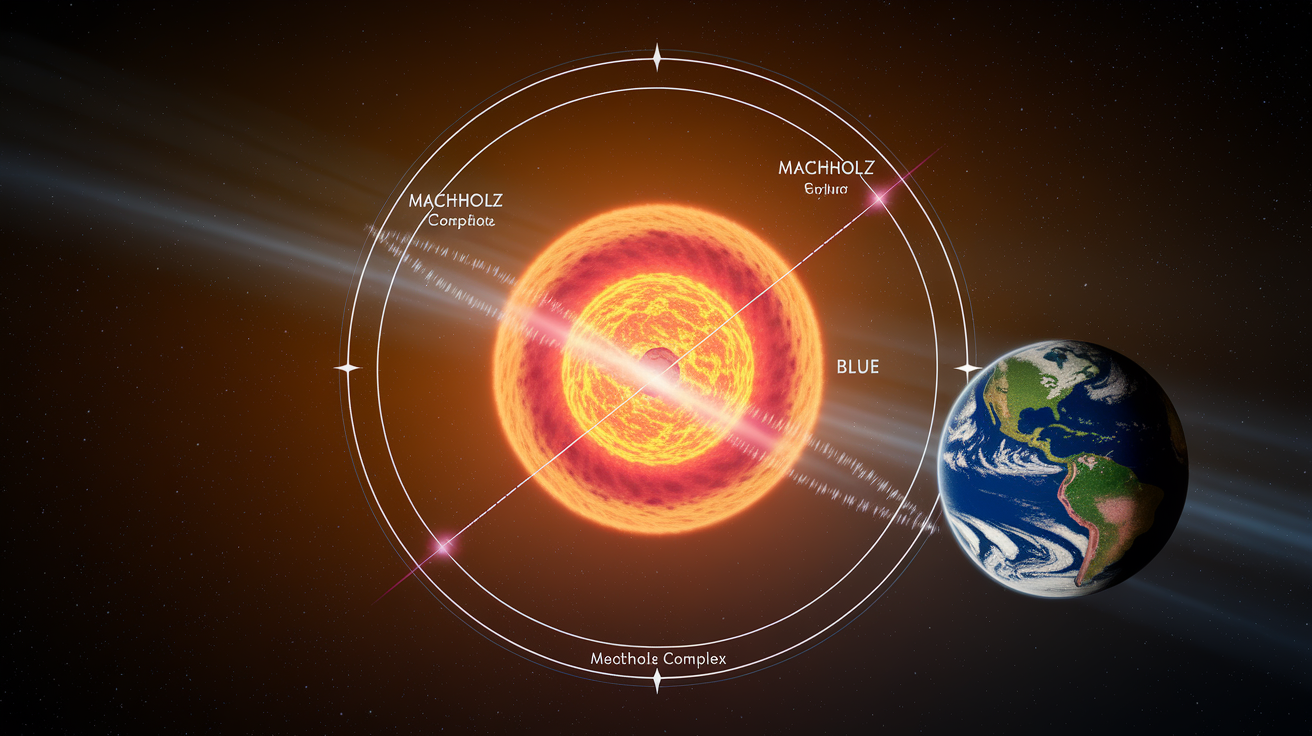
The most commonly cited parent body for the Arietids is Comet 96P/Machholz, a short-period comet discovered in May 1986. Orbital studies show that the comet’s path is similar to the stream of meteoroids that produces the Arietids. 96P/Machholz is also associated with a broader group of related objects called the Machholz Complex, which includes multiple meteor showers and at least one asteroid. Another candidate is the near-Earth asteroid 1566 Icarus, whose orbit also resembles the Arietid stream. The exact parent remains uncertain. It’s possible that the shower receives contributions from more than one source or that the original comet has since disintegrated into fragments.
Radio and Radar Detection of the Arietid Meteor Shower
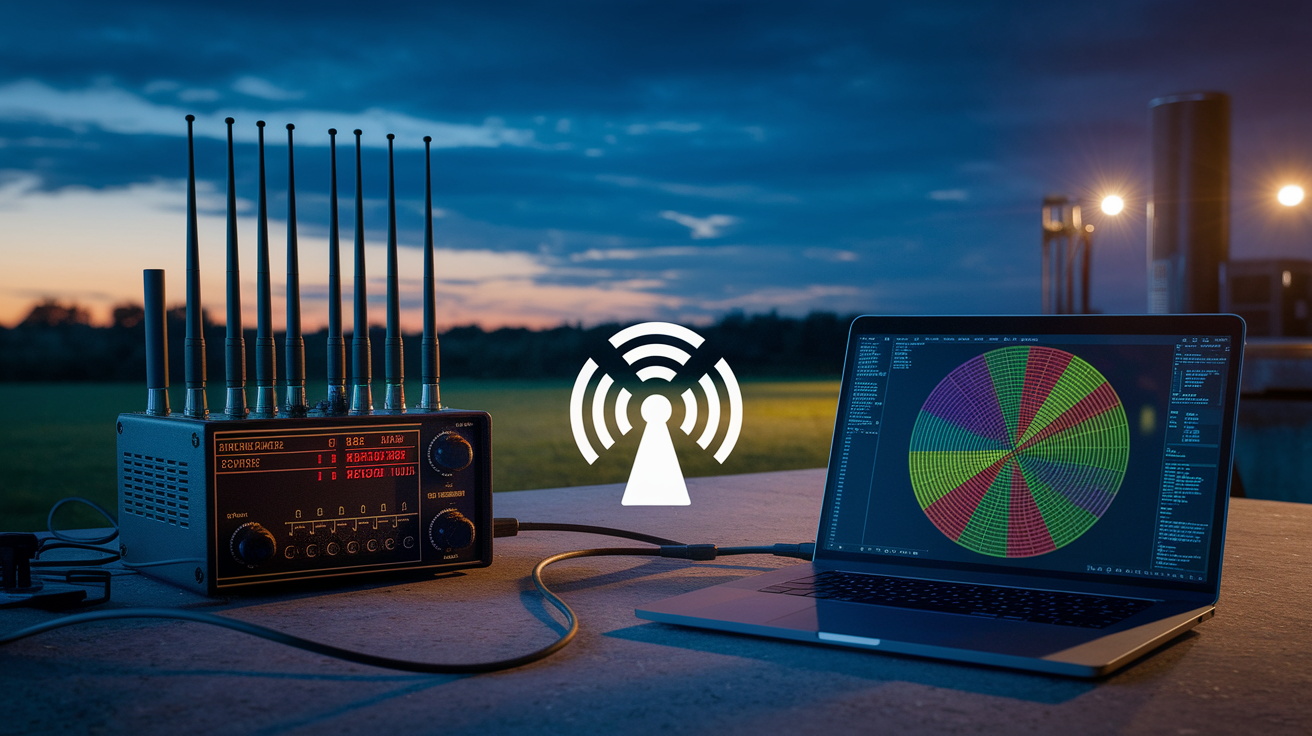
Radio detection relies on forward-scatter geometry. A distant FM transmitter sends a signal that normally passes over your location, but when a meteor ionizes the upper atmosphere, the ionization trail briefly reflects the transmitter’s signal down to your receiver. The result is a short ping or burst of audio that indicates a meteor has passed through the reflecting zone. This method works day and night, making it ideal for daytime showers like the Arietids.
Radar networks operated by meteor research organizations provide the most complete picture of Arietid activity. These systems use dedicated transmitters and receivers to measure meteor counts, velocities, and radiant positions continuously. Data from radar networks form the basis for published ZHR values and are used to refine the shower’s orbital elements and activity profile.
- Ideal transmitter distance: roughly 500 to 1,500 kilometers from your location. Closer transmitters may reflect too strongly, while very distant ones may not reflect enough.
- Recommended frequency band: FM broadcast band, 88 to 108 MHz, offers the best balance of transmitter availability and reflection efficiency.
- Use of SDRs: software-defined radios can record the entire band and let you analyze reflections later, or monitor multiple frequencies simultaneously.
- Recording audio traces: save audio or waterfall plots to count reflections and compare against expected peak times.
- Timing around peak: monitor continuously from June 6 through June 10 to capture the rise, peak, and fall of activity.
Multi-station radar observations add another layer of precision. When two or more stations detect the same meteor, researchers can triangulate its trajectory, measure its deceleration, and estimate the meteoroid’s mass and composition. These measurements contribute to our understanding of the stream’s structure and the physical properties of the dust grains themselves.
Comparison of the Arietid Meteor Shower with Other Seasonal Streams
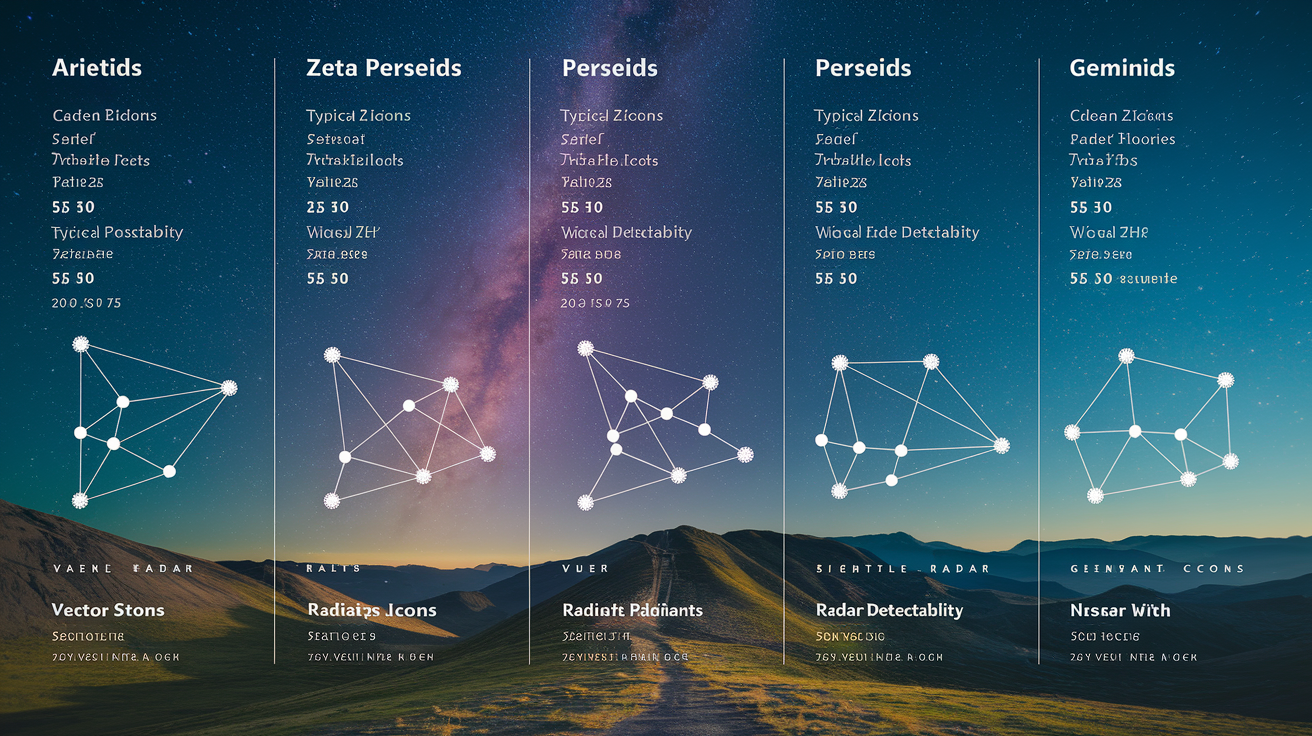
The Arietid meteor shower is often discussed alongside the Zeta Perseids, a smaller daytime shower active during the same period in late May and early June. The two radiants lie relatively close together in the sky (both in the east-northeast before dawn), so a meteor traced back to the horizon could belong to either stream. The Zeta Perseids have a lower ZHR, typically around 20 to 40 meteors per hour by radar counts, making the Arietids the dominant source of activity during this window.
Compared to well-known nighttime showers like the Perseids or Geminids, the Arietids are frustrating for visual observers but fascinating for radio and radar enthusiasts. The Perseids produce a similar ZHR but do so when the radiant is high in a dark sky, so visual counts can approach published rates. The Arietids reach comparable activity levels but remain hidden by daylight. A reminder that meteor showers aren’t inherently “visual” phenomena. They’re streams of dust particles, and whether we see them depends on geometry and sunlight.
- Zeta Perseids overlap: active at the same time, lower ZHR (~20–40), radiant nearby in Perseus
- ZHR comparison: Arietids rank among the strongest annual showers by total meteor count, comparable to the Perseids
- Visual difficulty: Arietids far more challenging than night showers due to daytime radiant position. Visual counts are always a tiny fraction of radar totals.
Planning and Preparing for an Arietid Observation Attempt
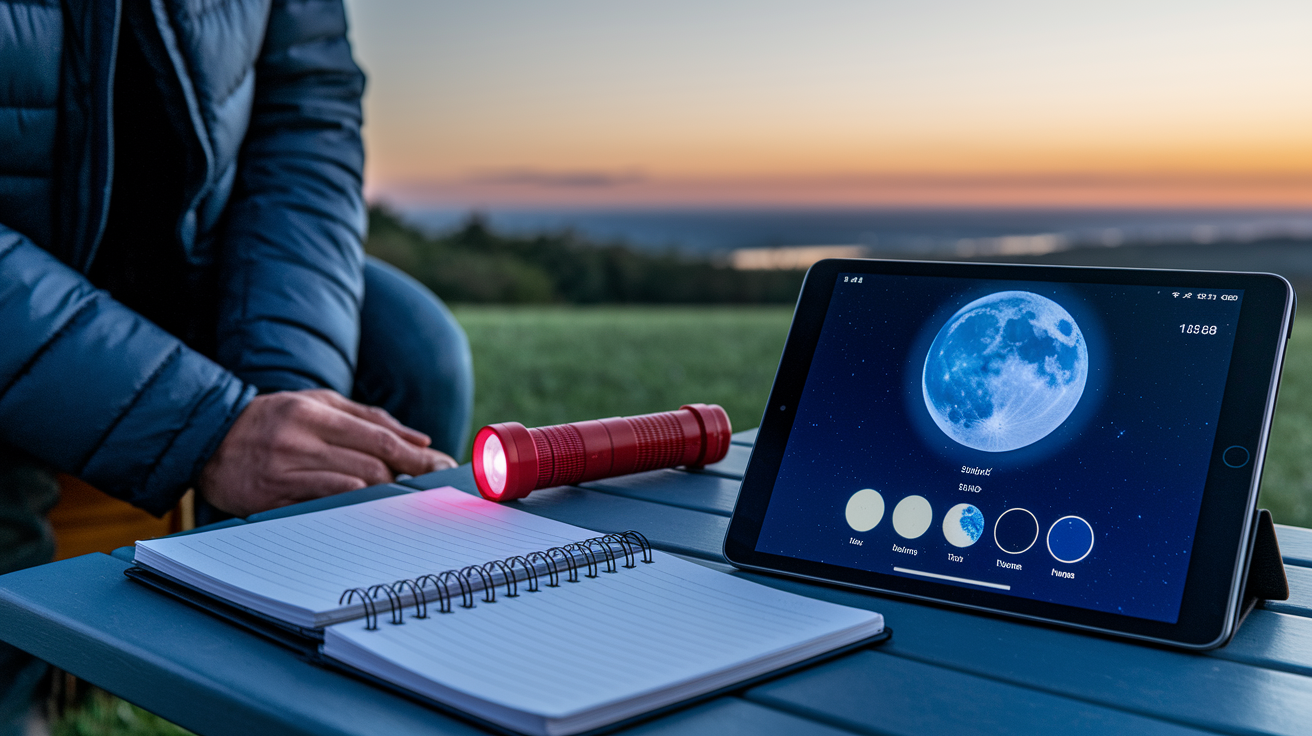
Planning an Arietid observation starts with checking the Moon phase and sunrise time for your location during the peak window. For 2026, the third-quarter Moon occurs at 10:00 UTC on June 8, placing a bright Moon in the sky during the pre-dawn hours near the peak. A bright Moon will reduce contrast and make it harder to spot faint meteors, so positioning yourself where the Moon is blocked by terrain or a distant structure can help. Face east and keep the Moon behind you or out of your direct line of sight.
- Clothing: early June mornings can be cool. Bring layers and a blanket if sitting.
- Horizon selection: choose a site with a clear view east and low on the horizon. Avoid light pollution and obstructions.
- Moon-blocking trick: use a building, hill, or tree to block the Moon without blocking your meteor view.
- Timing: arrive one to two hours before sunrise. Note the exact time of astronomical twilight for your location.
- Apps: use a planetarium app to confirm the radiant’s position and the Sun’s altitude below the horizon.
- Safety: if observing alone or near roads, bring a phone, a red flashlight, and let someone know your location.
Realistic expectations are essential. Even under ideal conditions, you may see only a handful of meteors during a 30- to 60-minute session. Radar data will show dozens or hundreds of meteors during the same period, but those numbers reflect the full sky and full daylight activity. Your visual count will be much lower. That’s normal. The reward isn’t a meteor storm but the chance to catch a bright fireball or a long earth-grazer sliding up from the eastern horizon just before the Sun ends your watch.
Final Words
We covered dates May 22 to July 3, an expected peak near June 10, the Aries radiant about 30 degrees from the Sun, and why radio and radar reveal the shower’s strength.
You saw the geometry that makes it a daytime event, what to expect from earth-grazers and bright twilight streaks, and simple visual and radio observing steps.
Watch the short pre-dawn window facing east and block the rising Sun or Moon with terrain. The arietid meteor shower is mostly quiet visually but rich in radio signals. Give it a try. You’ll learn a lot.
FAQ
Q: Where can I see the Arietids meteor shower?
A: The Arietids meteor shower can be seen mainly as a daytime event with a brief pre-dawn visual window; face east toward Aries (RA 2–3h, Dec +18°–+24°) or detect it by radio.
Q: What time is best to see the meteor showers tonight?
A: The best time to see meteor showers tonight is usually after midnight through pre-dawn when the radiant is highest; for daytime showers like the Arietids, the short hour before sunrise is best.
Q: What time is the meteor shower on July 29th?
A: The Arietid meteor shower is not active on July 29th; it runs roughly May 22–July 3 with a peak around June 10—check a current shower calendar for any late‑July activity.
Q: What time is the meteor shower on October 21st?
A: The meteor shower on October 21st is typically the Orionids (peaking around Oct 20–22); best viewing is after midnight into pre-dawn when the radiant rises in the east-southeast.