

What if the calendar is misleading about when meteor showers peak?
It kind of is, because showers peak at the same solar longitude in Earth’s orbit, not a fixed date.
That makes solar longitude the reliable way to find the true peak.
This post walks you through converting a solar longitude to a calendar date.
You’ll get a quick online method, the math behind it, step-by-step examples for major showers, time-zone handling, and a simple reference table.
By the end you’ll know the exact night to watch, no guessing.
Direct Method for Converting Solar Longitude to Calendar Dates
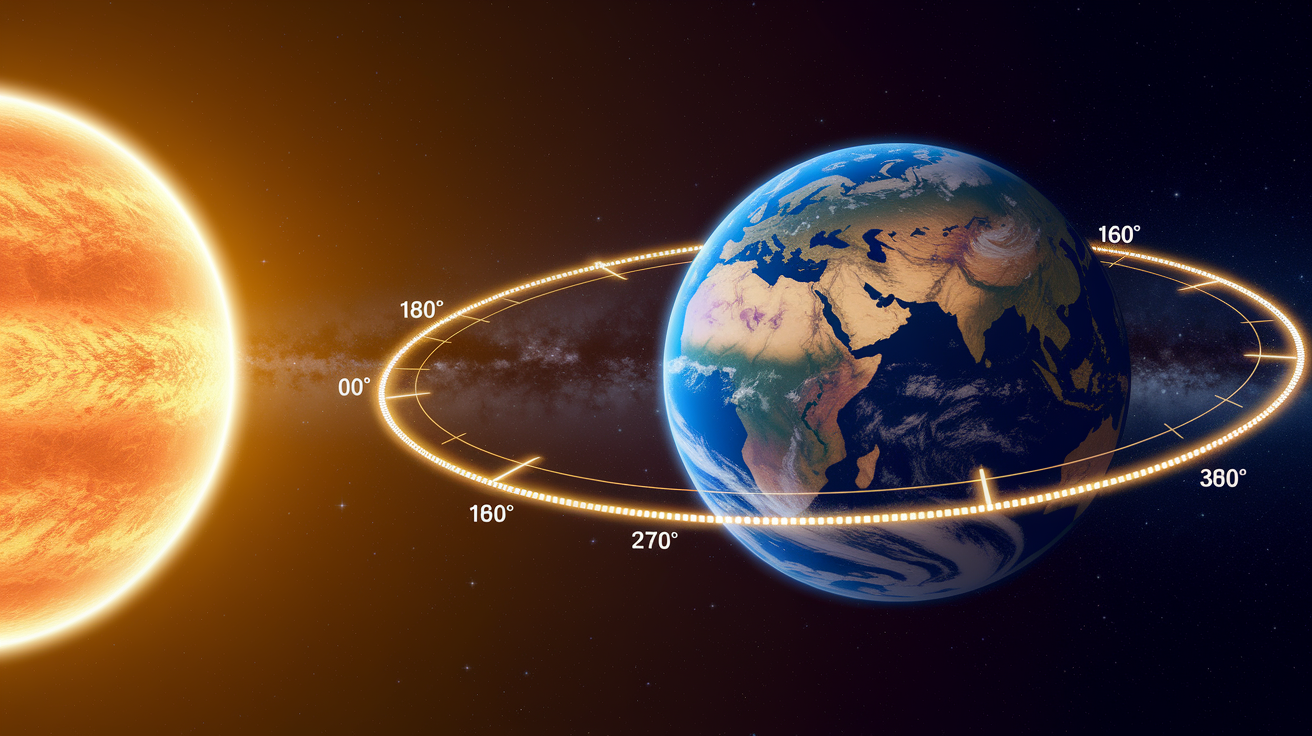
Solar longitude measures where Earth sits in its orbit around the Sun. It starts at 0° during the vernal equinox and ticks up through 360° as the year rolls forward. For meteor shower observers, it’s the best tool you’ve got. Showers peak at the same solar longitude every time, even when calendar dates wiggle around because of leap years or tiny orbital shifts. If a shower maxes out at 139.0°, you need to figure out which calendar date matches that spot in Earth’s path.
The quickest way? Use an online ephemeris calculator, astronomy software, or a pre-built lookup table. Tools like JPL Horizons, IMCCE ephemeris generators, or dedicated solar longitude converters will take your longitude value and hand back the date and time in Universal Time. Most are free and run in your browser.
Here’s how to do it:
- Pull up a solar longitude conversion tool (IMCCE ephemeris generator works well, or any astronomy calculator that accepts ecliptic longitude).
- Type in your solar longitude value. Say, 139.0° for the Perseid peak.
- Pick the year you’re interested in. The exact date drifts slightly year to year.
- Hit submit and check the output. You’ll see the date and time in Universal Time when the Sun crosses that longitude.
- Convert UT to your local time zone if you need to. Depending on your offset from UTC, the date might jump forward or back a day.
Mathematical Formula and Manual Calculation Approach

Every online calculator runs on a mathematical relationship between solar longitude, time, and Earth’s orbital position. The core equation begins with the mean anomaly, which is the angle Earth has traced through its orbit since perihelion (the closest point to the Sun). You calculate mean anomaly using the number of days since a fixed epoch, usually measured in Julian Days to dodge calendar quirks. The equation is M = n(t – T₀), where n is the mean motion (about 0.9856° per day for Earth), t is the current Julian Day, and T₀ is the Julian Day of perihelion.
Getting from mean anomaly to true solar longitude requires accounting for Earth’s elliptical orbit. That’s where the equation of center comes in. It’s a correction that adjusts for Earth moving faster near perihelion and slower near aphelion. This correction depends on orbital eccentricity and adds a sinusoidal term to the mean anomaly. True longitude is the sum of mean longitude and the equation of center, with adjustments for precession of the equinoxes and (if you want high precision) perturbations from other planets.
Most astronomers don’t bother with manual iteration. They use ephemeris tables or numerical methods to solve the inverse problem: given a target solar longitude, find the Julian Day that produces it. This requires an iterative solver because the relationship is transcendental. You can’t isolate time algebraically. Software libraries and online tools run Newton-Raphson or similar root-finding algorithms to converge on the correct date in seconds. For meteor shower planning, this automation is standard. You don’t need to work through the equations by hand unless you’re writing your own software or checking published results.
Step-by-Step Worked Examples for Major Meteor Showers
Let’s walk through conversions for three well-known meteor showers using their published peak longitudes. Each shower hits maximum activity when Earth crosses the same point in its orbit year after year. That point is defined by solar longitude, not by the calendar.
The Quadrantids peak at 283.2°. Using an ephemeris calculator for 2025, entering 283.2° gives you January 3, 2025, at about 17:00 UT. That’s evening in Universal Time. For observers in North America (UTC–5 to UTC–8), it converts to late afternoon or early evening on January 3 local time, so your best viewing window is the morning of January 4 before dawn. The solar longitude stays constant every year, but the calendar date can shift by ±1 day depending on leap-year timing and where the peak lands within the 24-hour cycle.
The Perseids peak at 139.0°. For 2025, entering that longitude returns August 12, 2025, around 22:00 UT. That’s late evening on August 12 in Universal Time, placing the peak during the night of August 12–13 for most of the world. Observers in Europe see peak rates after midnight on the 13th. In North America, the peak happens during the late hours of the 12th into the early morning of the 13th. The Perseids are one of the most reliable showers, and the 139.0° marker has stayed steady across decades of observations.
The Geminids reach maximum at 262.2°. Running the conversion for 2025 produces December 14, 2025, at roughly 10:00 UT. That’s mid-morning Universal Time, so the night of December 13–14 is your primary viewing window. Peak activity occurs during the early morning hours of the 14th in North America and late morning in Europe. Because the Geminids stay active for several days, the one-degree spread around 262.2° still delivers strong rates. But the solar longitude pinpoints the true maximum to within a few hours.
Handling Time Zones and UT-Based Solar Longitude Readings

Solar longitude values are always tied to Universal Time. The calendar date returned by a conversion tool is also in UT. When you convert that UT date to your local time zone, the calendar date can shift forward or backward by a full day, especially when the peak occurs near the edge of a 24-hour period. A peak at 02:00 UT on January 4 becomes 9:00 PM on January 3 in U.S. Eastern Time (UTC–5). That changes the “peak date” depending on how you describe it.
This matters for planning observations because the meteor shower doesn’t care about local midnight. If the solar longitude peak lands at 18:00 UT, an observer in California (UTC–8) is still in daylight at 10:00 AM local time. The actual peak occurs during the day, so the best observable rates will be the night before or after, not at the mathematical peak moment. Always convert the UT peak time to your local clock, then figure out which night gives you the best post-midnight viewing window when the radiant is high and the sky is dark.
Typical adjustments:
A UT peak time between 00:00 and 12:00 UT often shifts the local calendar date backward by one day in North American time zones.
A UT peak time between 12:00 and 24:00 UT usually keeps the same calendar date in European time zones but may shift it forward in Asia-Pacific zones.
Meteor activity spans hours around the peak. A ±6-hour window around the solar longitude maximum still delivers strong rates, so you don’t need to time your session to the exact minute.
Reference Table for Solar Longitude and Approximate Annual Dates
Meteor showers peak at nearly identical solar longitudes every year. You can use a reference table to quickly estimate the calendar date without running a calculation. The dates in this table are approximate and can shift by ±1 day depending on the year and the precise time of the solar longitude crossing in Universal Time. For exact timing in a specific year, use an ephemeris calculator with the solar longitude value.
| Solar Longitude | Meteor Shower | Approximate Peak Date |
|---|---|---|
| 283.2° | Quadrantids | January 3–4 |
| 32.0° | Lyrids | April 22–23 |
| 139.0° | Perseids | August 12–13 |
| 208.0° | Orionids | October 21–22 |
| 235.0° | Leonids | November 17–18 |
| 262.2° | Geminids | December 13–14 |
This table gives you a starting point for annual shower planning. When you see a shower listed at a given solar longitude in a research paper or observation report, cross-reference it here to get the approximate calendar date. Then confirm the exact time using a converter if you need precision for imaging, data collection, or coordinating with other observers across time zones.
Final Words
You’re set to convert a solar longitude into a usable calendar date using the quick online tools and the manual formulas we covered. We showed direct steps, the underlying math, worked examples for Quadrantids, Perseids, Geminids, and how to account for time zones.
If you keep an ephemeris or a calculator handy and remember the UT vs local-date shift, converting solar longitude to calendar dates for meteor peaks becomes routine. Try it with one shower tonight. Clear skies.
FAQ
Q: How is the lunisolar calendar calculated?
A: The lunisolar calendar is calculated by tracking lunar months from new moons and inserting intercalary months to keep months aligned with the solar year, often using the 19-year Metonic cycle with seven leap months.
Q: What is solar longitude?
A: Solar longitude is the Sun’s position measured along Earth’s orbit from the vernal equinox, given in degrees from 0 to 360, and used to mark seasonal positions and precise timings like meteor shower peaks.