

Could one telescope rewrite our story of the first galaxies?
In 2023 the James Webb Space Telescope shifted from dazzling first images to steady, targeted science.
Its infrared eyes and spectrographs aimed at five big questions: when galaxies formed, how black holes grew, what exoplanet air is made of, how stars form inside dusty clouds, and what nearby worlds are like.
This post walks through those 2023 objectives and the key discoveries they produced, like high-redshift galaxies, an early active black hole, detailed exoplanet chemistry, and Solar System finds, and why it matters.
Key 2023 Scientific Objectives of the James Webb Telescope
By 2023, the James Webb Space Telescope had settled into Cycle 2, its second full year of actual science work. After the excitement of first light in 2022, the observatory turned toward the long game: systematic surveys built to answer deep questions about where galaxies came from, what exoplanet atmospheres are made of, and how stars form. The 2023 targets weren’t dramatic shifts. They were the steady execution of a roadmap balancing early universe archaeology with nearby planet chemistry and Solar System close ups.
JWST’s infrared eyes let it see through cosmic dust and grab light that left galaxies when the universe was barely ten percent of its current age. At the same time, 2023 programs watched star nurseries buried in molecular clouds and recorded chemical fingerprints of distant planets crossing in front of their suns. The telescope’s real strength is catching warm objects and faint signals that don’t show up at optical wavelengths, like starlight filtered through an exoplanet’s air or the glow from galaxies just starting to make stars half a billion years after the Big Bang.
Big discoveries kept coming all year. JWST confirmed galaxies shining when the universe was only 390 to 700 million years old, spotted the most distant active supermassive black hole known at the time (formed about 570 million years after the Big Bang), and found methane plus carbon dioxide in the atmosphere of K2‑18 b, a distant sub‑Neptune circling a cool star. Closer to home, the telescope mapped a 3,000 mile wide jet stream on Jupiter racing at 320 miles per hour and identified carbon dioxide locked in Europa’s salty ocean. Each result fed back into planning cycles for follow up observations, calibration tweaks, and model revisions.
The key 2023 scientific priorities included:
Early universe galaxy surveys to detect and confirm high redshift galaxies, measure their masses and structures, and pin down when the first wave of star formation began.
Supermassive black hole growth studies to trace how million and billion solar mass black holes appeared so fast in young galaxies.
Exoplanet atmospheric characterization through transit and emission spectroscopy to catalog molecules (water, methane, CO2, sulfur dioxide) and assess habitability markers.
Star formation feedback mapping in nearby molecular clouds to reveal how ionizing radiation, winds, and jets shape protostellar disks and either trigger or halt new star birth.
Solar System atmospheric and compositional surveys targeting giant planets, icy moons, rings, and small bodies to understand chemistry, weather, and geologic activity across different environments.
JWST’s 2023 Focus on Early-Universe Observations and High-Redshift Galaxy Surveys
One of JWST’s flagship programs, JADES (the JWST Advanced Deep Extragalactic Survey), got a month of telescope time spread across two years. That might not sound like much. But in practice it meant long integrations on the same patch of sky, layer after layer, to pull out the faintest glimmers of light from the universe’s infancy. In one observing run, the team collected near infrared spectra from 250 candidate galaxies over 28 continuous hours across three nights. Four of those candidates turned out to have redshifts above 10, meaning their light was emitted when the universe was less than 500 million years old. Two galaxies clocked in around redshift 13, pushing the edge of what was observable before JWST arrived.
These weren’t just dots on a sensor. Follow up spectroscopy revealed galaxies with masses comparable to the Milky Way, mature red stellar populations, and structured features like spiral arms, bars, and rings appearing as early as 3.7 billion years after the Big Bang. Some galaxies showed up dusty and “ghostly” in the images, their starlight absorbed and re‑radiated at infrared wavelengths. One highlight from August 2023 was the confirmation of Maisie’s galaxy, which existed when the universe was roughly 390 million years old, making it one of the four earliest galaxies identified at that point. Another target appeared in an image corresponding to about 900 million years post Big Bang, heavily obscured by dust, hinting at a hidden population of early dusty galaxies that optical telescopes miss entirely.
The pace and scale of galaxy assembly in those first few hundred million years created immediate tension with existing models. Standard formation scenarios didn’t predict Milky Way mass galaxies with mature stellar populations so early. JWST’s ability to capture faint infrared spectra and resolve internal galaxy structure forced theorists back to their simulations to figure out how stars could form, age, and enrich their surroundings on such tight timelines. The 2023 observations set up a multi year campaign to confirm more candidates, measure their star formation histories, and refine estimates of when cosmic reionization truly began.
| Target Type | Redshift / Lookback | JWST Program |
|---|---|---|
| Massive early galaxies | z ≈ 10–13 (500–700 Myr after Big Bang) | JADES deep spectroscopy |
| Maisie’s galaxy | ~390 Myr after Big Bang | Confirmed August 2023 |
| Dusty “ghostly” galaxy | ~900 Myr after Big Bang | Deep field imaging |
| Structured early galaxies (spirals, bars) | ~3.7 Gyr after Big Bang | Morphology surveys |
Spectroscopic Mapping of the Earliest Galaxies
Getting a redshift confirmation takes more than a pretty picture. JWST’s NIRSpec instrument splits incoming light into a spectrum, revealing the wavelengths of hydrogen, oxygen, and other elements. When a galaxy is racing away from us at cosmic expansion speeds, those familiar spectral lines get stretched toward the red end of the spectrum. Bigger stretch, farther away and earlier in cosmic history the galaxy lived. In 2023, deep NIRSpec integrations captured the faintest infrared spectra ever recorded for distant galaxy candidates. Twenty eight hours of staring at the same region yielded enough photons to measure redshifts and estimate stellar masses, star formation rates, and chemical compositions. That data let the teams confirm that some of these tiny smudges really were ancient galaxies, not foreground interlopers or instrument noise.
Deep-Field Imaging Approaches in 2023
JADES and related deep field programs revisited the Hubble Ultra Deep Field, a patch of sky Hubble had already scrutinized for years. Hubble’s original image contained about 10,000 galaxies. JWST’s wider infrared field of view and sensitivity expanded that count to roughly 100,000 galaxies in the same region. Many of those new detections are faint red objects that Hubble’s optical instruments couldn’t see, galaxies whose starlight has been redshifted so far into the infrared that they were effectively invisible before. The 2023 imaging runs also targeted other deep fields, building up a census of early galaxy populations across different sky patches to check for cosmic variance and make sure the results weren’t flukes of one lucky sightline. The appearance of bars, spiral arms, and rings in galaxies just a few billion years old was a surprise. Standard galaxy evolution models assumed it took longer for those structures to settle into place. Seeing them so early means either stars and dark matter organized faster than expected, or the models need revised initial conditions and feedback prescriptions.
James Webb Telescope 2023 Objectives in Black Hole Growth and Cosmic Structure
Supermassive black holes are another early universe puzzle. By 2023, JWST had identified one of the most distant active supermassive black holes known, residing in a galaxy whose light was emitted about 570 million years after the Big Bang. That black hole clocks in at roughly 9 million times the mass of the Sun. On the one hand, that’s orders of magnitude smaller than the billion solar mass monsters found in some nearby galaxies. On the other hand, it’s still hard to explain how even a 9 million solar mass black hole grew that fast in such a young universe. Standard accretion models and black hole seed scenarios struggle to pack that much mass into a black hole in the available time, especially when the surrounding gas is still mostly hydrogen and helium with very few heavy elements to help cool and collapse.
Additional 2023 data highlighted two early galaxies where starlight from the host was clearly visible alongside the emission from one of the first supermassive black holes. Those observations let the teams study both the black hole and its galaxy in the same snapshot, measuring how black hole mass relates to host galaxy stellar mass at cosmic dawn. The galaxies themselves showed signs of rapid assembly, consistent with the massive early galaxies found in the JADES surveys. Kinematic studies using spectral line widths and shifts hinted at gas motions and rotation curves, providing clues about dark matter halos and whether early galaxies were dynamically settled or still violently merging.
Key 2023 findings on black hole growth and cosmic structure:
Detection of an active supermassive black hole at ~570 million years post Big Bang with ~9 million solar masses, lower than many billion solar mass SMBHs but still difficult to form so early.
Imaging of two early galaxies hosting emerging supermassive black holes, allowing simultaneous study of black hole and host galaxy properties.
Discovery of structured morphologies (bars, spirals, rings) in galaxies as early as ~3.7 billion years after the Big Bang, earlier than theoretical predictions.
Constraints on gas kinematics and rotation curves in high redshift galaxies, informing dark matter halo and merger history models.
JWST 2023 Exoplanet Atmosphere Objectives and Spectroscopy Campaigns
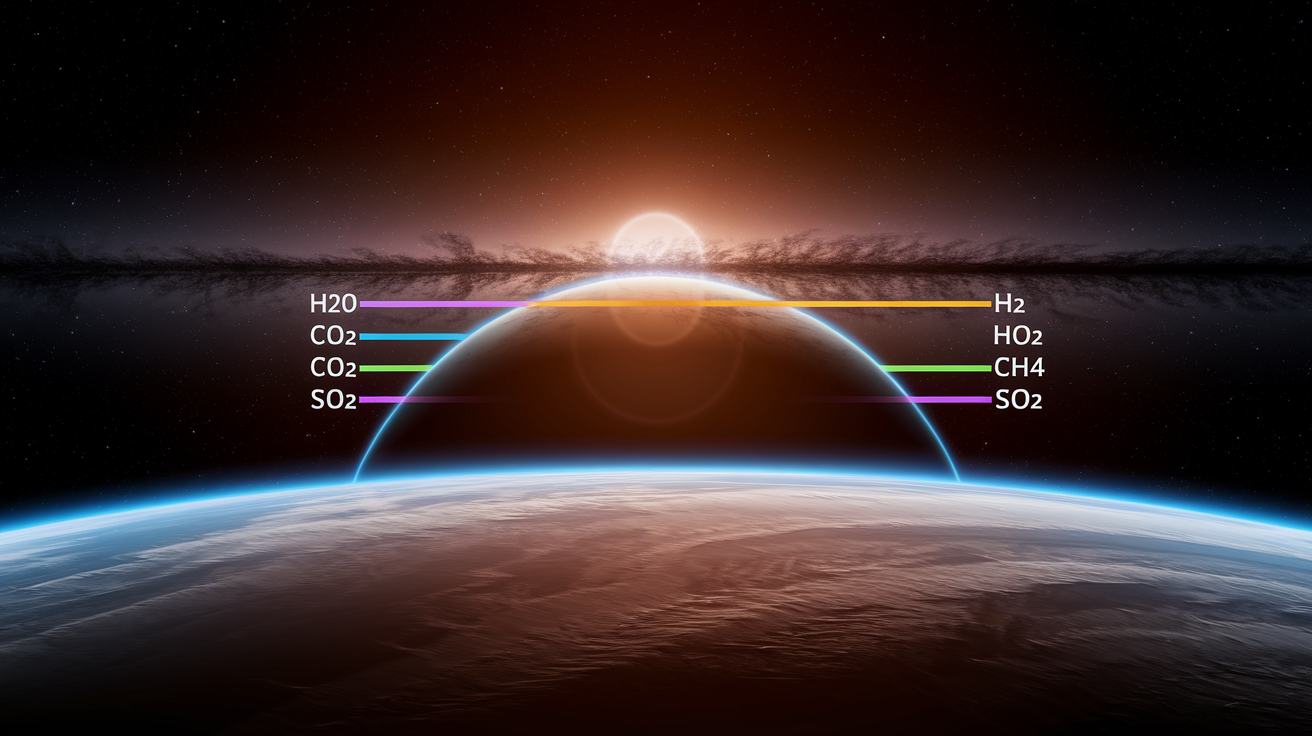
Exoplanet science was one of JWST’s headline promises, and 2023 delivered. The observatory’s sensitivity to infrared wavelengths makes it perfect for detecting molecules in planetary atmospheres, molecules that absorb specific colors of starlight as a planet crosses in front of its host star. One standout result came in September, when the team studying K2‑18 b, a sub‑Neptune orbiting a cool star about 120 light years from Earth, announced detections of methane and carbon dioxide with surprisingly little ammonia. The data came from just two JWST observations. That efficiency matters because telescope time is precious, and two observations were enough to reshape the conversation about whether K2‑18 b might be a “Hycean” world, a planet with a hydrogen rich atmosphere and a subsurface or underlying ocean.
Earlier in JWST’s mission, the first exoplanet spectrum from August 2022 had already broken new ground by confirming carbon dioxide in the atmosphere of WASP‑39b, a hot gas giant roughly Saturn’s mass orbiting eight times closer to its star than Mercury does to the Sun. Follow up studies added sulfur dioxide and carbon monoxide to WASP‑39b’s molecular inventory, all detected via transmission spectroscopy. By 2023, the exoplanet programs had expanded to include cooler sub‑Neptunes, hot Jupiters with different chemical makeups, and multi epoch observations to track atmospheric variability over time. The goal was to build a catalog of molecular detections across diverse planet types, test formation and migration theories, and identify which atmospheres might preserve biosignature gases like oxygen or methane in the right combinations.
The 2023 campaigns also set the stage for long term monitoring. Some planets were observed multiple times to check for clouds, hazes, and day night temperature contrasts. Others were targeted for emission spectroscopy, where JWST measured the planet’s own infrared glow rather than filtered starlight. That technique works best for hot Jupiters and gives direct constraints on atmospheric temperature profiles and heat redistribution. Together, transmission and emission spectra paint a fuller picture of exoplanet climates, circulation patterns, and chemistry.
Molecules detected or prioritized in 2023 exoplanet studies:
Water vapor detected in multiple hot Jupiters and sub‑Neptunes.
Carbon dioxide (CO₂) first confirmed in WASP‑39b, then found in K2‑18 b.
Methane (CH₄) detected in K2‑18 b, suggesting cooler atmospheric conditions or specific chemistry.
Sulfur dioxide (SO₂) identified in WASP‑39b, indicating photochemical processes driven by stellar UV.
Carbon monoxide (CO) measured in several hot Jupiters.
Ammonia (NH₃) searched for in K2‑18 b but found in unexpectedly low amounts, informing Hycean world scenarios.
Transit Spectroscopy Approaches
Transit spectroscopy is the workhorse technique for characterizing exoplanet atmospheres. When a planet passes in front of its star from our viewpoint, a tiny fraction of the starlight filters through the planet’s atmosphere before reaching JWST. Molecules in that atmosphere absorb specific wavelengths, leaving dips and bumps in the spectrum. JWST’s instruments compare the in transit spectrum to an out of transit baseline, isolating the atmospheric signature. The method works best for planets with extended atmospheres and bright host stars, which is why 2023 programs prioritized hot Jupiters and warm sub‑Neptunes. Sub‑Neptunes are particularly interesting because they’re common in the galaxy but absent from our own Solar System, and their atmospheres can range from hydrogen dominated envelopes to steam rich or even rocky compositions depending on formation history and stellar irradiation.
Mid-Infrared Molecular Detection with JWST
MIRI, the Mid‑Infrared Instrument, extends JWST’s wavelength coverage out to about 28 microns, where many molecules have strong absorption features. Water, methane, carbon dioxide, and sulfur bearing species all show up clearly in MIRI spectra. In 2023, MIRI contributed to exoplanet studies by measuring thermal emission from hot Jupiters, constraining dayside temperatures and checking for temperature inversions caused by high altitude absorbers. MIRI’s sensitivity also helped detect trace species that are hard to see at shorter wavelengths. Combining NIRSpec and MIRI data gave the teams a broader molecular inventory and tighter constraints on atmospheric chemistry, cloud properties, and circulation patterns.
2023 JWST Science Objectives in Star Formation and Protostellar Evolution
Star formation happens inside dense molecular clouds where dust blocks optical light. JWST’s infrared vision cuts through that dust, revealing the cavities, bubbles, and outflows that shape how stars and planets form. One of the first targets released in July 2022 was the Carina Nebula (NGC 3372), about 7,600 light years away. The iconic “Cosmic Cliffs” image showed the edge of a giant ionized cavity where ultraviolet radiation from massive young stars erodes and compresses nearby gas. By 2023, deeper analysis of that region and others revealed networks of cavities and bubble rims where feedback from star formation either triggers new collapse or shuts it down by dispersing the raw material.
JWST also mapped 24 individual protostellar outflows in star forming regions. Instead of smooth jets, the outflows showed chains of dense, fast moving clumps. That structure points to episodic accretion, where material falls onto the young star in bursts rather than a steady stream. Each burst drives a new pulse of outflow, and the spacing between clumps records the timing of those accretion events. Measuring outflow velocities and mass flux helps estimate how much material is being ejected versus how much ends up in the star and its surrounding disk, which in turn shapes the conditions for planet formation.
| Region | Key Feature | Scientific Value |
|---|---|---|
| NGC 3372 (Carina Nebula) | Ionized cavities and “Cosmic Cliffs” edge | Maps feedback from massive stars; erosion vs. triggered collapse |
| Protostellar outflow sources | 24 flows with dense clump chains | Constrains episodic accretion rates and mass‑loss history |
| Nearby spiral galaxies (PHANGS) | Cavities and gas bubbles along spiral arms | Traces star formation feedback in diverse galaxy environments |
Spectroscopy of molecular hydrogen and carbon monoxide lines provided additional detail about gas temperatures, densities, and velocities. Those measurements help distinguish between different feedback mechanisms, like radiation pressure, stellar winds, and supernova shocks, and show how each one influences the next generation of star formation. The 2023 observations were part of a broader effort to connect small scale protostellar physics with galaxy scale star formation rates and efficiencies.
Solar System Investigations within JWST’s 2023 Objectives
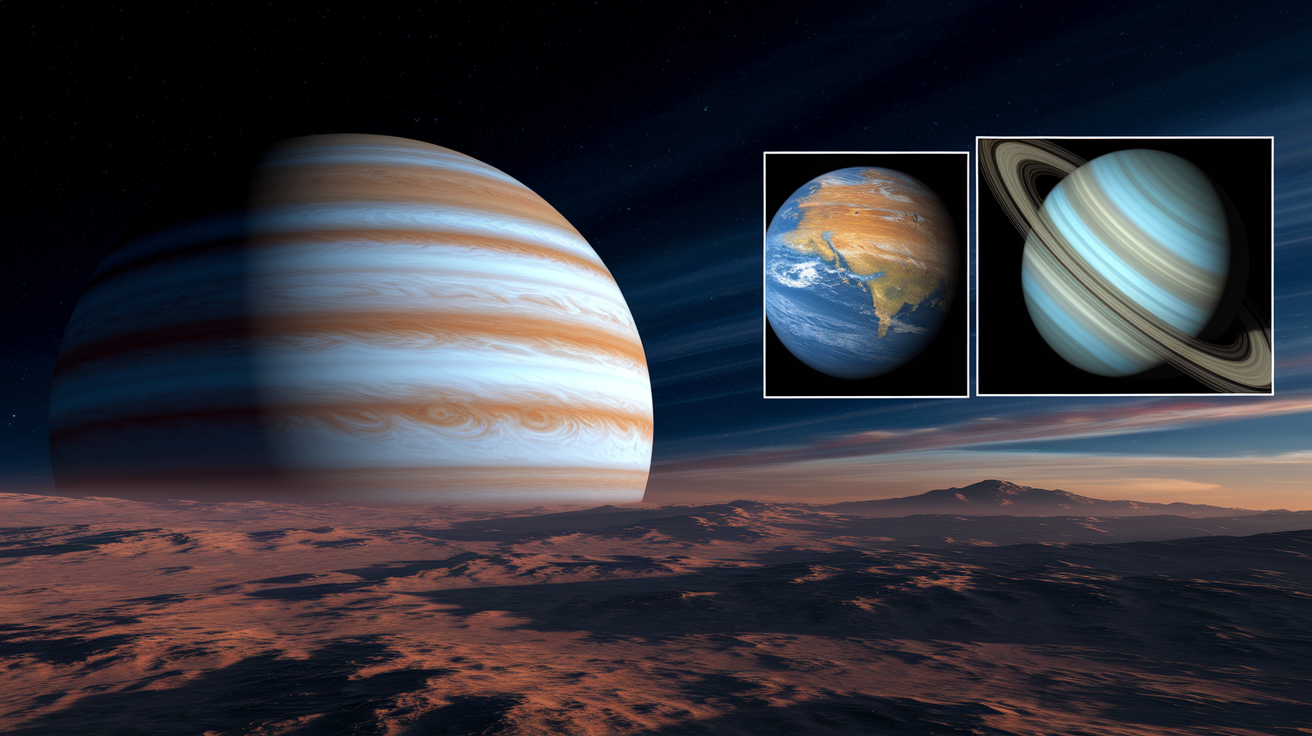
JWST isn’t just for distant galaxies and exoplanets. Its infrared instruments are surprisingly good at studying Solar System targets, from giant planets and their moons to asteroids and comets. In October 2023, JWST captured images of Jupiter that revealed a previously unseen jet stream about 3,000 miles wide, racing along at roughly 320 miles per hour. Jupiter’s rotation period is only about 10 hours, so aligning composite images from multiple filters is tricky, but the payoff is a detailed look at atmospheric layers that aren’t visible in optical light.
In June, JWST identified carbon dioxide in Europa’s salty subsurface ocean for the first time. That detection matters because CO₂ is a potential tracer of chemical processes happening beneath the ice shell, processes that might be relevant to habitability. JWST also imaged Saturn, its ring system, and three of its 146 known moons. Saturn appears very dark in JWST’s infrared bands because methane in its atmosphere absorbs those wavelengths strongly. Uranus got attention too, with JWST capturing the planet, its brightest moons, and 11 of its 13 known dusty rings.
Solar System priorities for 2023:
Giant planet atmospheric monitoring to map jet streams, storm systems, and temperature contrasts at infrared wavelengths.
Icy moon composition studies targeting Europa’s CO₂ signature and setting up future observations of Ganymede’s putative subsurface ocean.
Ring system imaging for Saturn and Uranus, revealing dust distributions and ring moon interactions.
Small body detection and characterization, including the accidental discovery in February of a main belt asteroid described as “about as tall as the Washington Monument,” demonstrating JWST’s sensitivity to sub mile objects.
Technical and Instrumental Priorities Behind JWST’s 2023 Science Objectives
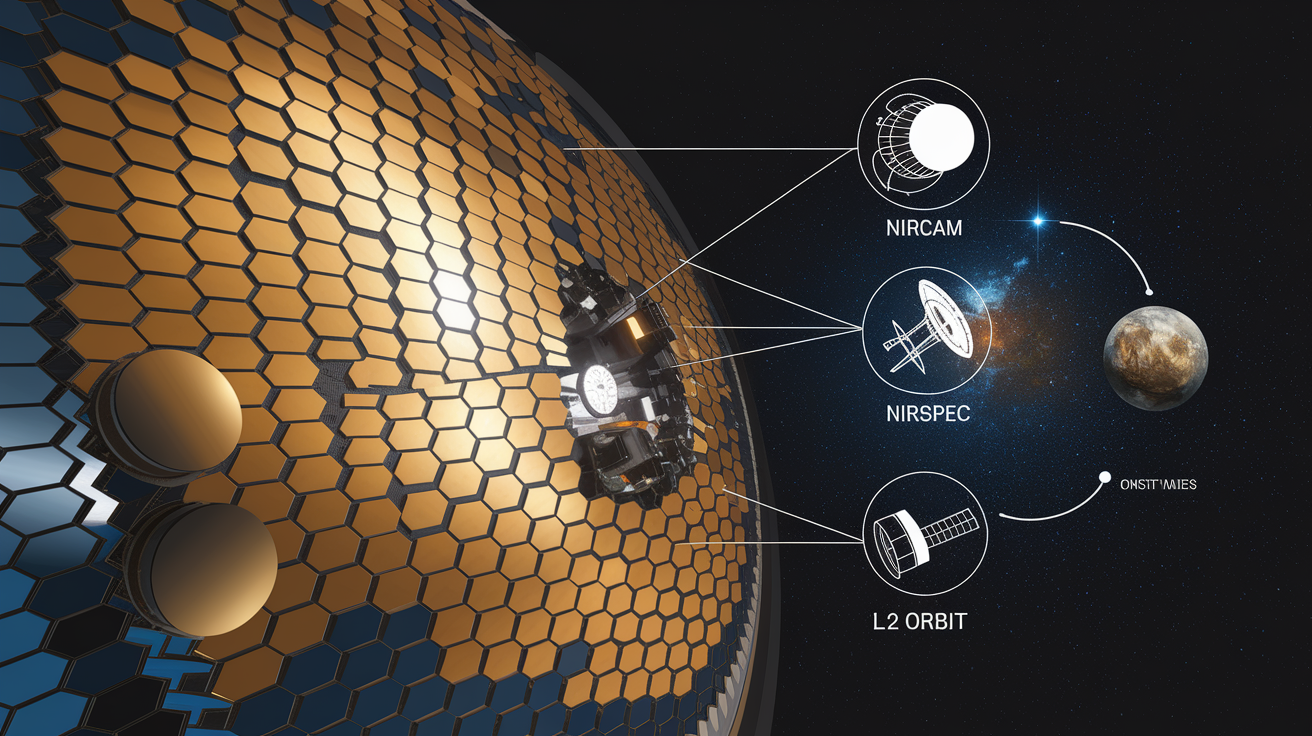
JWST’s 6.6 meter primary mirror, composed of 18 gold coated segments, collects infrared light and feeds it to four science instruments. NIRCam (the Near Infrared Camera) handles imaging and wide field surveys. NIRSpec provides spectroscopy across a broad wavelength range, often using long integrations to capture the faintest signals. MIRI extends coverage into the mid infrared, where warm dust and certain molecules shine brightest. The combination of large mirror area, sensitive detectors, and stable thermal environment at the second Lagrange point (L2, about 1.5 million kilometers from Earth) lets JWST collect photons over hours or days without the sky background overwhelming the signal.
The faintest infrared spectra captured in 2023, those 28 hour integrations on 250 high redshift galaxy candidates, pushed the instruments to their limits. Noise performance, calibration stability, and wavefront sensing all had to stay within tight tolerances. Cycle 2 included ongoing calibration refinements based on early science data, tweaking flat fields, correcting for detector systematics, and validating noise models. For Jupiter, three specialized NIRCam filters were used to image different atmospheric layers. The red filter highlighted lower clouds and upper hazes, the yellow green filter traced polar hazes, and the blue filter penetrated to the deeper main cloud layers. That multi filter approach turned JWST into a three dimensional atmospheric probe.
Instrumental roles supporting 2023 science:
NIRCam imaging enabled wide field deep surveys (JADES, PHANGS) and multi filter mapping of Solar System targets like Jupiter and Uranus.
NIRSpec spectroscopy confirmed high redshift galaxies, measured exoplanet atmospheric compositions, and traced molecular gas in star forming regions.
MIRI mid infrared sensitivity detected warm dust in early galaxies, thermal emission from hot Jupiters, and ring system features in the outer Solar System.
How JWST’s 2023 Science Objectives Shape Future Space Astronomy

The discoveries in 2023 didn’t just check boxes on a to do list. They opened new questions and created tensions with existing models. Massive galaxies appearing 500 to 700 million years after the Big Bang, supermassive black holes with unclear growth pathways, and three bright objects that might be exotic “dark stars” powered by dark matter annihilation all forced theorists to revisit assumptions about early cosmic evolution. In June 2023, JWST detected complex carbon based molecules, similar to compounds found in terrestrial oil and coal, in a galaxy observed more than 12 billion years ago, when the universe was only about 10 percent of its current age. That finding pushed back the timeline for organic molecule formation and raised questions about how dust grains enriched in heavy elements could assemble so quickly.
Some results deepened existing puzzles. JWST observed Cepheid variable stars, classical distance indicators up to 100,000 times brighter than the Sun, to refine measurements of the Hubble constant. Instead of resolving the tension between model based and observation based expansion rates, the 2023 data intensified the debate. The telescope’s precision confirmed earlier measurements but didn’t reconcile them with predictions from the cosmic microwave background and standard cosmological models. That mismatch motivated follow up programs, alternative distance ladder techniques, and closer scrutiny of systematic uncertainties.
Future directions shaped by 2023 results:
Deep field follow ups to confirm more high redshift galaxies, refine mass estimates, and measure star formation histories in the first billion years.
Exoplanet atmospheric surveys expanding molecular catalogs, searching for biosignature gases, and tracking atmospheric variability across multiple epochs.
Supermassive black hole studies targeting early quasars and their host galaxies to constrain seed formation mechanisms and accretion rate limits.
Final Words
Right in the action, JWST spent 2023 pushing deeper: finding very early galaxies and a young active black hole, reading exoplanet atmospheres like K2-18 b, and mapping protostellar outflows and Solar System targets.
Those Cycle 2 efforts leaned on NIRSpec, NIRCam, and MIRI, testing models for galaxy growth, SMBH seeds, and atmospheric chemistry. The main priorities—early-universe surveys, SMBH growth, exoplanet spectra, star-formation mapping, and Solar System composition—were all tackled.
James Webb Telescope 2023 science objectives set a clear path forward, and there’s more good science to come.
FAQ
What were the main scientific objectives of the James Webb Telescope in 2023?
The James Webb Telescope’s 2023 scientific objectives focused on observing the earliest galaxies 390 to 700 million years after the Big Bang, characterizing exoplanet atmospheres including methane and carbon dioxide detections, mapping star formation feedback in molecular clouds, and investigating supermassive black hole growth in the early universe.
How did JWST target early universe observations in 2023?
JWST targeted early universe observations in 2023 through deep-field programs like JADES, which used 28-hour spectroscopic integrations to confirm galaxies at redshift greater than 10, revealing unexpectedly mature structures including bars and spirals only 3.7 billion years after the Big Bang.
What exoplanet atmosphere studies did JWST conduct in 2023?
JWST’s 2023 exoplanet atmosphere studies included transit spectroscopy of K2-18 b, detecting methane and carbon dioxide in just two observations, and expanding molecular inventories for hot Jupiters like WASP-39b using both near-infrared and mid-infrared instruments to characterize atmospheric chemistry.
How does JWST study star formation in molecular clouds?
JWST studies star formation in molecular clouds by mapping infrared structures invisible in optical wavelengths, revealing cavities, bubbles, and 24 protostellar outflows in regions like Carina Nebula, with molecular-line spectroscopy tracking episodic accretion and early disk formation feedback.
What black hole discoveries did JWST make in 2023?
JWST discovered in 2023 one of the earliest active supermassive black holes approximately 570 million years after the Big Bang with a mass around 9 million solar masses, plus two additional early galaxies hosting emerging black holes, challenging models of black hole seed growth.
Which Solar System targets did JWST observe in 2023?
JWST observed Solar System targets in 2023 including Jupiter’s 3,000-mile-wide jet stream at 320 mph, carbon dioxide on Europa’s surface, Saturn’s rings and three moons, and Uranus with 11 visible rings, expanding atmospheric and compositional monitoring capabilities.
How do JWST’s instruments support its 2023 science objectives?
JWST’s instruments support 2023 science objectives through NIRCam’s multi-filter atmospheric imaging, NIRSpec’s 28-hour deep spectroscopic integrations capturing the faintest distant galaxy spectra, and MIRI’s mid-infrared molecular detection, all enabled by the 6.6-meter mirror’s unprecedented infrared sensitivity.
What transmission spectroscopy techniques does JWST use for exoplanets?
JWST uses transmission spectroscopy techniques by measuring starlight filtered through exoplanet atmospheres during transits, with 2023 programs prioritizing sub-Neptunes and hot Jupiters to build chemical inventories and constrain atmospheric structure through wavelength-dependent absorption signatures.
How did JWST’s 2023 discoveries challenge cosmological models?
JWST’s 2023 discoveries challenged cosmological models by revealing massive, mature galaxies 500 to 700 million years after the Big Bang with unexpectedly developed structures, unclear supermassive black hole growth mechanisms, and three dark-star candidates that tension current galaxy-formation timelines.
What role does spectroscopic redshift confirmation play in JWST surveys?
Spectroscopic redshift confirmation plays a critical role in JWST surveys by validating candidate high-redshift galaxies through precise age and mass constraints, with programs like JADES confirming four galaxies at redshift greater than 10 from 250 candidates using deep near-infrared spectroscopy.
How does JWST map protostellar evolution?
JWST maps protostellar evolution by observing 24 protostellar outflows with dense clumps indicating episodic accretion, using infrared sensitivity to reveal hidden feedback structures and molecular hydrogen and carbon monoxide line emissions that trace early disk formation stages.
What future directions emerged from JWST’s 2023 science objectives?
Future directions from JWST’s 2023 science objectives include follow-up observations of deep fields to resolve galaxy-formation tensions, expanded exoplanet atmospheric surveys, investigations of supermassive black hole seed mechanisms, and continued study of dusty early galaxies discovered beyond current model predictions.