

Could a handful of Martian rock cores rewrite our story about life on Mars?
In 2023 Perseverance moved up Jezero’s delta to focus on coarse, carbonate-rich (minerals formed in water), river-laid sediments that are best at locking in fragile organics.
It used SuperCam, SHERLOC, PIXL and its drill to pick, test, and seal samples for a future Mars Sample Return, while MOXIE and Ingenuity proved tech for humans to come.
This post lays out those 2023 science objectives, why the team picked these samples, and what a successful cache would mean for astrobiology and future missions.
Key 2023 Objectives of the Perseverance Rover Mission
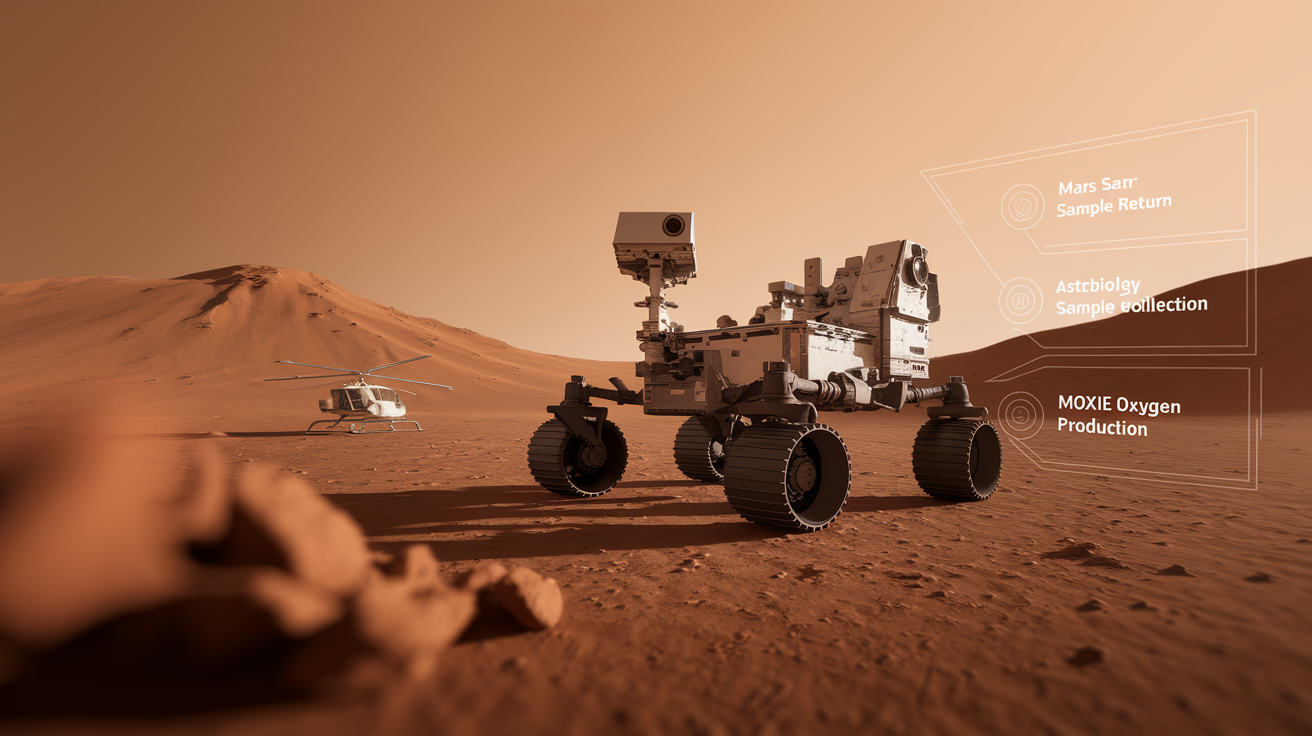
By early 2023, Perseverance had logged more than two years on Mars and moved into a new zone. The focus shifted to the sedimentary fan and upper reaches of Jezero Crater’s ancient delta. That year, the rover zeroed in on a few core things: getting ready for Mars Sample Return, expanding astrobiology work through careful sample collection, and testing tech that future human missions will need. As of March 30, 2023, Perseverance had drilled its 16th rock core. That brought the total to 19 samples and 3 witness tubes, with 10 already sitting in a backup cache on the Martian surface.
The 2023 science campaign marked a shift. Earlier work tackled igneous rocks on the crater floor and fine-grained lakebed sediments. Now the team went after coarse-grained stuff laid down by ancient rivers. This let scientists sample rocks shaped by vigorous water flow, revealing different chapters in Jezero’s water and geology story. Perseverance kept climbing the delta toward a bend called Castell Henllys, moving through terrain that preserved evidence of ancient sediment transport from regions beyond the crater rim.
MOXIE, the oxygen-making experiment, kept running in 2023. It validated in-situ resource use under real Martian conditions. The Ingenuity helicopter scouted routes and flagged scientifically promising spots ahead of the rover’s path. Together, these pieces reinforced Perseverance’s role as a multi-tool platform pushing NASA’s Moon-to-Mars strategy forward, linking sample-return science with tech proving for crewed missions.
Perseverance Rover Sampling Campaign and Rock Targets in 2023
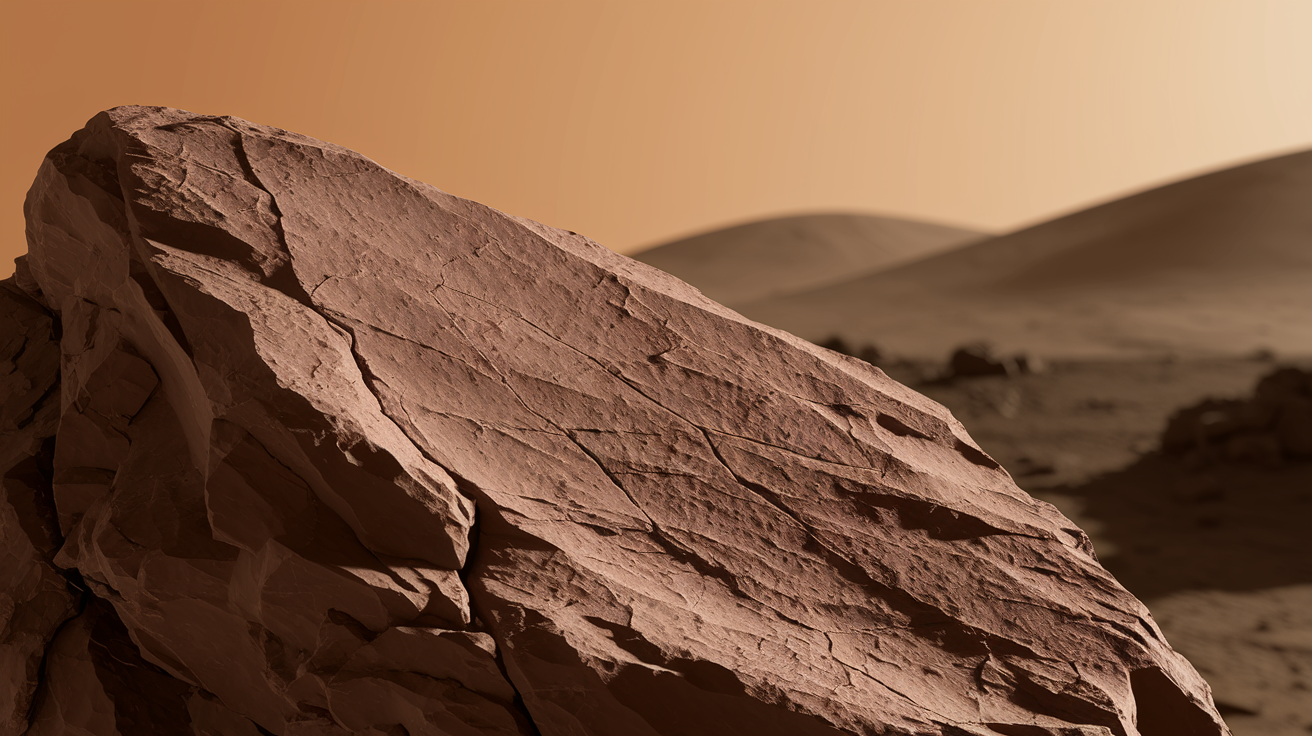
In 2023, Perseverance’s sampling approach evolved. The priority became coarse-grained sedimentary rocks deposited by the ancient river system that once fed Jezero’s lake. This was a deliberate move away from igneous basement rocks on the crater floor and the fine-grained mudstones and siltstones that formed in calm lakebed settings. Climbing the delta fan brought the rover into contact with clasts, pebbles, and sand-sized grains moved by energetic water flow. It opened a window into regional geology and the way sediment traveled across the Martian surface billions of years ago.
One standout was the Berea core, collected March 30, 2023. Berea is carbonate-rich, interpreted as a fluvial deposit carried downstream by the ancient river. It likely came from materials outside Jezero’s interior basin. Its makeup and texture reflect sediment transport over serious distances, preserving fragments of geology that might not be accessible elsewhere in the crater. Analyzing rocks like this helps scientists reconstruct the spatial reach of Mars’ ancient water network and the processes that shaped the landscape when water activity was sustained.
The 2023 rock targets included:
- Coarse-grained fluvial sediments moved by high-energy river flow
- Carbonate-bearing materials formed or altered where liquid water was present
- Conglomerate and sandstone units recording where sediment came from and how far it traveled
- Fine to medium mudstones representing transitional deposition settings
- Layered delta stratigraphy preserving sequential records of environmental change
Stratigraphically, the delta’s upper layers represent the final stages of sediment deposition before Jezero’s lake dried up or drained. By moving upward through these layers, Perseverance sampled a time sequence capturing shifts in water chemistry, flow energy, and sediment source regions. This stratigraphic context is crucial for understanding how Mars went from a wetter, possibly habitable world to the dry, radiation-exposed surface we see today. The rover’s ability to collect cores from different stratigraphic levels within the delta provides a layered geological archive. Each sample documents a distinct interval in the crater’s environmental history.
Astrobiology Research and Biosignature Detection Goals for 2023
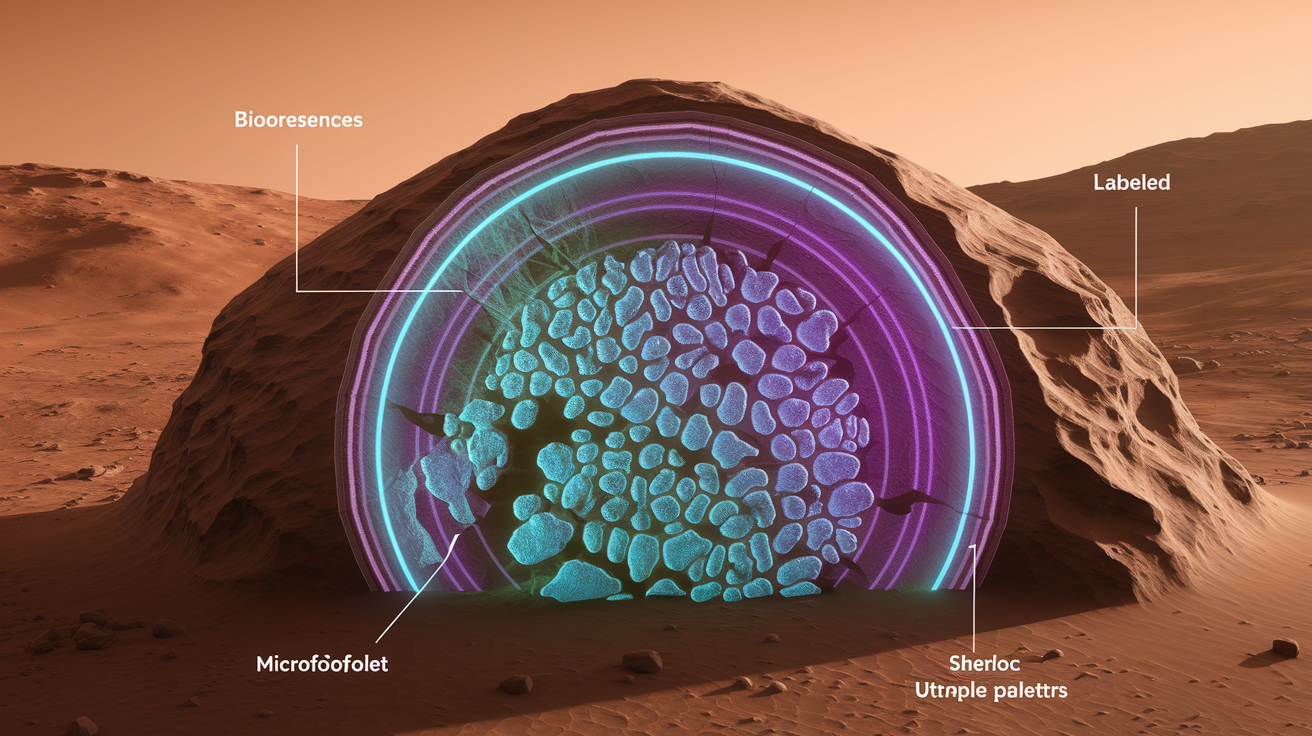
The 2023 science campaign put a strong emphasis on astrobiology. Specifically, the search for chemical, textural, or mineralogical evidence that ancient microbial life once existed in Jezero. The rover’s shift to sampling river-transported sediments and carbonate-bearing rocks came from the hypothesis that these materials offer higher preservation potential for biosignatures compared to igneous or heavily weathered rocks. Ancient microbial life, if it existed on Mars, would’ve needed liquid water, energy sources, and stable chemical conditions. Jezero’s delta and lakebed environment likely met those criteria during the Noachian and early Hesperian periods.
Carbonate minerals are especially valuable for biosignature preservation. They precipitate from water and can lock in organic molecules, microbial textures, and stable isotope ratios that reflect biological activity. On Earth, carbonate rocks preserve fossilized stromatolites, microbial mats, and chemical signatures of ancient ecosystems. The Berea sample and similar carbonate-rich cores collected in 2023 were prioritized because their mineral structure can protect fragile organic compounds from degradation by radiation and oxidation over billions of years. If Mars hosted life, the geochemical fingerprints would most likely survive in environments where carbonates formed and stayed sealed within sedimentary layers.
Perseverance’s astrobiology objectives in 2023 went beyond simple detection of organics. The mission looked at habitability, whether the environments sampled had the chemical ingredients, energy fluxes, and physical stability necessary to support life. This included searching for redox-sensitive minerals, sulfates, clays, and other indicators of aqueous chemistry that could’ve sustained microbial metabolisms. By sampling rocks shaped by flowing water and deposited in diverse microenvironments, Perseverance increased the odds of encountering preservation settings where biosignatures, if present, could still be detected.
Techniques for Identifying Organics
Perseverance uses a suite of spectroscopic tools to identify organic molecules and assess preservation conditions in sampled rocks before cores get sealed and stored. SHERLOC, the rover’s Raman and fluorescence spectrometer, can detect aromatic and aliphatic organic compounds by their molecular vibrations and fluorescence response when hit with ultraviolet light. This lets mission scientists map organic distribution across rock surfaces and figure out whether organics concentrate in specific mineral phases or textures.
Carbonate minerals like calcite and siderite offer especially good conditions for preserving organics. They form at near-neutral pH in aqueous environments, and their crystal lattices can encapsulate and shield organic molecules from destructive surface chemistry. When SHERLOC detects organic signatures co-located with carbonate grains, it strengthens the case that those organics were incorporated during mineral formation rather than introduced by later contamination or meteoritic infall. This context is critical for biosignature interpretation. Knowing where and how organics are preserved helps distinguish biological from abiotic sources.
Perseverance Instruments Supporting 2023 Scientific Objectives
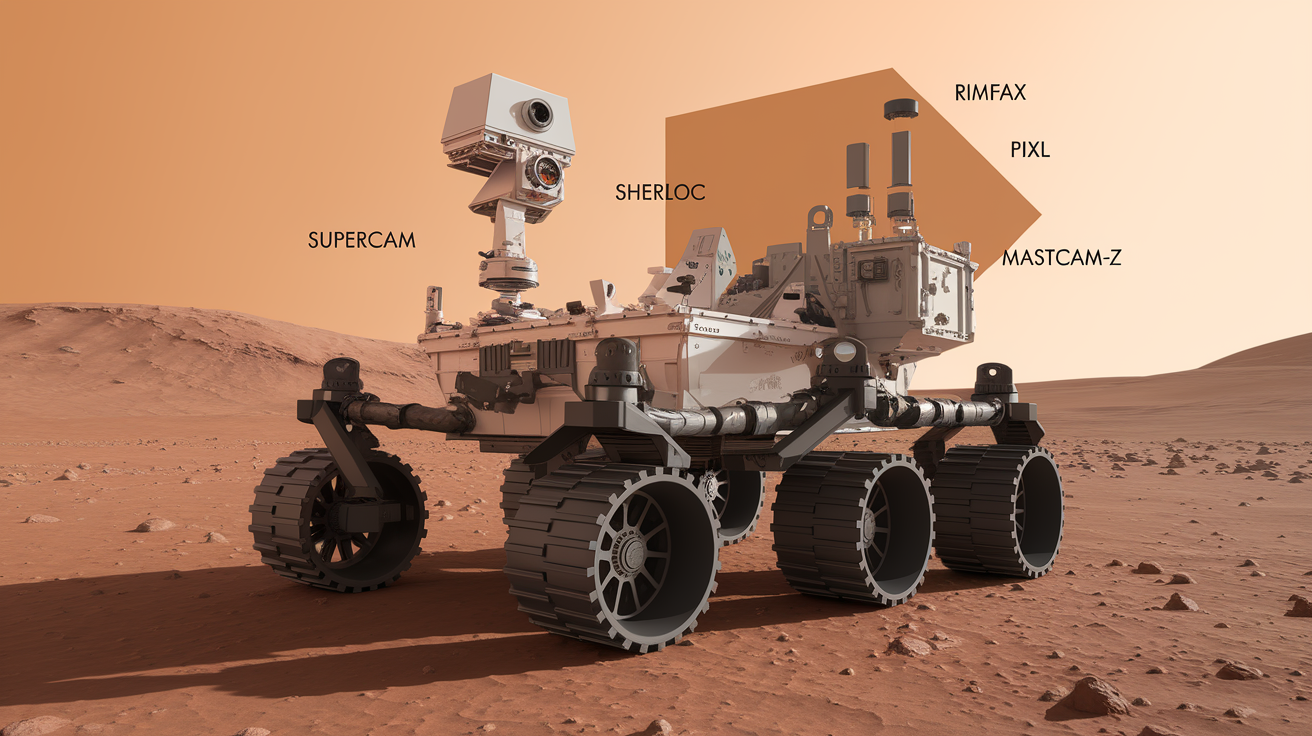
Perseverance’s science instruments form an integrated analytical system designed to characterize rock targets at scales ranging from centimeters to micrometers, guiding both daily operations and long-term sample selection. In 2023, these tools were essential for identifying carbonate-rich sediments, mapping elemental chemistry, and assessing textural properties of rocks before drilling and caching cores.
SuperCam
SuperCam uses laser-induced breakdown spectroscopy (LIBS) to vaporize tiny rock fragments and analyze the resulting plasma to determine elemental composition. During the 2023 delta ascent, SuperCam fired thousands of laser shots at candidate targets, measuring the abundance of carbon, calcium, magnesium, iron, and other elements to identify carbonate minerals and assess rock chemistry from a distance. This remote-sensing capability lets the rover screen dozens of targets per week without physical contact, narrowing down the most scientifically valuable rocks for closer inspection. SuperCam also includes Raman and infrared spectroscopy modes, which provide additional mineral identification and can detect organic molecular bonds in ideal conditions.
SHERLOC
SHERLOC is a deep-ultraviolet Raman and fluorescence spectrometer mounted on the rover’s robotic arm. It maps the spatial distribution of organic molecules and minerals at sub-millimeter resolution, creating detailed compositional maps of rock surfaces. In 2023, SHERLOC was used extensively to examine fine-grained textures in delta sediments, searching for organic hotspots that might indicate biosignature preservation. The instrument’s ability to detect both organics and their mineral host phases simultaneously makes it critical for understanding how potential biosignatures are locked into rock structures and whether those organics are indigenous to the rock or contaminants.
PIXL
PIXL is an X-ray fluorescence instrument that measures elemental chemistry at the scale of individual mineral grains. By rastering its X-ray beam across polished rock surfaces, PIXL generates high-resolution elemental maps showing where calcium, magnesium, iron, sulfur, and other elements concentrate. In 2023, PIXL data helped identify carbonate veins, sulfate patches, and clay-bearing layers within the delta stratigraphy, providing chemical context for the environments where these rocks formed. PIXL’s precision also lets mission scientists target the most chemically interesting zones for coring, getting the most scientific return from each sample.
RIMFAX and Mastcam-Z
RIMFAX is a ground-penetrating radar that images subsurface layering to depths of about ten meters, revealing stratigraphy hidden beneath dust and weathering rinds. As Perseverance climbed the delta in 2023, RIMFAX helped map sedimentary layers, identify buried contacts between rock units, and guide traverse planning toward areas with intact, undisturbed stratigraphy. Mastcam-Z, a stereoscopic imaging system, provides high-resolution color and multispectral images used to document geologic context, measure sedimentary structures, and identify targets for spectroscopic follow-up. Together, RIMFAX and Mastcam-Z offer the spatial and stratigraphic framework within which all other instrument data are interpreted.
| Instrument | Primary Technique | 2023 Contribution |
|---|---|---|
| SuperCam | Laser-induced breakdown spectroscopy (LIBS), Raman, infrared | Remote elemental analysis and carbonate identification |
| SHERLOC | Deep-UV Raman and fluorescence spectroscopy | High-resolution organic and mineral mapping on abraded targets |
| PIXL | X-ray fluorescence microscopy | Grain-scale elemental chemistry and carbonate vein characterization |
| RIMFAX & Mastcam-Z | Ground-penetrating radar and stereo imaging | Subsurface stratigraphy and contextual documentation for sampling |
Sample Collection, Tube Sealing, and the Mars Sample Return Link in 2023
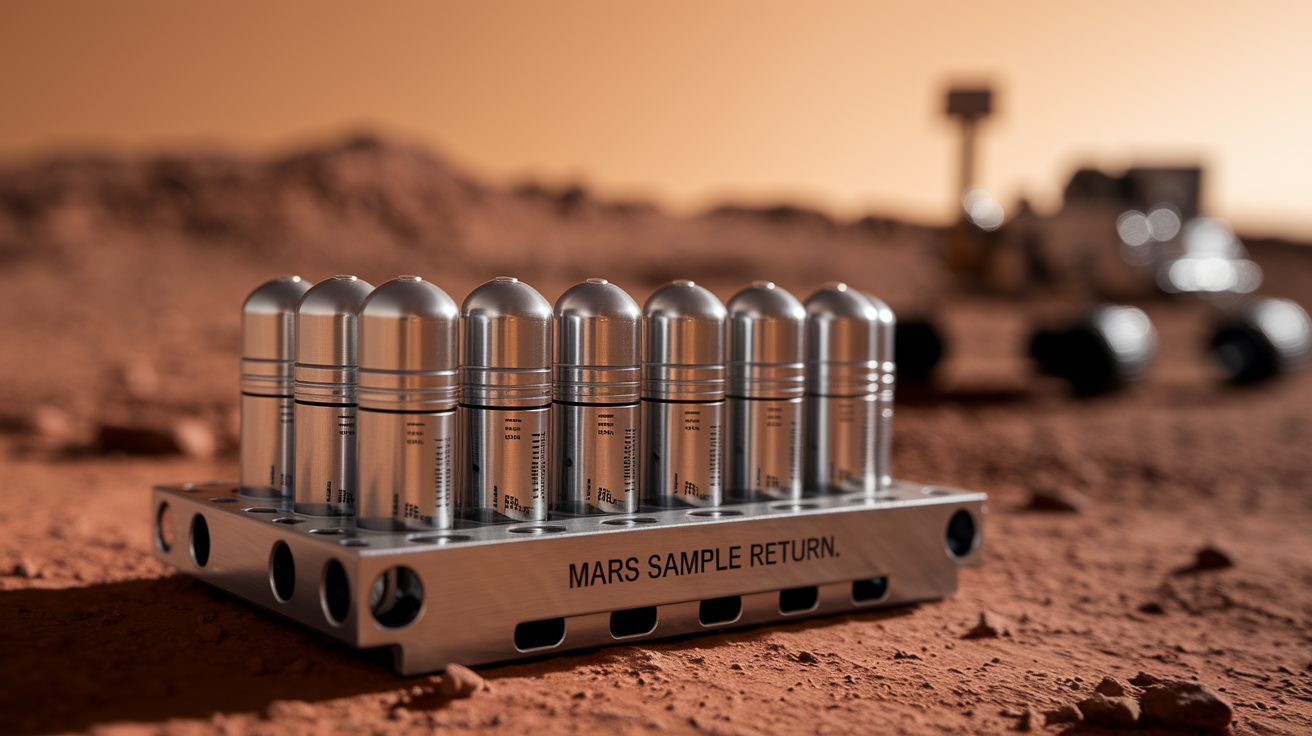
Perseverance’s sample-collection setup directly supports the multi-mission NASA-ESA Mars Sample Return campaign, which intends to bring Martian rocks and soil back to Earth for detailed lab analysis. Each core collected in 2023 was sealed in an ultra-clean titanium tube designed to prevent contamination and preserve the rock’s chemistry, mineralogy, and potential organic content until it can be studied with instruments far more sensitive than those aboard the rover. By early 2023, the rover had accumulated 19 samples and 3 witness tubes, with 10 tubes deposited at a backup cache site on the Martian surface to ensure redundancy in case the rover can’t deliver its primary cache to a future lander.
The Berea core and other 2023 samples stay stored in the rover’s belly, awaiting integration into the planned sample-retrieval sequence. These cores represent a curated collection of rocks spanning igneous basement, lakebed mudstones, and river-deposited carbonates, offering future scientists a cross-section of Jezero’s geological and environmental history. The Mars Sample Return architecture envisions a lander touching down near Perseverance in the early 2030s, retrieving the sample tubes, launching them into Mars orbit, and transferring them to an Earth-return spacecraft built by ESA. This multi-decade, multi-agency effort hinges on the quality and scientific diversity of the samples Perseverance is collecting now.
| Sample Type | Science Goal | Status in 2023 |
|---|---|---|
| Igneous crater-floor rocks | Radiometric age dating and early Mars volcanism | Collected in 2021-2022; cached onboard and in depot |
| Fine-grained lakebed sediments | Organic preservation and aqueous geochemistry | Collected in 2022; stored in primary cache |
| Carbonate-bearing fluvial deposits | Biosignature potential and climate archive | Actively collected in 2023; includes Berea core |
| Witness tubes and atmospheric samples | Contamination monitoring and Mars atmosphere composition | Three witness tubes sealed; maintained for return analysis |
MOXIE Oxygen Production and 2023 In-Situ Resource Utilization Results
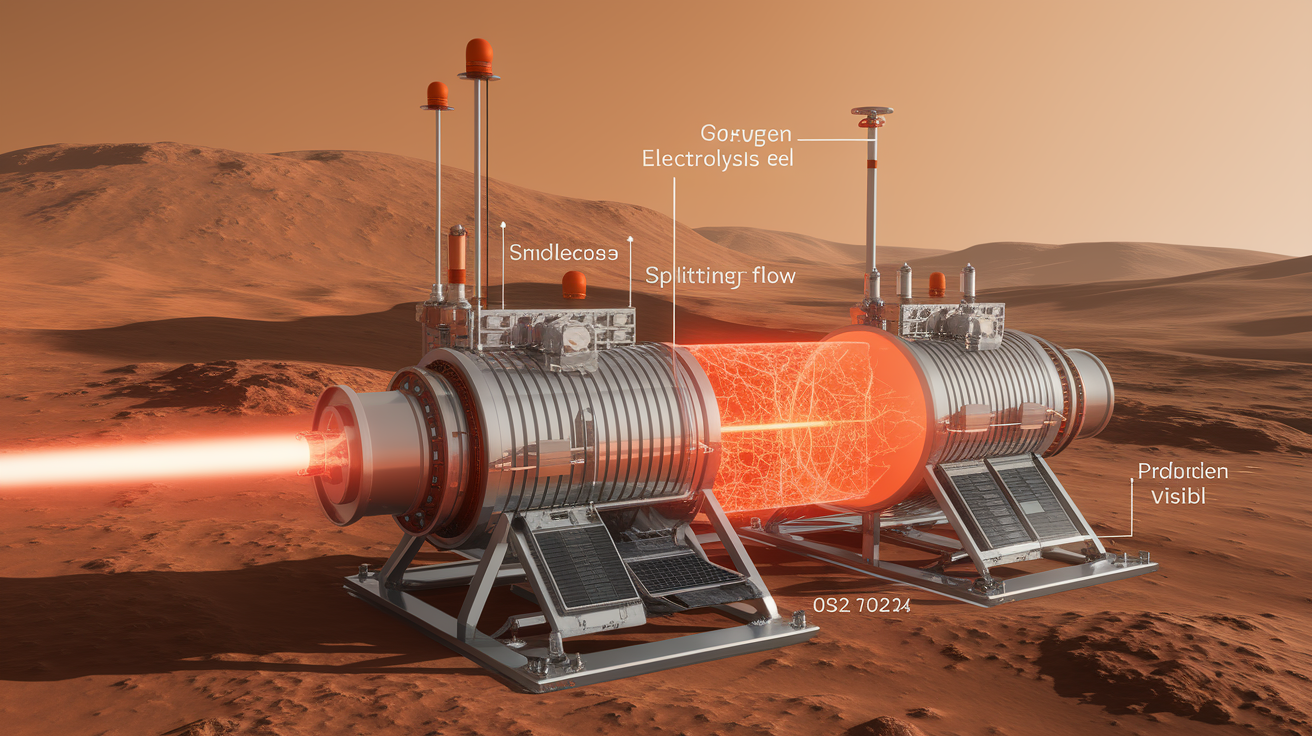
MOXIE, the Mars Oxygen In-Situ Resource Utilization Experiment, continued to demonstrate stable oxygen production from atmospheric carbon dioxide throughout 2023, validating the tech needed for future human missions that’ll require locally sourced propellant and breathing air. The instrument operates by drawing in Martian air, heating it to approximately 800°C, and using solid oxide electrolysis to strip oxygen atoms from CO₂ molecules. The freed oxygen is stored temporarily and measured, while carbon monoxide byproduct is vented back into the atmosphere.
During 2023, MOXIE ran multiple production cycles under varying environmental conditions, including different seasons, atmospheric densities, and dust loadings. These runs confirmed that the system can operate reliably across the range of conditions a future large-scale oxygen plant would encounter. Each successful run moved MOXIE closer to meeting its performance benchmarks and provided engineering data that’ll inform the design of scaled-up systems capable of producing tons of oxygen per year, enough to refuel ascent vehicles and support crew life support during extended surface stays.
Key operational capabilities validated by MOXIE in 2023 included:
- Sustained oxygen production rates sufficient to meet instrument design targets
- Stable performance across seasonal atmospheric pressure variations
- Resilience to dust ingestion and thermal cycling between Martian day and night
- Autonomous operation with minimal rover intervention, demonstrating reliability for future uncrewed or crew-support deployments
Ingenuity Helicopter Support for Perseverance’s 2023 Science Campaign

Ingenuity, originally designed as a five-flight tech demonstrator, transitioned into an operational reconnaissance platform supporting Perseverance’s delta ascent in 2023. Flying ahead of the rover, Ingenuity surveyed potential routes, imaged terrain features too hazardous or distant for ground-based inspection, and identified scientifically interesting outcrops that warranted closer examination. This aerial perspective let mission planners optimize traverse efficiency, avoid unnecessary detours, and prioritize high-value targets before committing the rover to weeks of driving.
One practical example from 2023 involved scouting the approach to Castell Henllys, where Ingenuity’s aerial images revealed layered sedimentary exposures and potential carbonate-rich zones that guided Perseverance’s sampling strategy. By capturing high-resolution stereo imagery from altitudes of 10 to 15 meters, the helicopter provided geologic context that would’ve taken the rover days or weeks to gather from the ground. This synergy between aerial and surface exploration represents a new way to run planetary missions, where rotorcraft act as force multipliers, extending the scientific reach and situational awareness of wheeled rovers.
2023 Mission Timeline, Discoveries, and Next Steps for the Perseverance Rover
The first quarter of 2023 saw Perseverance steadily climbing the delta fan, navigating boulder fields and steep slopes while conducting continuous spectroscopic surveys. Dust devils and seasonal winds occasionally obscured targets and required mission planners to adjust imaging schedules, but the rover’s autonomous navigation system let it make steady progress toward Castell Henllys. Instrument health remained strong, with all science payloads functioning within nominal parameters and sample-tube sealing mechanisms operating reliably.
By mid-year, the rover had expanded its sample inventory to include multiple carbonate-rich cores, strengthening the astrobiology case for Jezero’s ancient habitability. Ground teams analyzed data from SuperCam, SHERLOC, and PIXL to refine models of the delta’s depositional history, identifying distinct sedimentary facies that recorded shifts in water flow, chemistry, and sediment provenance. These findings fed into ongoing Mars Sample Return planning, helping mission architects understand which rocks would offer the highest scientific return once brought back to Earth.
Looking ahead, Perseverance’s traverse plan called for continued ascent toward the upper delta and eventual exploration of the crater rim, where ancient rocks from Mars’ crust might be exposed. Each new sample, each instrument scan, and each sol of exploration added layers of understanding to the story of Jezero and, by extension, the broader question of whether Mars once supported life.
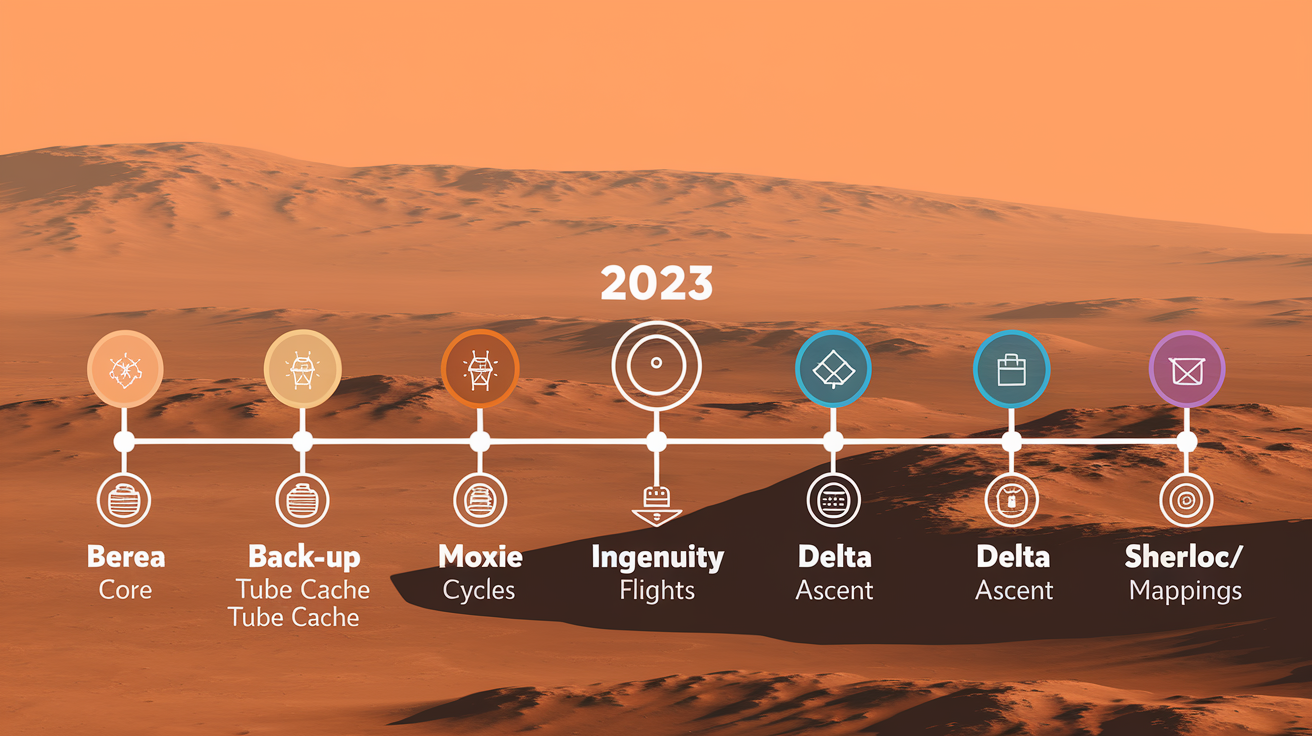
Key events in the 2023 timeline included:
- Collection of the Berea core on March 30, marking the 16th cored rock sample and expanding the carbonate archive.
- Deposition of the 10-tube backup cache, completing a critical Mars Sample Return redundancy milestone.
- Progression of MOXIE oxygen-production runs under diverse atmospheric conditions, validating in-situ resource use for future crewed missions.
- Ingenuity reconnaissance flights supporting route planning and target identification during the delta ascent.
- Spectroscopic mapping campaigns using SHERLOC and PIXL to identify organic hotspots and carbonate veins in sedimentary layers.
- Continued RIMFAX ground-penetrating radar surveys revealing subsurface stratigraphy and guiding traverse decisions toward scientifically intact rock units.
Final Words
In the action, Perseverance kept climbing Jezero’s delta, taking targeted cores, guiding Ingenuity, and running MOXIE tests. It pushed sample collection and caching forward while mapping the ascent.
By March 30, 2023 the rover had sealed 19 samples plus 3 witness tubes, kept a 10-tube backup depot, and added new cores for Mars Sample Return. It’s a steady, careful campaign of fieldwork on another planet.
These Perseverance rover 2023 science objectives move MSR and human mission prep ahead. Small steps, big payoff. Hopeful stuff.
FAQ
Q: What were Perseverance’s main objectives in 2023?
A: Perseverance’s main objectives in 2023 were ascending the Jezero delta, expanding sample collection, supporting Ingenuity reconnaissance, running MOXIE oxygen demonstrations, and advancing work for the Mars Sample Return campaign.
Q: How many samples had Perseverance collected by early 2023 and what was the depot status?
A: By March 30, 2023 Perseverance had 19 collected samples plus 3 witness tubes, with 10 tubes deposited as a backup cache and additional cores sealed onboard for return.
Q: How did the rover’s sampling strategy change during 2023?
A: The rover’s 2023 sampling strategy shifted from crater‑floor igneous and fine lakebed deposits toward coarser sediments carried by ancient rivers, including the Berea core sourced from outside Jezero.
Q: How did Ingenuity support Perseverance’s 2023 science campaign?
A: Ingenuity supported the 2023 campaign by flying reconnaissance missions that scouted routes, identified sampling‑relevant terrain features, and helped plan safer, more efficient rover traverses during the delta ascent.
Q: What did MOXIE achieve in 2023?
A: MOXIE in 2023 demonstrated stable oxygen production from Mars’s CO2 across different environmental conditions, validating operational modes and strengthening its role for future crewed‑mission resource plans.
Q: What roles do SuperCam, SHERLOC, PIXL, RIMFAX, and Mastcam‑Z play in 2023 science?
A: Those instruments together guide sampling: SuperCam provides remote laser chemistry, SHERLOC uses Raman and fluorescence for organics, PIXL gives X‑ray chemistry, while RIMFAX and Mastcam‑Z map context and structure.
Q: How does 2023 sampling connect to the Mars Sample Return effort?
A: 2023 sampling connects to Mars Sample Return by sealing and storing cores onboard, depositing a 10‑tube backup cache on the surface, and preparing selected samples for future NASA‑ESA pickup.
Q: What rock classes did Perseverance target in 2023?
A: In 2023 Perseverance targeted crater‑floor igneous rocks, fine‑grained lakebed deposits, coarse river‑transported sediments, delta stratigraphic units, and regionally transported material like the Berea sample.
Q: What techniques does Perseverance use to identify organic materials?
A: Perseverance uses spectroscopy—Raman, fluorescence, laser‑induced breakdown, and X‑ray methods—alongside targeted sampling; minerals such as carbonates can favorably trap and preserve organic signals.
Q: What were the next steps and timeline after early 2023?
A: After early 2023 Perseverance kept climbing the delta toward Castell Henllys, planned upstream river‑deposit sampling, collected more cores, and readied samples and traverses to support upcoming MSR activities.