

Meteor shower names tell you exactly where to look in the sky.
They’re not poetic labels.
They come from the constellation that holds the radiant (the spot meteors seem to spread from).
This guide explains how names are picked, why that naming helps observers, and what the big ones, Perseids, Geminids, Leonids, really mean for a viewing night.
You’ll also get peak dates, typical hourly rates, and the parent comet or asteroid for each shower so planning a clear-sky session is easy.
Comprehensive Overview of Meteor Shower Names and Their Official Designations

Meteor showers get their names from the constellation that holds their radiant, the spot in the sky where all the meteor streaks seem to come from. It’s a perspective thing. When Earth cuts through a debris stream left behind by a comet or asteroid, those particles burn up in our atmosphere. The meteors all look like they’re shooting out from one point, even though the particles themselves are moving on nearly parallel paths through space.
That point sits inside a constellation, and that’s what you call the shower. Radiant in Perseus? Perseids. Radiant in Gemini? Geminids.
This system makes it simple to tell observers where to look and helps confirm whether a streak belongs to a particular shower or is just a random sporadic meteor. Most big annual showers follow this constellation-based pattern. A handful use older names tied to constellations astronomers don’t officially recognize anymore, but the logic stays the same: wherever the radiant sits at peak activity, that’s what the shower’s called.
The names you’ll see on observing calendars every year each come with a documented peak date, a typical meteors-per-hour rate (usually listed as Zenithal Hourly Rate, or ZHR), and a known parent comet or asteroid. Here are the major ones:
Quadrantids – Named after the defunct constellation Quadrans Muralis. Peaks early January with rates around 110 meteors per hour.
Lyrids – Radiant in Lyra. Peaks around April 22, typically 15 to 20 meteors per hour.
Eta Aquariids – Radiant near the star Eta Aquarii. Peaks early May, rates around 50 per hour.
Delta Aquariids – Radiant near Delta Aquarii. Peaks late July, around 25 per hour.
Perseids – Radiant in Perseus. Mid-August peak with rates over 100 per hour. One of the year’s most reliable shows.
Draconids – Radiant in Draco. Early October peak, usually below 10 per hour but capable of rare outbursts.
Orionids – Radiant in Orion. Late October, around 20 per hour.
Northern Taurids – Radiant in Taurus. Mid-November, low rates around 5 per hour but known for fireballs.
Southern Taurids – Also in Taurus. Early November, similar low rates, same fireball potential.
Leonids – Radiant in Leo. Mid-November, typical rates 10 to 15 per hour. Historically capable of meteor storms.
Geminids – Radiant in Gemini. Mid-December, rates of 120 to 150 per hour. One of the strongest Northern Hemisphere showers.
Ursids – Radiant in Ursa Minor. Around December 22, typical rates 5 to 10 per hour.
How Meteor Shower Names Are Chosen Using Constellation Radiants

The naming convention comes straight from where the radiant sits. When you trace meteor paths backward during a shower, they all seem to spread out from one point. It’s like railroad tracks appearing to meet at the horizon, a perspective trick. The debris particles are actually traveling on nearly parallel paths, but from where we’re standing on Earth, they fan out from a single spot.
Astronomers identify the constellation containing that radiant at the shower’s peak, and that constellation gives the shower its name. Lyrids radiate from Lyra, Draconids from Draco, Leonids from Leo. It’s straightforward and helps observers confirm they’re seeing shower meteors instead of random ones. If a trail doesn’t trace back to the expected radiant, it’s not part of that shower.
Key examples:
Perseids – Radiant in Perseus, visible after midnight, rising in the northeast.
Geminids – Radiant in Gemini, rising in the early evening during December.
Orionids – Radiant in Orion, highest around 2 a.m. in late October.
Eta Aquariids – Radiant near the star Eta Aquarii in Aquarius, better for southern latitudes.
Ursids – Radiant in Ursa Minor near the North Star, circumpolar at northern latitudes.
Obsolete and Alternative Names
The Quadrantids are named after Quadrans Muralis, a constellation introduced in the late 1700s that the International Astronomical Union doesn’t recognize anymore. The radiant sits in what’s now considered part of Boötes, but the shower kept its historical name. The Draconids are sometimes called the Giacobinids, after comet 21P/Giacobini-Zinner that produces the debris stream. You’ll see both names in observing guides, though Draconids is more common now.
Major Annual Meteor Shower Names and Their Peak Dates
Major meteor showers follow a predictable yearly calendar. Earth passes through the same debris streams at the same time every year. Observers plan around these peak dates, when rates are highest and the radiant’s well placed. Some years the moon’s phase cooperates, other years bright moonlight kills the view.
The timing ties directly to Earth’s orbit. As we move around the Sun, we hit different debris trails at specific points. That’s why the Perseids always peak mid-August and the Geminids always peak mid-December. The exact peak time can shift by a few hours year to year, but the general date window holds steady.
| Meteor Shower Name | Peak Date | Typical Peak Rate | Radiant Constellation |
|---|---|---|---|
| Quadrantids | January 4 | ~110 meteors/hour | Boötes (Quadrans Muralis) |
| Lyrids | April 22 | ~15–20 meteors/hour | Lyra |
| Eta Aquariids | May 6 | ~50 meteors/hour | Aquarius |
| Delta Aquariids | July 31 | ~25 meteors/hour | Aquarius |
| Perseids | August 13 | ~100+ meteors/hour | Perseus |
| Draconids | October 9 | ~10 meteors/hour | Draco |
| Orionids | October 21 | ~20 meteors/hour | Orion |
| Northern Taurids | November 12 | ~5 meteors/hour | Taurus |
| Leonids | November 17 | ~10–15 meteors/hour | Leo |
| Geminids | December 14 | ~120–150 meteors/hour | Gemini |
| Ursids | December 22 | ~5–10 meteors/hour | Ursa Minor |
Several major showers cluster in late summer and early winter. The Perseids in mid-August and the Geminids in mid-December anchor the calendar, offering the highest and most reliable rates for Northern Hemisphere observers. Spring brings the Lyrids and Eta Aquariids, autumn features the Orionids, Draconids, and Leonids. The Quadrantids kick off the year in early January with a sharp, brief peak that requires careful timing.
Parent Comets and Asteroids Behind Meteor Shower Names
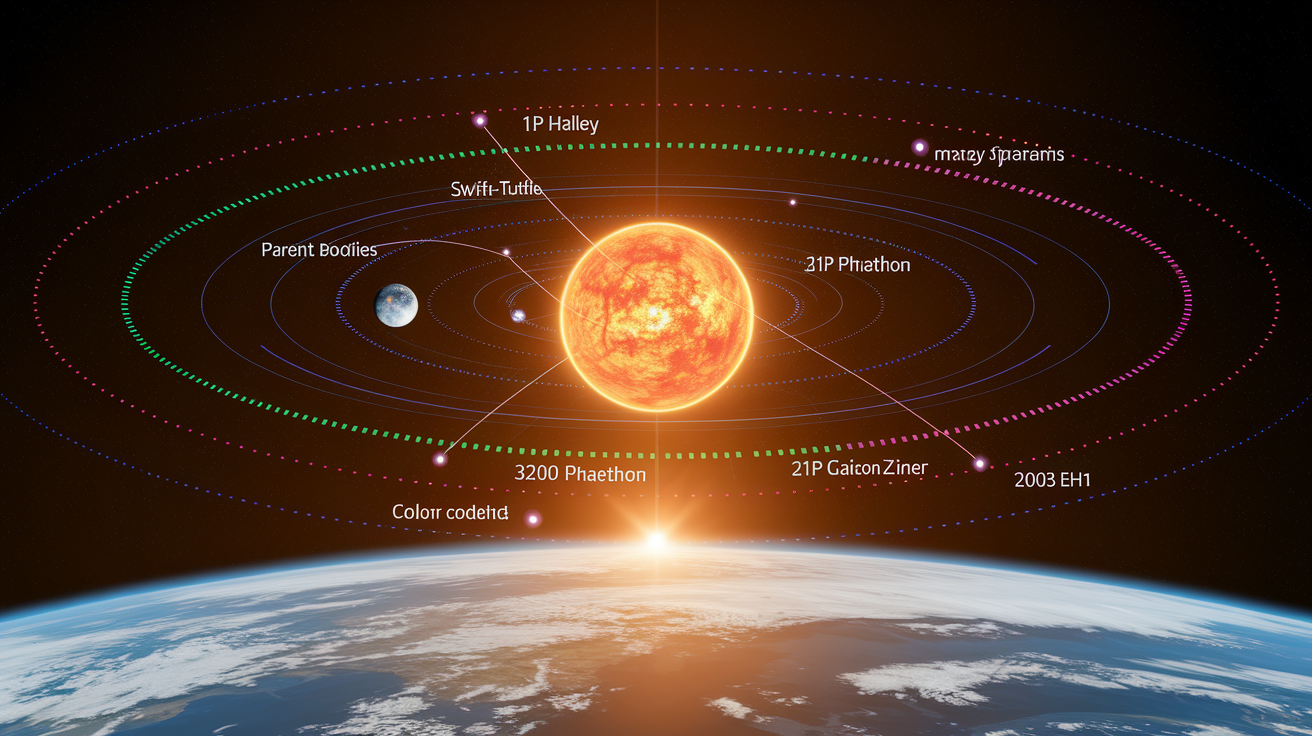
Every meteor shower comes from a parent body, a comet or asteroid that’s shed debris along its orbit. When Earth crosses that debris trail, the particles enter our atmosphere and burn up. The parent body’s orbital period and physical traits shape the shower’s behavior: meteor speed, brightness, how dense the debris stream is.
Some showers link to well-known comets. The Perseids come from comet 109P/Swift-Tuttle, a large object with a nucleus about 26 kilometers across and an orbital period of roughly 133 years. The Orionids and Eta Aquariids both come from Halley’s Comet, which orbits the Sun every 75 to 76 years and last visited the inner solar system in 1986. The Leonids are tied to comet 55P/Tempel-Tuttle, a 33-year orbit and a nucleus about 3 kilometers across.
Not all showers trace back to comets. The Geminids come from 3200 Phaethon, an object classified as an asteroid but sometimes called a “rock comet” because it acts like one. Phaethon has an orbital period of just 524 days and a highly elliptical orbit that brings it extremely close to the Sun, heating its surface to an estimated 730°C at perihelion. The Quadrantids might come from an extinct comet, now cataloged as asteroid 2003 EH1.
Perseids – Parent comet 109P/Swift-Tuttle. 26 km nucleus, 133-year orbit.
Geminids – Parent asteroid 3200 Phaethon. 524-day orbit, surface reaches around 730°C at perihelion.
Lyrids – Parent comet C/1861 G1 (Thatcher). Roughly 415-year orbit, last visited 1861, next return around 2283.
Orionids and Eta Aquariids – Both from Halley’s Comet (1P/Halley). 75 to 76 year orbit, last seen 1986, next return 2061.
Leonids – Parent comet 55P/Tempel-Tuttle. About 3 km nucleus, 33-year orbit, capable of producing meteor storms.
Draconids – Parent comet 21P/Giacobini-Zinner. Known for occasional outbursts when Earth crosses dense debris filaments.
Minor and Lesser-Known Meteor Shower Names
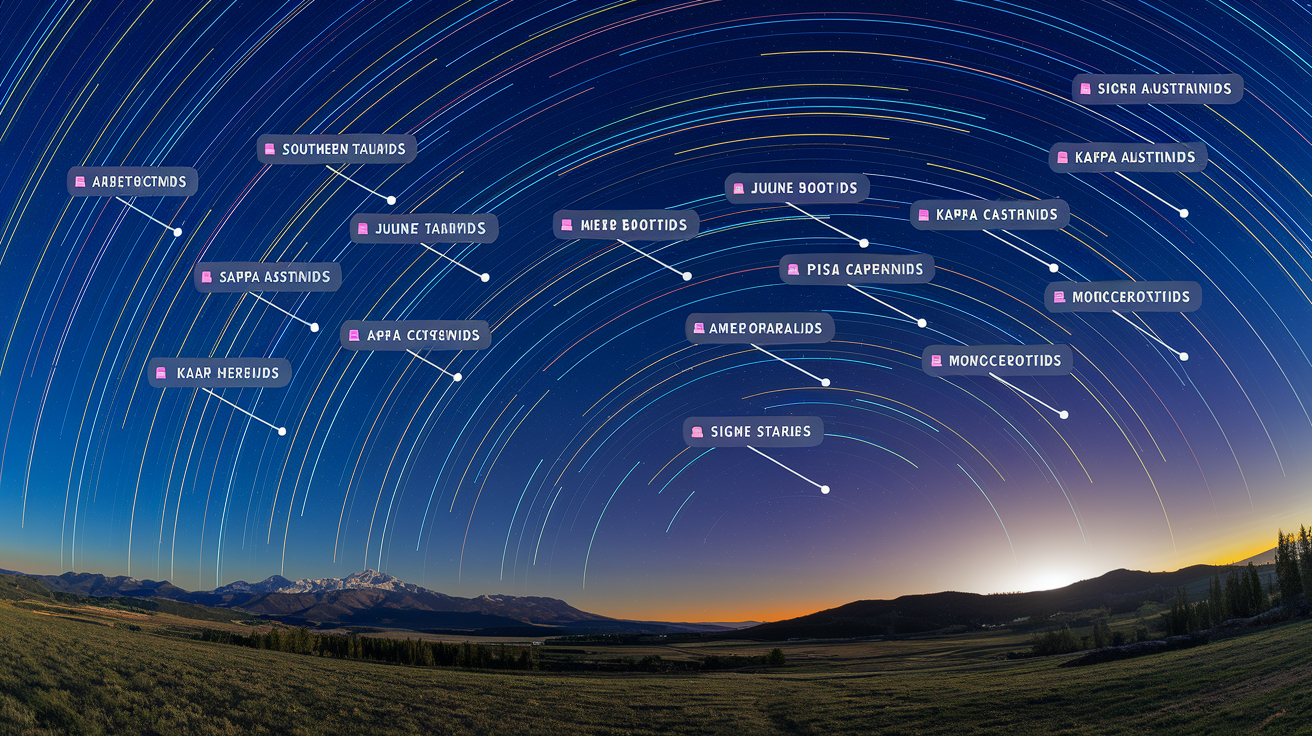
Beyond the major annual showers, dozens of minor meteor showers happen throughout the year. Some are visible only from specific hemispheres, some produce very low rates, and a few are daytime showers detectable only by radar or radio. These lesser-known showers fill in the calendar and occasionally surprise observers with unexpected activity.
Daytime showers like the Arietids peak when their radiant is above the horizon during daylight. The Arietids, active from late May through early July, have a radiant in Aries that rises around sunrise. Radar observations suggest rates of 60 to possibly 200 meteors per hour, but visual observers can only catch them in the brief dark window before dawn by watching the eastern sky. Other minor showers produce such low rates or have such faint meteors that they’re hard to tell apart from sporadic background activity.
Arietids – Daytime shower peaking around June 10. Radar-detected rates of around 60 to 200/hour, radiant in Aries.
Southern Taurids – Overlaps with Northern Taurids in autumn, radiant in Taurus, low rates but fireball potential.
June Bootids – Rare, low-rate shower from Boötes, capable of occasional brief outbursts.
Phoenicids – Southern Hemisphere shower in early December, radiant in Phoenix, low rates, rare outbursts.
Kappa Cygnids – Active in mid-August, radiant in Cygnus, very low rates, produces occasional fireballs.
Piscis Austrinids – Southern shower in late July, radiant in Piscis Austrinus, low rates.
Alpha Capricornids – Active late July into August, radiant in Capricornus, low rates but known for bright, slow fireballs.
Camelopardalids – Rare, unpredictable shower in May, radiant in Camelopardalis, produced a brief outburst in 2014.
Sigma Hydrids – Southern Hemisphere shower in December, radiant in Hydra, low rates.
Monocerotids – Rare, short-duration outburst shower, radiant in Monoceros, capable of brief, intense activity.
Naming Etymology: Mythology, Latin Roots, and Historical Meteor Shower Names
Meteor shower names carry the legacy of ancient astronomy and the Latin used in star cataloging. Most constellation names come from Greek and Roman mythology, so the showers named after them inherit that mythological flavor. Perseus, the hero who slew Medusa, gives his name to the Perseids. Leo, the lion, gives us the Leonids. Gemini, the twins Castor and Pollux, provides the name for the Geminids.
The Latin genitive case shows up in formal astronomical names. “Eta Aquariids” refers to meteors radiating from near the star Eta Aquarii, Aquarii being the genitive form of Aquarius. This grammatical structure appears across many shower names, especially those tied to specific stars rather than general constellation areas. It’s a holdover from how astronomers historically cataloged celestial objects.
Meteor shower names entered the scientific record in the 19th century, when careful observers began documenting recurring annual meteor activity. The Leonid meteor storms of 1833 and 1866 drew widespread attention and prompted systematic study. Those early records cemented names like Leonids and Perseids in the literature. Some showers have been known for centuries under various names, but standardization came as observational astronomy became more organized and international collaboration increased.
Meteor Shower Name Variations, Abbreviations, and Cataloging Standards

The International Meteor Organization (IMO) maintains an official working list of established meteor showers, assigning each a unique three-letter code and cataloging its radiant coordinates, active dates, and parent body when known. This standardized approach helps researchers and observers worldwide communicate clearly about shower activity. PER is the code for the Perseids, GEM for the Geminids, ORI for the Orionids.
Not all showers have universally agreed-upon names. Some have alternate designations based on discoverer names or historical usage. The Draconids are also known as the Giacobinids, after the comet’s discoverers. The Quadrantids retain a name from an obsolete constellation, even though the radiant now sits within Boötes. Catalogues list both the preferred name and known aliases to avoid confusion.
How Code Identifiers Work
Three-letter identifiers simplify data logging and archival records. The codes are typically drawn from the first few letters of the shower’s formal name: PER for Perseids, LEO for Leonids, GEM for Geminids. When multiple showers share a similar name or constellation, additional letters or numbers distinguish them. Northern Taurids and Southern Taurids use NTA and STA. These codes appear on observing forms, in scientific papers, and in databases that track meteor shower activity over decades.
Learning and Memorizing Meteor Shower Names

Memorizing meteor shower names gets easier when you notice seasonal patterns and the link between radiants and familiar constellations. The Perseids always peak in mid-August, the Geminids in mid-December, the Quadrantids in early January. Associating each shower with its time of year and the constellation you can see helps the name stick. If you know where to find Perseus in the summer sky or Gemini in the winter sky, the shower names start to feel natural.
Seasonal anchors – Group showers by season. Quadrantids (winter), Lyrids and Eta Aquariids (spring), Perseids (summer), Orionids and Leonids (autumn), Geminids and Ursids (winter).
Constellation recognition – Learn the major constellations visible at each shower’s peak. The shower name follows directly.
Peak-date mnemonics – Remember key dates like “Perseids peak around August 12 to 13” or “Geminids peak mid-December.”
Parent-body stories – Connecting showers to their parent comets (Halley for Orionids and Eta Aquariids, Swift-Tuttle for Perseids) adds a narrative hook.
Observing logs – Keeping your own records reinforces names through repetition and personal experience. Writing “Perseid, magnitude 2, trail in Cassiopeia” helps the name stick.
Final Words
Tracing meteors back to their radiants, we listed the major showers, showed how names come from constellations, and gave peak dates and parent bodies you can check in the sky.
We also covered minor showers, older names, catalog codes, and simple memory tricks that actually work when you’re looking up and down a dark sky.
Use those mnemonic tips to lock in meteor shower names and pick a clear night to watch. It’s simple, rewarding, and you’ll notice more with each pass.
FAQ
Q: Do meteor showers have names?
A: Meteor showers do have names. They’re typically named for the constellation containing their radiant (Perseids from Perseus, Geminids from Gemini). The International Meteor Organization lists the official shower names.
Q: What are some famous meteor showers?
A: Famous meteor showers include the Perseids, Geminids, Leonids, Orionids, Quadrantids, Lyrids, Draconids, and Taurids — each with distinct peak dates and typical hourly rates.
Q: What are the names of meteors?
A: Individual meteors usually don’t have formal names; notable fireballs sometimes get informal names tied to place or date (for example, the Chelyabinsk meteor). Meteor showers, not single meteors, get standard names.
Q: What is another name for a meteor shower?
A: Another name for a meteor shower is a meteor stream (the trail of debris that causes the shower) or, more casually, a “shooting-star display” when seen from Earth.