

What if a cold, lonely brown dwarf was lighting up on its own?
Space telescopes led by JWST found methane in emission from W1935, a nearby brown dwarf 47 light-years away.
That’s strange because methane in cool objects usually absorbs light, not glows.
Here’s the point: this single observation suggests auroral or magnetospheric processes, maybe even an active moon, are injecting energy into a free-floating object.
In short, W1935 breaks our simple cooling models and gives astronomers a rare, close-up lab to study non-thermal atmospheres and search for unseen satellites.
Why This Newly Characterized Brown Dwarf Matters Scientifically

Space telescopes just characterized a brown dwarf called W1935, sitting 47 light-years away, and found something atmospheric models didn’t expect. Instead of absorbing infrared light in the methane band (the normal behavior for a cold substellar object), W1935’s methane showed up in emission. The methane molecules were glowing, releasing energy rather than soaking it up. The discovery was presented at the January 2024 American Astronomical Society meeting and is currently in press with Nature.
Why does methane emission matter? Cold brown dwarfs should show methane absorption. Their atmospheres are too cool to sustain the nuclear fusion that powers stars, and without a nearby star there’s no obvious external energy input. The emission signature suggests auroral processes, phenomena we know from Jupiter and Saturn, where charged particles interact with magnetic fields and pump energy into upper atmospheres. W1935 is isolated and doesn’t orbit a star, so researchers floated an active moon as one possible driver. Ground-based infrared telescopes lack the sensitivity and spectral resolution to catch this faint emission feature against thermal noise. JWST’s cooled optics and precise spectrographs made the discovery possible.
This object reshapes expectations for free-floating substellar atmospheres. It’s a nearby laboratory to study magnetospheric interactions without the complicating glare of a host star, and it challenges atmospheric chemists to explain how an isolated, cool brown dwarf maintains enough energy to excite methane molecules. Scientific implications include:
- Demonstrating that auroral or magnetospheric processes can operate on isolated brown dwarfs, not just planets orbiting stars.
- Requiring revised atmospheric energy-balance models to account for non-thermal heating mechanisms.
- Opening a search for moons around brown dwarfs, a new class of substellar satellite system.
- Providing a benchmark for testing models of atmospheric chemistry and cloud dynamics in low-temperature, high-gravity environments.
- Linking observations of brown dwarfs directly to gas-giant planet physics, narrowing the gap between planetary science and stellar astrophysics.
Physical Properties of the Newly Characterized Brown Dwarf

W1935 sits at the cold end of the brown dwarf temperature range. Its spectrum shows methane features that normally appear in absorption for objects this cool, but the emission signature flips the script. Temperature estimates place it well below the threshold for sustained hydrogen fusion. Its faint luminosity marks it as an evolved, cooling object that’s radiated away most of its formation heat over millions or billions of years.
Spectral markers detected by JWST include methane and likely water vapor, both common in substellar atmospheres. The emission behavior of methane indicates localized heating or energy injection, while absorption features elsewhere in the spectrum confirm the overall cool thermal structure. This combination helps astronomers separate bulk atmospheric properties from dynamic processes layered on top.
| Property | Description | Scientific Relevance |
|---|---|---|
| Distance | 47 light-years from Earth | Close enough for detailed follow-up and faint-signal detection |
| Methane behavior | Emission instead of absorption | Indicates unexpected atmospheric energy input or auroral processes |
| Temperature regime | Low-temperature substellar object | Tests cooling models and atmospheric chemistry at the planet–star boundary |
| Isolation status | Free-floating, no host star | Removes stellar radiation as an energy source, focusing attention on intrinsic or satellite-driven mechanisms |
Space Telescopes Behind the Discovery and Characterization

NASA’s James Webb Space Telescope provided the spectroscopic breakthrough. JWST observed W1935 as part of a program targeting 12 cold brown dwarfs, using its near- and mid-infrared instruments to capture faint emission lines that previous facilities couldn’t resolve. The cooled optics and large collecting area let JWST separate methane emission from the background thermal glow and neighboring absorption features, turning what might have been a confusing smudge into a clear diagnostic.
The Spitzer Space Telescope contributed context from earlier studies of brown dwarf atmospheres. Spitzer time-series photometry revealed that many brown dwarfs show cloudiness concentrated near their equators, a pattern that affects observed colors depending on viewing angle. Equator-on views appear redder. Pole-on views appear bluer. Those results, published in The Astrophysical Journal Letters in 2023, helped astronomers understand why brown dwarf spectra can vary and prepared the ground for interpreting JWST’s more detailed observations.
NASA’s Wide-field Infrared Survey Explorer (WISE) and the European Space Agency’s Gaia mission anchored the initial identification and characterization. WISE provided all-sky infrared imaging that flagged faint, cool objects by their motion and color. Gaia supplied precise distances and proper motions. Together, these datasets allowed researchers to prioritize targets and confirm W1935’s proximity and isolation before allocating precious JWST observing time.
The roles each telescope played:
- JWST: High-resolution infrared spectroscopy to detect methane emission and map atmospheric composition with unprecedented sensitivity.
- Spitzer: Time-series photometry and inclination studies showing how cloud distribution affects observed spectra and colors across the brown dwarf population.
- WISE: Wide-field infrared survey imaging to discover and catalog faint, cool brown dwarfs through motion detection.
- Gaia: Precise astrometry providing distances, proper motions, and velocity data to confirm object properties and guide follow-up target selection.
Atmospheric and Spectral Significance of the Newly Characterized Brown Dwarf

Standard atmospheric models predict that methane in a cold brown dwarf will absorb infrared photons at specific wavelengths, creating dark bands in the spectrum. This happens because methane molecules at low temperatures sit in their lowest energy states and soak up incoming light to jump to higher states. Emission (the opposite process) requires an energy source to excite the molecules so they can fall back down and release photons. For an isolated brown dwarf with no star nearby, there’s no obvious external heat source to power that excitation.
W1935’s methane emission suggests something is pumping energy into its upper atmosphere. The leading candidate mechanism is auroral activity, where charged particles spiral along magnetic field lines and collide with atmospheric molecules, heating them and triggering emission. Jupiter and Saturn show similar processes, driven by interactions with the solar wind and their own magnetic fields. W1935 has no stellar wind to tap, so researchers proposed that an active moon (analogous to Io feeding Jupiter’s aurora) might generate electric currents and particle flows. Confirming or ruling out that hypothesis requires follow-up observations searching for magnetic signatures and potential satellite companions.
These findings inform broader atmospheric chemistry models for both brown dwarfs and giant exoplanets. Gas giants in other stellar systems can show emission features driven by irradiation from their host stars, but W1935 demonstrates that non-thermal processes can also operate in isolation. That means atmospheric retrievals (methods that infer composition and temperature structure from spectra) must now account for localized heating, magnetospheric interactions, and possibly moon-driven energy injection. The discovery pushes modelers to add new physics and to recognize that cold, isolated objects aren’t necessarily inert.
Formation and Evolution Insights from This Brown Dwarf Discovery

Brown dwarfs form when clouds of gas and dust collapse under gravity, just like stars, but the core never gathers enough mass to ignite sustained hydrogen fusion. They start hot from gravitational contraction and then cool over billions of years, fading through a sequence of spectral types as their atmospheres shift from warm and dusty to cool and methane-rich. W1935’s isolation (no stellar companion, no obvious membership in a young cluster) suggests it formed as a single object or was ejected early in its history.
The unexpected methane emission highlights gaps in our understanding of how these objects evolve. Standard cooling models assume brown dwarfs simply radiate away their formation heat, with atmospheric chemistry determined solely by temperature, pressure, and elemental abundances. W1935 shows that additional energy inputs can alter atmospheric structure even billions of years after formation. Evolution isn’t just a passive cooling process. If moons or magnetospheric currents can inject energy, then age estimates based purely on luminosity and temperature may need refinement.
How Brown Dwarf Evolution Models Are Challenged
Models predict that as brown dwarfs cool, their atmospheres should settle into stable, stratified layers with methane, water, and eventually ammonia dominating at different temperatures. Emission features disrupt that picture by requiring localized heating or non-thermal excitation. Researchers must now incorporate magnetic-field generation, particle acceleration, and possible satellite interactions into their simulations. This adds complexity but also opens a window into processes that link brown dwarf physics to planetary magnetospheres. The challenge is to reconcile the faint, steady thermal emission expected from an old, cooling object with the dynamic, energetic processes implied by methane emission. A puzzle that will require both better atmospheric models and targeted follow-up observations to resolve.
Population and Classification Implications in the Galactic Neighborhood
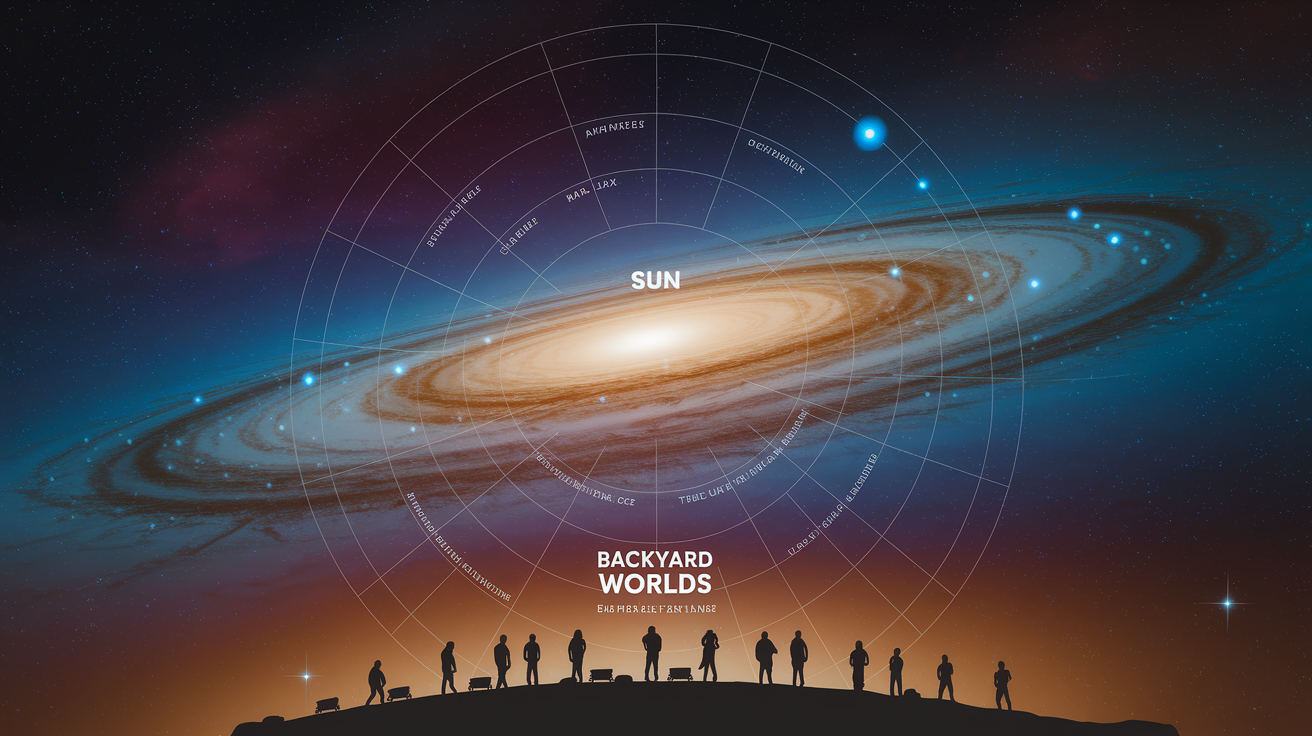
Surveys powered by citizen-science projects like Backyard Worlds: Planet 9 have expanded the brown dwarf census dramatically. At the January 2024 AAS meeting, researchers announced 89 new ultracool dwarf companions orbiting higher-mass stars, bringing more than 100,000 volunteers into the discovery process. Of those new systems, 72 have separations greater than 1,000 astronomical units (roughly 93 billion miles), placing them in a regime where gravitational binding is weak and long-term survival is uncertain. These discoveries double or triple the known population of widely separated low-mass companions and provide crucial data points for testing formation and dynamical-evolution theories.
W1935 and similar isolated objects help refine estimates of brown dwarf frequency in the solar neighborhood. Earlier surveys suggested that M dwarfs, which make up more than half of all stars in the Milky Way, were mostly single. Improved infrared sensitivity and citizen-science scanning have revealed that low-mass companions were systematically undercounted. Adding these newly characterized objects to the catalog changes our understanding of how often brown dwarfs form alongside stars versus in isolation, and it informs models of the substellar mass function (the distribution of objects from the smallest stars down through brown dwarfs to the most massive planets). Widely separated systems also offer age benchmarks. Thirty-seven of the new companions have constrained ages, and age-dated nearby objects are rare and valuable for calibrating cooling models and testing atmospheric chemistry predictions over time.
Observational Challenges and Techniques for Characterizing Brown Dwarfs
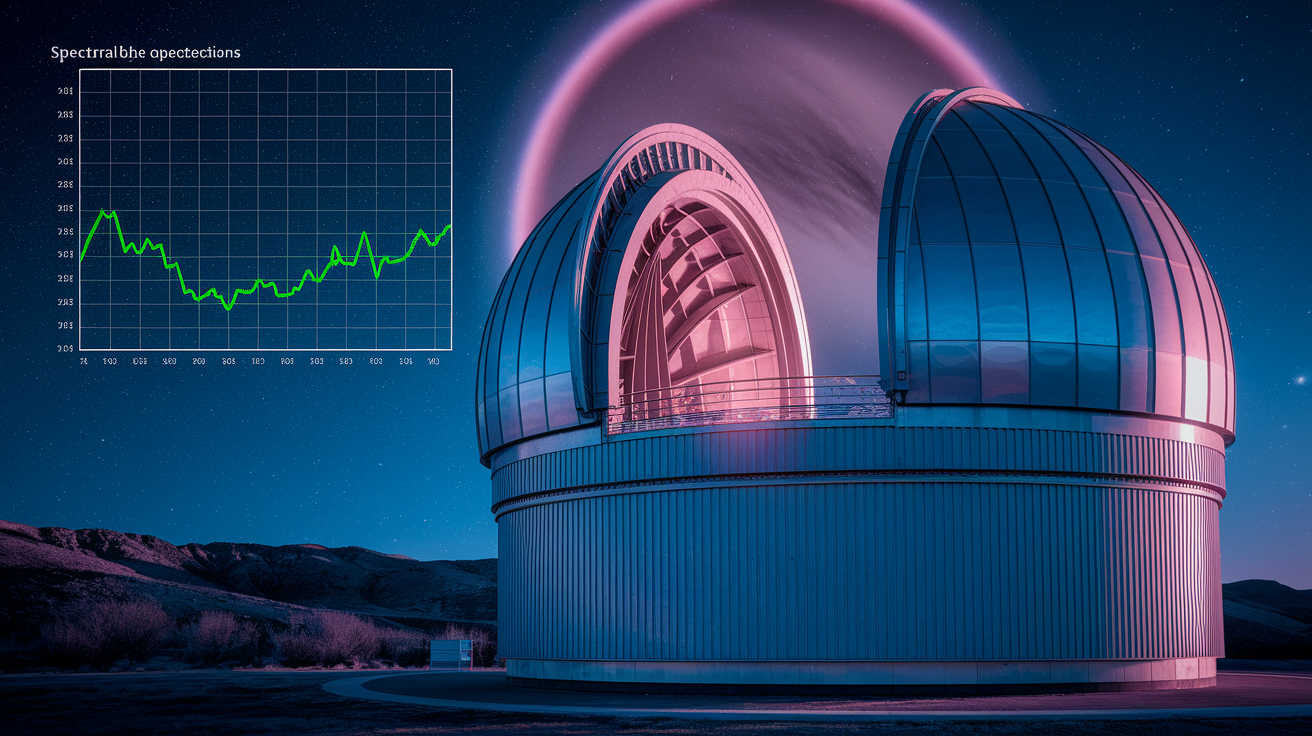
Detecting faint emission features in the spectrum of a cold brown dwarf pushes the limits of infrared astronomy. Ground-based telescopes face atmospheric absorption and thermal emission from the telescope and sky, which swamp the faint signal from a distant substellar object. Space telescopes eliminate atmospheric interference, and cooled optics reduce thermal background, but even then the challenge is separating a subtle emission spike from noise and neighboring absorption bands. JWST’s sensitivity (enabled by its 6.5-meter mirror, cryogenic instruments, and stable pointing) made the methane emission detection on W1935 possible.
Spitzer’s inclination studies relied on time-series photometry, observing brown dwarfs as they rotated to map brightness variations caused by patchy cloud cover. By comparing colors at different viewing angles, astronomers inferred that clouds cluster near the equator, affecting the spectrum depending on whether the observer looks edge-on or pole-on. Ground-based follow-up with adaptive-optics imaging and echelle spectrographs confirmed proper motions, radial velocities, and multiplicity, anchoring WISE and Gaia data with higher-resolution measurements. Combining data across wavelengths and facilities (each contributing a piece of the puzzle) is essential for building a complete picture of these faint, cool objects.
| Technique | Telescope/Instrument | Key Contribution |
|---|---|---|
| High-resolution infrared spectroscopy | JWST (NIRSpec, MIRI) | Detection of faint methane emission and detailed atmospheric composition |
| Time-series photometry | Spitzer Space Telescope | Mapping cloud distribution and viewing-angle color shifts |
| All-sky infrared imaging | WISE | Discovery and motion detection of faint, cool brown dwarfs |
| Precision astrometry | Gaia | Distance, proper motion, and velocity measurements for target confirmation |
| Adaptive-optics imaging and radial velocity | Ground-based telescopes (e.g., Keck, Subaru) | Multiplicity checks, orbital parameters, and spectroscopic follow-up |
Future Research Enabled by This Newly Characterized Brown Dwarf

W1935 will serve as a priority target for additional JWST observations and multiwavelength campaigns. Researchers plan to search for moons by looking for periodic variations in brightness or emission strength that could signal a satellite crossing the brown dwarf’s disk or modulating its magnetosphere. Detecting auroral signatures (such as ultraviolet or X-ray emission) would confirm magnetospheric activity and help pin down the energy source driving methane emission. Higher-resolution spectroscopy can map temperature and composition gradients across the atmosphere, testing whether heating is global or confined to polar regions like auroras on Jupiter.
The broader census of brown dwarfs will continue to expand as citizen scientists and automated surveys process archival data and new sky surveys come online. Follow-up observations of the 89 newly announced ultracool companions will measure masses, ages, and atmospheric properties, turning a list of discoveries into a well-characterized population that can test formation and evolution models. Long-term monitoring will track cloud evolution, weather patterns, and variability, building a library of atmospheric behaviors that spans the full range of brown dwarf temperatures and ages.
W1935’s benchmark status means it will anchor comparisons for future discoveries. When the next isolated brown dwarf with unusual emission is found, W1935 will provide the reference case. When models are updated to include magnetospheric heating or moon-driven currents, W1935 will be the first object used to validate those updates. This discovery doesn’t just add one more entry to the catalog. It opens a research pathway linking substellar atmospheres, planetary magnetospheres, and satellite interactions, with implications stretching from brown dwarf formation all the way to the study of giant exoplanets around distant stars.
Final Words
In the action, JWST spotted methane in emission from W1935, a cold brown dwarf 47 light-years away. That odd signal breaks the usual absorption story and made us rethink atmospheric heating and magnetospheric activity.
Space telescopes made the detection possible. Combined data from Spitzer, WISE and Gaia helped pin down its properties and show why this case matters for models.
This new data underscores the significance of a newly characterized brown dwarf found by space telescopes. It’s a practical benchmark for theory and future observations. Exciting paths lie ahead.
FAQ
Q: What are the characteristics of a brown dwarf?
A: The characteristics of a brown dwarf are that it sits between a planet and a star, about 13–80 Jupiter masses, can’t burn hydrogen steadily, glows mainly in infrared, and often shows cool, methane-rich atmospheres.
Q: What planet has 99.7% chance of life?
A: The planet with a 99.7% chance of life does not exist; we can’t assign such precise probabilities. Assessments are uncertain and based on habitability factors, not definitive percentages.
Q: What are the recent findings of the James Webb Telescope?
A: The recent findings of the James Webb Telescope include detecting methane in emission on brown dwarf W1935, mapping exoplanet atmospheres in detail, and revealing distant infrared-bright galaxies from the early universe.
Q: Why are scientists now able to observe and identify brown dwarf stars?
A: Scientists can now observe and identify brown dwarf stars because infrared space telescopes like JWST and WISE detect their faint heat, while Gaia and spectroscopy confirm distance, motion, and chemical fingerprints.