

Not the rocket, but navigation and communications decided success for 2023 lunar missions, and often whether the science actually made it home.
Every flight had the same five goals: know your location well enough to plan descent, make autonomous choices near touchdown, keep steady Earth links, let surface assets talk, and return the data.
That chain included both the hardware in flight and quiet architecture work, standards, relays, and services like LunaNet that underpinned 2023 operations and future plans.
What 2023 Lunar Missions Needed to Achieve
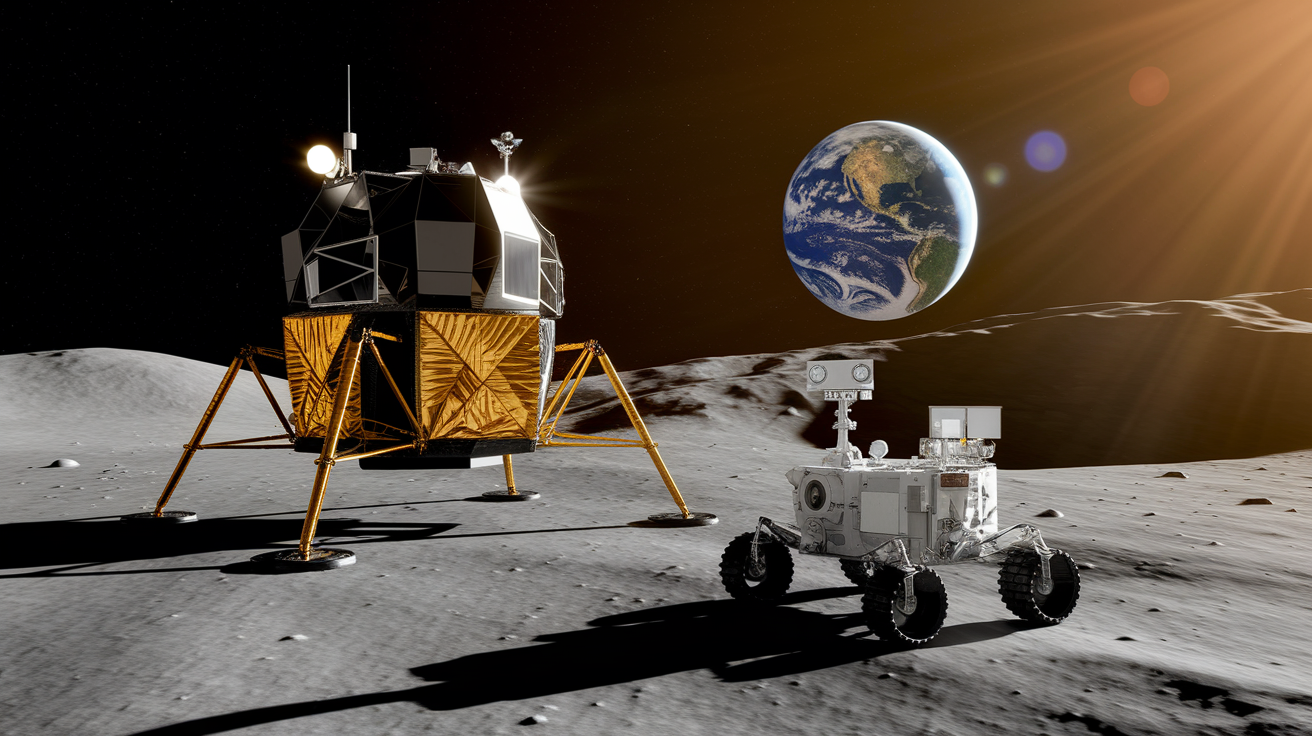
Every lunar mission flying or in development during 2023 had to solve the same basic problem, even if the hardware looked completely different from one programme to the next. A spacecraft had to navigate safely to the Moon, know where it was with enough confidence to land or orbit without incident, and keep talking to Earth the whole time. That meant orbit determination accurate enough to plan a descent, autonomous decision making during the final minutes before touchdown since no one on Earth could react fast enough, steady telemetry and command links, a way for landers and rovers to talk to each other on the surface, and enough bandwidth left over to actually bring the science data home. Think of it as five objectives stacked together. Know where you are, land safely, stay in contact, let your rover talk to your lander, and send the data back.
Here’s the part that trips a lot of people up. “2023 objectives” doesn’t just mean missions that launched that year. It also includes the architecture and standards work happening quietly in the background, meant to support lunar missions years down the road. NASA’s LunaNet concept and its Lunar Telecommunications and Navigation work are good examples. No crewed Artemis flight happened in 2023, but that didn’t mean nothing was happening. Engineers were building the interoperability standards, the relay concepts, and the ground support agreements that future missions would lean on. So when we talk about 2023, we’re really talking about a mix of actual flight hardware doing actual flying, and architecture groundwork being laid for what comes next.
Mission-Dependent Technical Planning Baselines
- UHF proximity links, roughly 300 MHz to 3 GHz, were the go to choice for short range lander to rover chatter, typically running at kbps up to a few hundred kbps.
- S band, around 2 to 4 GHz, handled command, telemetry, and ranging duties, usually sitting somewhere around 10 kbps to a few hundred kbps.
- X band, Ka band, and optical systems covered the higher end. X band might carry 100 kbps up to a few Mbps, Ka band and optical experiments could reach several Mbps and, under good conditions, more than 100 Mbps.
- Earth Moon propagation delay runs about 1.28 seconds one way, 2.56 seconds round trip. That’s not a huge number, but it’s enough to rule out real time joystick control during a landing.
- NASA’s Deep Space Network, ESA’s ESTRACK, and ISRO’s Byalalu facilities formed the backbone of ground tracking in 2023. Anything landing on the lunar farside, or tucked into a shadowed polar crater, needed a relay spacecraft with a clear line of sight to Earth.
- NASA ESA Gateway cooperation, LunaNet interoperability work, ESA’s Moonlight initiative, and commercial service providers were all pieces of a bigger push toward shared, reusable lunar infrastructure rather than every mission building its own isolated system.
| Mission or Programme | 2023 Status | Navigation Objective | Communications Objective | Outcome or Scope |
|---|---|---|---|---|
| Chandrayaan-3 | Launched and landed | Autonomous precision soft landing | Lander to Earth telemetry, lander to rover link | Successful landing 23 August 2023 |
| Luna-25 | Launched, lost in orbit | Polar orbit insertion and landing approach | Orbital telemetry and command | Lost 19 August 2023 before landing attempt |
| NASA Artemis / LunaNet | Architecture development, no crewed flight | Shared navigation service concepts | Interoperable relay and comms standards | Technology maturation and standards work |
| ESA Moonlight | Planning and procurement phase | Lunar positioning service concept | Commercial relay service model | Moving from concept toward implementation |
| Commercial lunar landers (CLPS-era) | Active development, multiple providers | Mission-specific descent and landing | Own telecom interfaces or agency relay use | Varied by provider and payload contract |
That table is a snapshot of status and intent, nothing more. Every frequency, data rate, positioning accuracy, and coverage figure mentioned anywhere in this article depends on the specific mission, its landing site, antenna size, available power, payload priorities, relay geometry, and which ground network actually had an open slot that week. None of it is a fixed universal spec. Worth keeping in mind as we go deeper.
End-to-End Lunar Operations From Tracking to Data Return
(((alt-img2)))
A lunar mission’s day to day operation follows a loop, and it’s worth walking through it once before diving into sensors and radios. Ground stations pick up tracking observations, Doppler shifts, range measurements, and time tag them precisely. Mission control feeds those observations into orbit determination software, which estimates where the spacecraft actually is versus where it was supposed to be. Based on that updated state, controllers uplink new commands or refined trajectory products during the next scheduled contact window. It’s methodical, almost like checking in on a long road trip and adjusting the route based on where you actually ended up.
Between those contacts, the spacecraft is on its own. It propagates its own state using onboard models, essentially estimating its position based on its last known fix and its own sensors, until the next ground contact rolls around and the
Final Words
We focused on the core goals: safe navigation, autonomous terminal descent, continuous telemetry, rover links, and enough capacity for science. The piece walked through end-to-end operations, technical baselines, radio-band tradeoffs, ground and relay needs, and Chandrayaan-3 and Luna-25 case studies.
Use the tables and checklist to turn those aims into measurable requirements. Remember every figure depends on mission design, site, antenna, power, and ground support. The navigation and communications objectives for 2023 lunar missions offer a practical starting point, and it’s a promising path forward.
FAQ
Q: What were the shared navigation and communications objectives for 2023 lunar missions?
A: The shared navigation and communications objectives for 2023 lunar missions were safe precision landing, reliable orbit determination, autonomous terminal descent, continuous telemetry and command, robust surface connectivity, and sufficient capacity for scientific data return.
Q: Does “2023 objectives” refer only to flown missions or also to architecture and service development?
A: The “2023 objectives” label refers to both flown mission activity and concurrent architecture or service development, including relay, navigation, and ground-network efforts intended to support later lunar operations.
Q: Which 2023 lunar missions and programmes provide the clearest operational evidence?
A: The 2023 missions with clear evidence were Chandrayaan-3, which achieved soft landing and rover ops, and Luna-25, which failed during lunar orbital operations before its planned surface attempt.
Q: What radio bands and indicative data-rate envelopes were used in 2023 planning baselines?
A: The 2023 planning baselines listed UHF for proximity links at kbps–low hundreds kbps, S-band ~10s–hundreds kbps, X-band ~100 kbps–few Mbps, Ka-band several–tens Mbps, and optical multi-Mbps to >100 Mbps as indicative envelopes.
Q: What is the Earth–Moon one-way and round-trip signal delay to expect?
A: The Earth–Moon one-way light-time is about 1.28 seconds and the round-trip is about 2.56 seconds, which makes time-critical landing control inherently autonomous rather than real-time piloted from Earth.
Q: Why are relay satellites required for farside landings or obstructed polar sites?
A: Relay satellites are required because farside and some polar terrain block direct Earth visibility, so an orbiting or relay node provides continuous command, telemetry, and data-forwarding links to ground stations.
Q: How did end-to-end lunar operations manage tracking, navigation, and commands in 2023 missions?
A: End-to-end operations collected time-tagged tracking at ground stations, estimated spacecraft state at mission control, uplinked commands or trajectory updates, and relied on onboard propagation and autonomy for time-critical descent decisions.
Q: What practical lessons for navigation and communications came from Chandrayaan-3 and Luna-25?
A: Chandrayaan-3 showed preserving comms through descent-to-surface transitions and rover links; Luna-25 highlighted the need to validate propulsion commands, monitor manoeuvres, maintain orbit determination, and design robust autonomous fault responses.
Q: Which navigation sensors and error drivers most influence lunar landing accuracy?
A: Radiometric ranging, Doppler, delta-DOR, IMUs, star trackers, optical terrain-relative navigation, and LiDAR/radar altimetry drive accuracy; key error sources include sensor bias, clock error, gravity-model uncertainty, map-registration, lighting, and guidance performance.
Q: What practical checklist steps should planners follow for 2023-style nav and comms requirements?
A: Planners should pick the matching mission category, set measurable performance criteria, build navigation allocations, evaluate candidate links from the radio table, document ground architecture, enforce interoperability, validate baseline assumptions, record verification, link recovery plans, and gain approval.