

Could we actually visit a planet’s core, without drilling?
Psyche might be that chance: a metal-rich asteroid that could be the exposed heart of a baby planet, but it’s still unproven.
The spacecraft’s goals are clear: map composition, measure mass and density, search for remanent magnetism, and record geology to test the exposed-core idea.
Why care? Because if Psyche really is core material we get a direct look at planetary formation and dynamo history. If it’s not, that result reshapes how we think collisions and mixing built the early solar system.
What Scientists Hope to Learn at Asteroid 16 Psyche
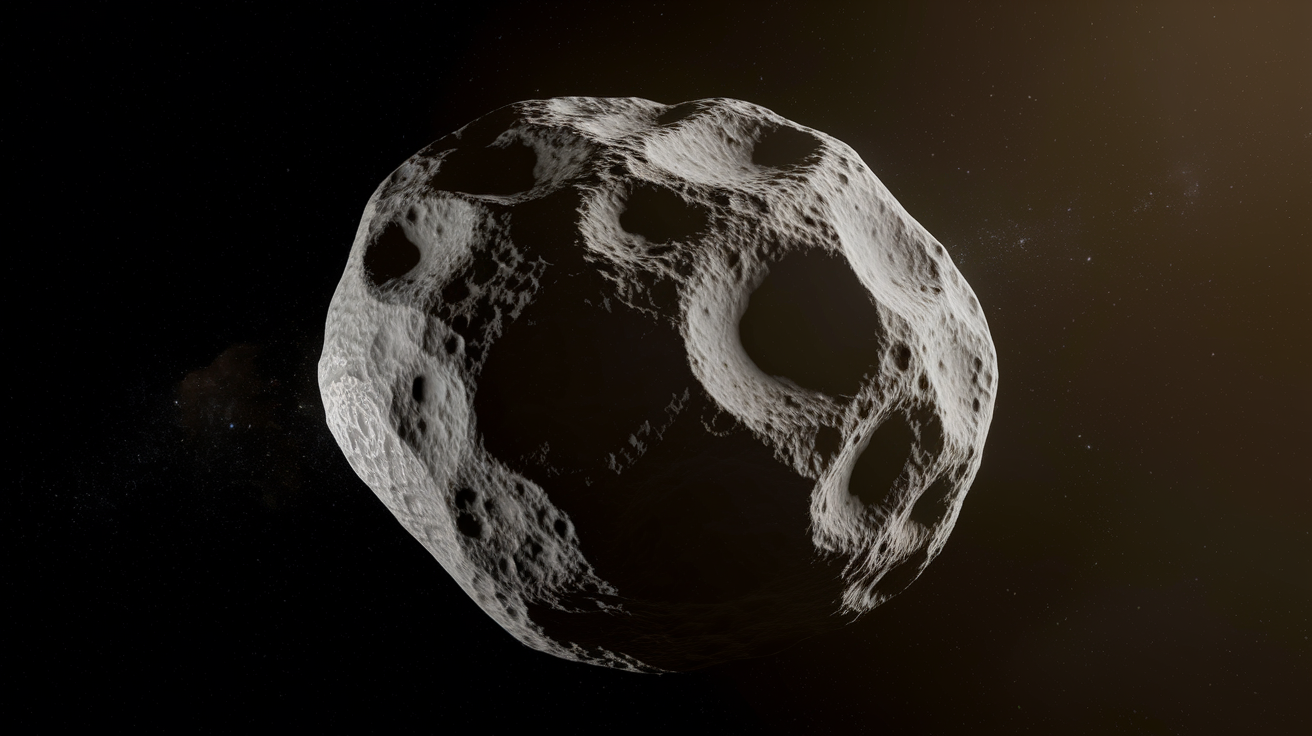
Psyche mission objectives center on a single, rare target: a metal-rich main-belt asteroid that might be something no human has ever directly studied before. The exposed-core hypothesis suggests that 16 Psyche could be the leftover heart of a baby planet, stripped of its outer layers by ancient collisions. It’s a compelling idea, but here’s the honest part. It’s still unconfirmed. That’s exactly why we’re sending a spacecraft instead of just guessing from telescope data.
So why study a metallic asteroid in the first place? Earth has a core too, but we can’t drill down and look at it. We infer its properties from seismic waves and magnetic field models, kind of like studying a house by only listening to sounds through the walls. If Psyche really is exposed core material, it hands scientists a direct look at something normally buried thousands of kilometers beneath our feet.
Here are the five primary objectives driving the mission.
- Determine whether Psyche is a differentiated core, primordial metal-rich body, or mixed object.
- Map elemental and mineral composition across its surface.
- Map morphology, craters, geology, shape, and topography.
- Search for remanent magnetization from a possible ancient dynamo.
- Measure mass, gravity, bulk density, and internal structure.
Each of these measurements feeds into bigger questions about planetary differentiation, the process where molten material separates into a metal core and a rocky mantle. If Psyche shows clear core-like chemistry and signs of an ancient dynamo, that’s strong supporting evidence for the exposed-core story. If the data comes back mixed or inconclusive, that tells scientists something too. Maybe early collisions and accretion worked differently than models predict. Worth remembering, the spacecraft collects evidence. The conclusions about what that evidence means will take years of careful analysis afterward.
Asteroid 16 Psyche’s Known Characteristics Before Arrival
(((alt-img2)))
Located in the main asteroid belt, 16 Psyche stands out as one of the largest metal-rich objects known, with an effective spherical diameter of about 222 to 230 kilometers. Shape models suggest a lumpy, triaxial body measuring roughly 280 by 240 by 170 kilometers. More potato than sphere, really. It spins fast too, completing a full rotation in just over four hours. Its classification as an M-type asteroid, the “M” standing for metallic, is what makes it such an unusual target in a belt dominated by rockier, carbon-rich bodies.
Radar observations give us one of the best pre-arrival clues about what Psyche is made of. Its radar albedo (how much radar signal bounces back) measures 0.37 ± 0.09, a notably high value that lines up with a metal-heavy surface. Bulk-density estimates, how much mass is packed into a given volume, range from about 3,400 to 4,100 kg per cubic meter, with a more recent figure landing at 4,172 ± 145 kg/m³. That’s dense, but not as dense as pure iron-nickel would be. This gap matters. It hints at fractures, void space, or lighter material mixed throughout the body, rather than a solid metal ball.
Telescopic reflectance spectroscopy, essentially reading the “fingerprint” of light bouncing off the surface, paints a more complicated picture. Scientists have spotted signs of iron-bearing silicates like olivine and pyroxene, plus small traces of hydrated material, mixed in with the metal signature. The surface looks like it has texture and variation across different regions. But here’s the catch: regolith (the loose surface dust and rubble) can behave differently than solid interior material, and space weathering can alter how metal reflects light over time. Combined with limited resolution from Earth-based telescopes, this means we genuinely don’t know yet whether the surface we’re seeing matches what’s underneath.
How Psyche’s Instruments Address the Metallic Asteroid Science Goals
(((alt-img3)))
No single instrument on Psyche can answer the big question alone. It takes all four working together, cross-checking each other, before scientists can build a confident picture of what this asteroid really is.
Multispectral Imagers for Geology, Mineralogy, and Topography
Psyche carries two redundant camera heads (one primary, one backup) that capture images through a broad filter centered at 540 ± 125 nm alongside narrower filters at 442, 494, 548, 722, 840, 942, and 1,014 nm. Together, these filters map surface color variation, terrain shape, and spectral hints of iron-bearing silicates and sulfide minerals. The mission’s core imaging requirement is ambitious: capture the surface at 20 meters per pixel or better across at least 80% of the body.
Here’s something that surprises people. Psyche doesn’t carry a laser altimeter, the instrument many missions use to measure elevation directly. Instead, topography gets built through stereo imaging, stereophotogrammetry, and stereophotoclinometry, techniques that reconstruct 3D shape by comparing overlapping images taken from different angles and lighting conditions.
Gamma-Ray and Neutron Spectrometer for Elemental Composition
When cosmic rays strike the asteroid’s surface, they trigger gamma rays and neutron emissions with energies tied to specific elements, kind of like each element leaving its own signature glow. The GRNS instrument catches these signals using a high-purity germanium detector cooled to a frosty 85 Kelvin. This lets scientists map abundances of iron, nickel, silicon, sulfur, potassium, calcium, and aluminum across the surface, testing how much metal versus silicate is really there and under what chemical conditions it formed.
Magnetometer for Ancient Dynamo Evidence
Remanent magnetization is basically a magnetic fossil, a frozen record of a magnetic field that existed when the material cooled. If Psyche once had a molten, churning interior like early Earth, it might have generated its own magnetic field through a dynamo process. Finding leftover magnetism in the rock would be strong evidence that this churning actually happened.
Final Words
We named Psyche a rare metal-rich main-belt asteroid and put the exposed-core idea front and center, then listed five clear objectives that will test that idea.
We walked through the instruments and mapping orbits, showing how multispectral imaging, gamma-ray and neutron spectroscopy, magnetometry, and radio science will turn measurements into composition, magnetism, gravity, and shape maps.
Those measurements are exactly what the Psyche mission objectives and why study a metallic asteroid aim to answer: whether core formation, collisions, or primordial chemistry made Psyche. The data won’t close every question, but they’ll sharpen the story and point to smart next steps for planetary science.
FAQ
Q: What are the main objectives of the Psyche mission?
A: The Psyche mission objectives are to test whether Psyche is a core-like body, map surface composition and geology, search for remanent magnetization, and measure mass, gravity, bulk density, and internal structure.
Q: Why study a metallic asteroid like 16 Psyche?
A: Studying 16 Psyche helps because it may be an exposed planetary core or metal-rich relic, offering direct clues about core formation, metal-silicate separation, and early collisions that shaped rocky planets.
Q: What did we know about 16 Psyche before the spacecraft arrived?
A: Before arrival, 16 Psyche was known as a metal-rich main-belt asteroid about 222–230 km across, spinning just over four hours, with high radar reflectivity and density estimates suggesting substantial metal but uncertain structure.
Q: How will Psyche’s instruments reveal the asteroid’s composition and structure?
A: Psyche’s instruments will reveal composition and structure by imaging surface colours and shapes, measuring elemental gamma-ray and neutron signals, detecting remanent magnetization, and mapping gravity via Doppler tracking.
Q: How do the multispectral imagers, GRNS, magnetometer, and radio science each address mission goals?
A: Psyche’s instruments address goals by imaging mineralogy and topography, the GRNS mapping Fe/Ni and other elements, the magnetometer searching for ancient magnetic signatures, and radio science mapping gravity to infer internal mass distribution.
Q: How will the mapping orbits build a complete asteroid record?
A: The mapping orbits build a record by starting high for global context, moving to lower altitudes for finer detail, sequencing to cover seasonal illumination, and co-registering all data to a single 3D shape model.
Q: What is the Psyche mission timeline and how does the spacecraft get there?
A: The Psyche mission launched October 13, 2023 on Falcon Heavy, uses solar-electric propulsion with a Mars gravity assist in May 2026, and arrives for orbital science in 2029 for about 26.5 months of mapping.
Q: What measurements would indicate Psyche is an exposed differentiated core rather than another type?
A: Measurements indicating an exposed core would show dominant metal abundance, core-like Ni/Fe chemistry, high bulk density with low porosity, coherent internal mass, and remanent magnetization consistent with an ancient dynamo.
Q: What findings would complicate identifying Psyche’s origin?
A: Findings that complicate origin include mixed metal-silicate surface chemistry, low or ambiguous nickel values, high porosity, internal heterogeneity, lack of magnetization, and impact or weathering effects that mask original signatures.
Q: How and when will Psyche mission data be released and validated?
A: Psyche mission data will move from raw telemetry to calibrated and derived PDS4 products, validated by calibration checks, repeat observations, cross-team comparisons, and peer review, then posted in open planetary-data archives.
Q: What follow-on studies or missions could come after the prime Psyche campaign?
A: Follow-on work could include a lower-altitude extended map campaign, lab studies comparing meteorite analogues, refined collisional and thermal models, surveys of other metal-rich asteroids, and possibly a future sample-return mission.