

What if dark energy isn’t a new ingredient but a trick of gravity?
Euclid won’t detect dark energy directly; instead it measures the Universe’s stretching and the way matter clumps, letting those two stories reveal the cause.
Using weak gravitational lensing (tiny, coherent twists in galaxy shapes), galaxy clustering and baryon acoustic oscillations (a cosmic standard ruler), redshift-space distortions, and precise photometric and spectroscopic redshifts, Euclid will map geometry and growth across 10 billion years.
The thesis: compare geometry versus growth to see if our theory holds or if something stranger is at work.
Euclid’s Core Dark Energy Measurements at a Glance
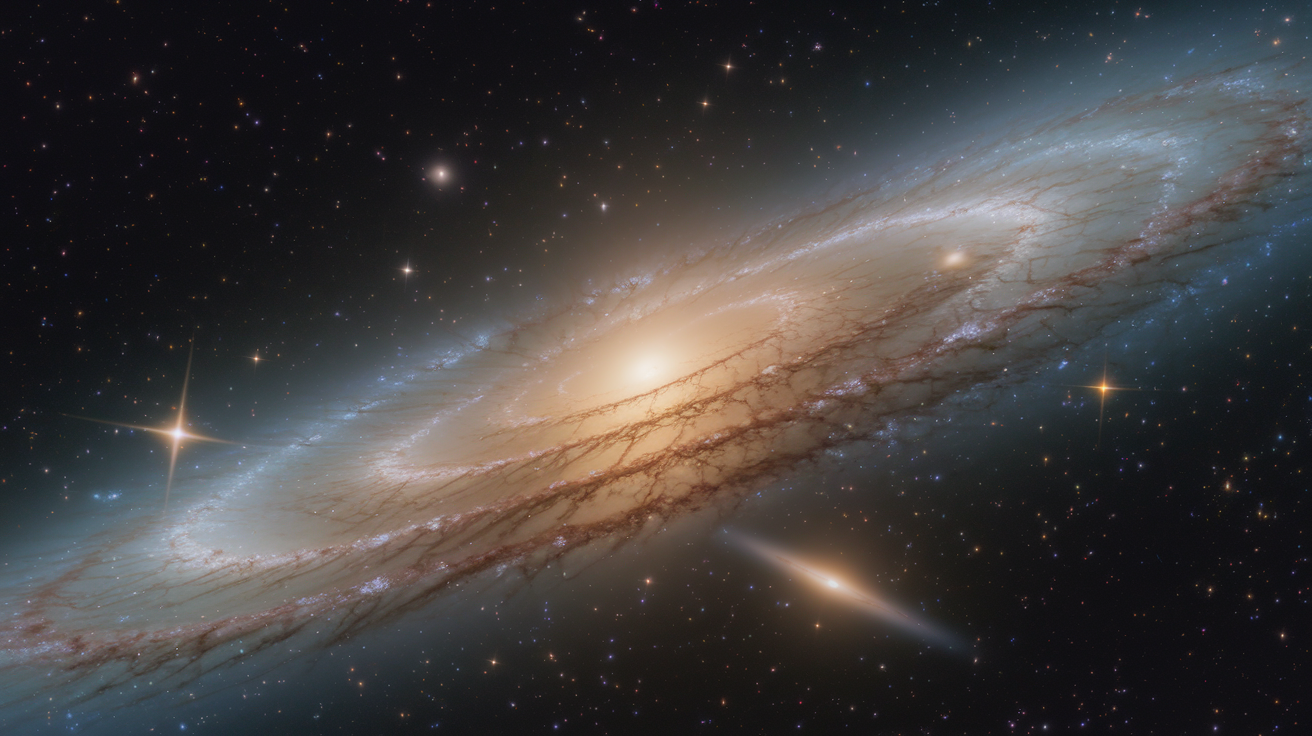
Here’s the thing worth getting straight from the start: Euclid will not detect dark energy directly. There’s no sensor that picks up a “dark energy particle” or flashes a light when it finds some. Instead, Euclid measures how the Universe has stretched over time and how clumps of matter have grown, then lets those two storylines tell us what’s really driving cosmic acceleration.
That might sound indirect, but it’s actually how most of modern cosmology works. You watch the shadows, not the thing casting them. Euclid’s job is to track the geometry of space, how fast it’s expanding at different points in history, and the growth of structure, how matter has clustered into galaxies, filaments, and voids over roughly 10 billion years. Put those together, and patterns emerge that either match our standard model or don’t.
| Euclid Measurement | Direct Observable | What It Reveals | Main Cosmological Output |
|---|---|---|---|
| Weak gravitational lensing and cosmic shear | Tiny, coherent distortions in galaxy shapes | The foreground mass bending light from distant galaxies | Dark matter maps and the matter power spectrum P(k,z) |
| Galaxy clustering and 3D positions | Angular position plus redshift for millions of galaxies | How galaxies group together across cosmic volume | Large-scale structure maps and growth-rate measurements |
| Baryon acoustic oscillations | A preferred separation distance between galaxies | A fixed “standard ruler” imprinted in the early Universe | Expansion history and distance measurements |
| Redshift-space distortions | Squeezing or stretching of clustering patterns | How galaxies move under gravity’s pull | Growth-rate measurement fσ8 |
| Photometric and spectroscopic redshifts | Color-based and spectral-line-based distance estimates | How far back in time each galaxy sits | Accurate 3D positioning for all other measurements |
So what do you do with five different measurements pointing at the same question? You check if they agree. If the expansion history (the geometry side) and the structure growth (the dynamics side) tell the same story that General Relativity predicts, that’s a point in favor of the standard picture. If they pull apart, even slightly, that’s where things get interesting, and where modified gravity or evolving dark energy might start creeping into the conversation.
Euclid Mission Scope, Survey Size, and Measuring Instruments
(((alt-img2)))
Euclid launched on 1 July 2023 and now operates near the Sun-Earth L2 point, a gravitationally quiet spot about 1.5 million kilometers from Earth. It carries a 1.2 meter Korsch telescope, a design chosen for its wide, flat field of view, which matters a lot when your job is surveying huge chunks of sky rather than zooming in on single objects. Over its nominal 6 year mission, Euclid is mapping about 15,000 square degrees of extragalactic sky, avoiding the crowded, dusty plane of our own galaxy.
That’s roughly a third of the entire sky. Not a narrow pencil-beam survey. A sweeping, methodical pass across a huge swath of the cosmos, repeated with enough precision that faint, distant galaxies become usable data points instead of smudges.
VIS Shape Measurements
VIS, Euclid’s visible imager, is built for one job above all others: capturing galaxy shapes with extreme stability and precision. It observes in visible light, roughly 550 to 900 nanometers, with a pixel scale near 0.1 arcseconds. That fine pixel sampling matters because weak lensing distortions are subtle. We’re talking about shape changes of a percent or two, so the telescope’s point spread function, how a single point of light gets smeared across the detector, needs to be understood almost perfectly.
Across the survey, VIS is expected to image on the order of 1.5 billion galaxies. That’s an enormous shape catalog, and it’s the raw material for everything cosmic shear related. Without that kind of stability and resolution, the lensing signal would just get buried in noise.
NISP Photometry and Spectroscopy
NISP, the near-infrared spectrometer and photometer, handles two jobs at once. In photometry mode, it images in the Y, J, and H near-infrared bands, giving color information that helps estimate distances for galaxies too faint or red for VIS alone to pin down well. In spectroscopy mode, it uses a slitless setup across roughly 0.9 to 2.0 microns, with a resolving power around R ≈ 250, good enough to pick out emission lines without needing to slice the light into narrow slits first.
The spectroscopic side is where Euclid gets its most precise distances. The projected sample is roughly 30 to 50 million galaxies with measured spectroscopic redshifts, with a specific target of about 50 million Hα-emitting galaxies spanning 0.9 < z < 1.8. Those Hα emission lines, a bright signature from star-forming gas, are a workhorse. NISP picks them up, measures where they land in the spectrum, and that tells you how much the light has stretched on its way to us.
VIS and NISP point at the same patches of sky, essentially working as a matched pair. One nails down shape, the other nails down distance, and together they turn a plain image into a three-dimensional map of the Universe.
Weak Gravitational Lensing and Euclid’s Dark Matter
(((alt-img3)))
Final Words
Euclid measures how the Universe expands and how cosmic structure grows. It does not detect dark energy directly; it turns galaxy shapes, positions, and redshifts into distances, dark-matter maps, and growth-rate numbers.
Weak lensing, galaxy clustering, BAO, redshift-space distortions, and photometric and spectroscopic redshifts form a linked picture that tests dark energy and gravity across time.
Euclid dark energy objectives what the mission will measure focus on geometry and growth, comparing expansion history and structure growth to reveal physics. It’s a big, careful step forward.
FAQ
Q: What are some observational signs that dark matter exists?
A: Observational signs that dark matter exists include flat galaxy rotation curves, stronger-than-expected gravitational lensing, galaxy-cluster dynamics, and patterns in the cosmic microwave background and large-scale structure needing unseen mass.
Q: What is Euclid in space?
A: Euclid in space is a European Space Agency space telescope mapping billions of galaxies from Sun–Earth L2 to study cosmic acceleration and dark matter using weak gravitational lensing and galaxy clustering.
Q: How long until James Webb runs out of fuel?
A: James Webb is estimated to run out of station-keeping fuel in the mid-to-late 2030s, though the exact date depends on operations, trajectory choices, and remaining consumables.
Q: How does dark energy affect the expansion of the universe?
A: Dark energy affects the expansion of the universe by producing accelerated expansion—acting like a negative-pressure component that increases cosmic expansion rate and alters structure growth over time.