

Think engineers pick spacecraft instruments because they look cool?
It’s not even close.
Every sensor answers a real question tied to a mission goal.
In 2023 missions show this clearly.
JUICE needed radar and magnetometers to probe icy shells.
Psyche carried spectrometers and a magnetometer to read composition and history.
Euclid packed wide-field optical and infrared cameras to map dark matter.
Chandrayaan-3 and OSIRIS-REx used landing and sample systems tied directly to their goals.
This post shows how objectives become measurable observables, and how those observables set instrument types and specs.
What 2023 Space Missions Reveal About Objectives and Instrument Choice
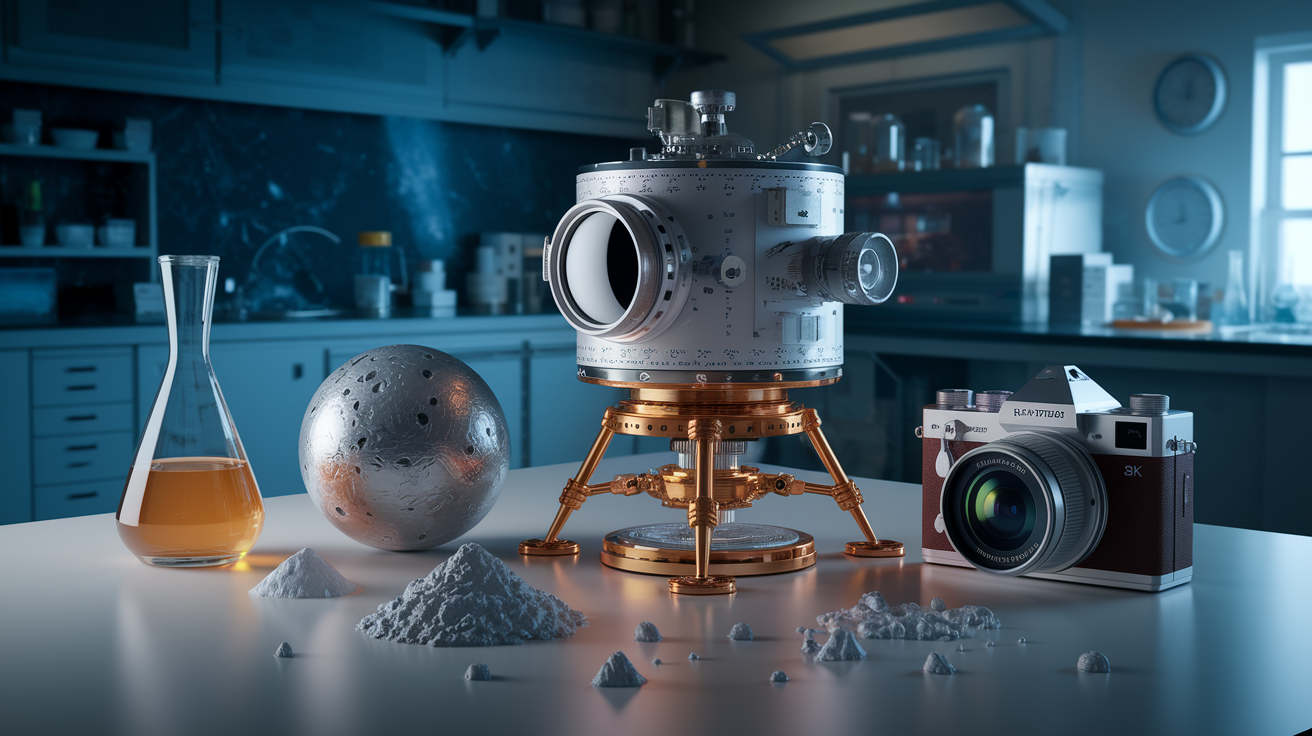
Here’s the thing about spacecraft instruments: nobody just picks a cool camera and bolts it on. Every sensor traces back to a question someone wanted answered. The chain runs like this. A mission objective defines an observable quantity, something you can actually measure. That observable gets a required precision and coverage. And that requirement points straight at an instrument type.
Think of it as a funnel. A broad goal like “understand this asteroid” narrows down to “measure its elemental composition,” which narrows further to “we need a gamma-ray and neutron spectrometer capable of detecting specific energy signatures.” Compare that to a goal like “map the moon’s surface shape in three dimensions.” That one calls for a completely different toolkit. Imaging, radar, or laser altimetry, because shape and elevation is a different physical quantity than composition.
| Mission and 2023 Event | Primary Objective | Instrument Pairing | Objective-Based Rationale |
|---|---|---|---|
| JUICE, launched 14 April 2023 | Investigate Jupiter’s icy moons and Ganymede’s potential habitability | Imaging and spectroscopy paired with ice-penetrating radar, laser altimetry, magnetometers and particle instruments | Subsurface oceans and icy shells aren’t visible from the outside, so radar and magnetic sensing are needed to probe beneath the surface |
| Psyche, launched 13 October 2023 | Determine asteroid 16 Psyche’s composition, structure and magnetic history | Multispectral imagers paired with gamma-ray and neutron spectroscopy, a magnetometer and radio science | Composition requires detectors sensitive to elemental signatures, not just visual appearance |
| Euclid, launched 1 July 2023 | Map dark matter and investigate cosmic expansion | Visible imaging paired with near-infrared imaging and spectroscopy | Measuring galaxy shapes, distances and redshifts across huge volumes of sky demands wide-field optical and infrared coverage |
| Chandrayaan-3, launched and landed in 2023 | Demonstrate a lunar soft landing and conduct local surface science | Landing sensors paired with lander and rover science instruments | A safe touchdown and surface measurements require separate but connected hardware (detailed later in this article) |
| OSIRIS-REx, 2023 sample-delivery milestone | Return a preserved Bennu sample for laboratory analysis | Sample acquisition and containment systems paired with an Earth-return capsule | Some analyses simply can’t happen onboard a spacecraft. They need full laboratory equipment back on Earth |
It’s worth separating scientific instruments from everything else riding along on these spacecraft. Star trackers, navigation cameras, and attitude sensors help a spacecraft know where it is and where it’s pointing, but they don’t collect science data themselves. Same goes for technology demonstrations, which test new hardware without necessarily answering a science question. JUICE’s 2023 launch, Euclid’s 2023 launch, Psyche’s 2023 launch, and OSIRIS-REx’s 2023 sample delivery are all genuine milestones. But the instruments doing the science work are a distinct category from the sensors keeping the spacecraft alive and oriented.
How Are Mission Objectives Converted Into Measurable Instrument Requirements?
(((alt-img2)))
A science traceability matrix sounds bureaucratic, and honestly, it kind of is. But it’s also one of the most useful tools in mission design. It’s a document that forces every instrument specification to connect, in writing, back to a scientific objective. No vague language allowed. You can’t just say an instrument needs “high resolution.” You need a number, a threshold, something that can be tested and verified.
This matters because without it, requirements drift. Someone adds a spec because it sounds impressive, not because it’s tied to an actual question. The matrix keeps everyone honest by recording the objective, the scientific question behind it, the observable quantity, the measurement threshold, the instrument requirement, and the verification method, all in one traceable line.
| Traceability Level | Lunar Composition Example | Measurable Requirement or Threshold |
|---|---|---|
| Mission objective | Map variations in lunar surface composition | Coverage across a defined target region at mission completion |
| Scientific question | Where do diagnostic minerals or elements occur | Detection of specific mineral absorption features |
| Observable | Wavelength-dependent reflected or emitted radiation | Spectral signal across a defined wavelength range |
| Measurement thresholds | Spectrometer performance needed to detect those features | Required wavelength range, spectral resolution, spatial resolution, signal-to-noise ratio and radiometric accuracy |
| Verification | Confirming the instrument meets each threshold before launch</
Final WordsIn the action, we followed the chain from objective to observable to measurable requirement to instrument. Short examples—composition needs composition-sensitive detectors; 3-D maps need imaging, radar or altimetry—made that concrete. We used 2023 missions as case studies: JUICE, Psyche, Euclid, Chandrayaan-3 and OSIRIS-REx showed how launches or delivery milestones map to specific sensors and trade-offs. That’s the practical point: how mission objectives determine spacecraft instruments 2023 examples remind us that clear science goals drive testable requirements and realistic payloads. It’s doable, and that clarity leads to better missions. FAQQ: What scientific tasks do you think the instruments on the Mars Rover perform?A: The instruments on the Mars Rover perform geological imaging and spectroscopy to analyze rock and soil composition, environmental sensing for weather and radiation, subsurface sounding, and sample collection and processing for detailed laboratory-style study. Q: What are the names of some of NASA’s space probes?A: Some of NASA’s space probes are Voyager, Pioneer, Cassini, Juno, New Horizons, Parker Solar Probe, OSIRIS-REx and Psyche, covering outer-planet exploration, heliophysics, asteroid study and sample-return work. Q: How is Elon Musk related to NASA?A: Elon Musk is related to NASA as SpaceX’s founder; SpaceX is a commercial partner that launches NASA cargo and crew, provides crewed transport, and holds contracts for lunar and cargo services. Q: What is the Artemis 2 mission going to do?A: The Artemis 2 mission is going to fly a crewed Orion spacecraft around the Moon to test life support, navigation and deep-space operations, collecting data to prepare for a later lunar landing mission. |