

Could telescopes be tricked into seeing methane on Mars, or are they really reading a Martian fingerprint?
They catch infrared sunlight from Mars and feed it to a spectrometer, a super-precise prism that splits light into thousands of narrow colors.
Methane soaks up light near 3.3 microns (thousandths of a millimeter), leaving three thin notches that match methane’s fingerprint.
This post walks through the instruments, the lab line lists we use, and how observers strip away Earth’s air so the Martian signal is real.
Core Spectroscopic Process Behind Methane Detection on Mars

Infrared light bounces off Mars, crosses space, and hits ground telescopes fitted with spectrometers that chop the signal into thousands of narrow wavelength slices. Think prism spreading white light into a rainbow, but way more precise. Most methane detections come from telescopes parked on high, dry peaks like Mauna Kea in Hawaii. Up there, the thin air cuts down interference from Earth’s own water vapor and atmospheric junk. The spectrometer spreads reflected Martian sunlight across detectors tuned to infrared, especially the near-IR L Band around 3.3 microns. That’s where methane’s strongest vibrational signature shows up.
When methane molecules in Mars’s atmosphere soak up specific wavelengths of this infrared light, they carve out narrow notches in the spectrum. Imagine missing slivers in an otherwise smooth rainbow. Three distinct absorption lines pop up at once, sitting at exact wavelengths near 3.3 microns. It’s a fingerprint no other common Martian gas shares. Instruments on NASA’s Infrared Telescope Facility and the W.M. Keck telescope can pick out these individual lines, but only if the spectrometer’s resolution is sharp enough to tease methane’s narrow features apart from overlapping signals. That includes Earth’s own methane and water vapor. The near-IR L Band gets the nod because methane absorbs hardest there, and specialized detector arrays plus adaptive optics can fix atmospheric blur at these wavelengths. Makes the faint Martian signal actually visible.
Here’s how the instrument-based detection unfolds:
- Reflected sunlight from Mars enters the telescope, gets routed to an infrared spectrometer
- Spectrometer breaks the light into a spectrum covering the L Band near 3.3 microns
- Detectors log intensity at each narrow wavelength slot, building a brightness profile across thousands of channels
- Software spots dips in brightness at methane’s three characteristic wavelengths, checks them against lab-measured line positions
- High spectral resolution pulls the Martian methane signal out from telluric interference by modeling and removing Earth’s atmospheric absorption
Spectroscopy Fundamentals Enabling Methane Identification
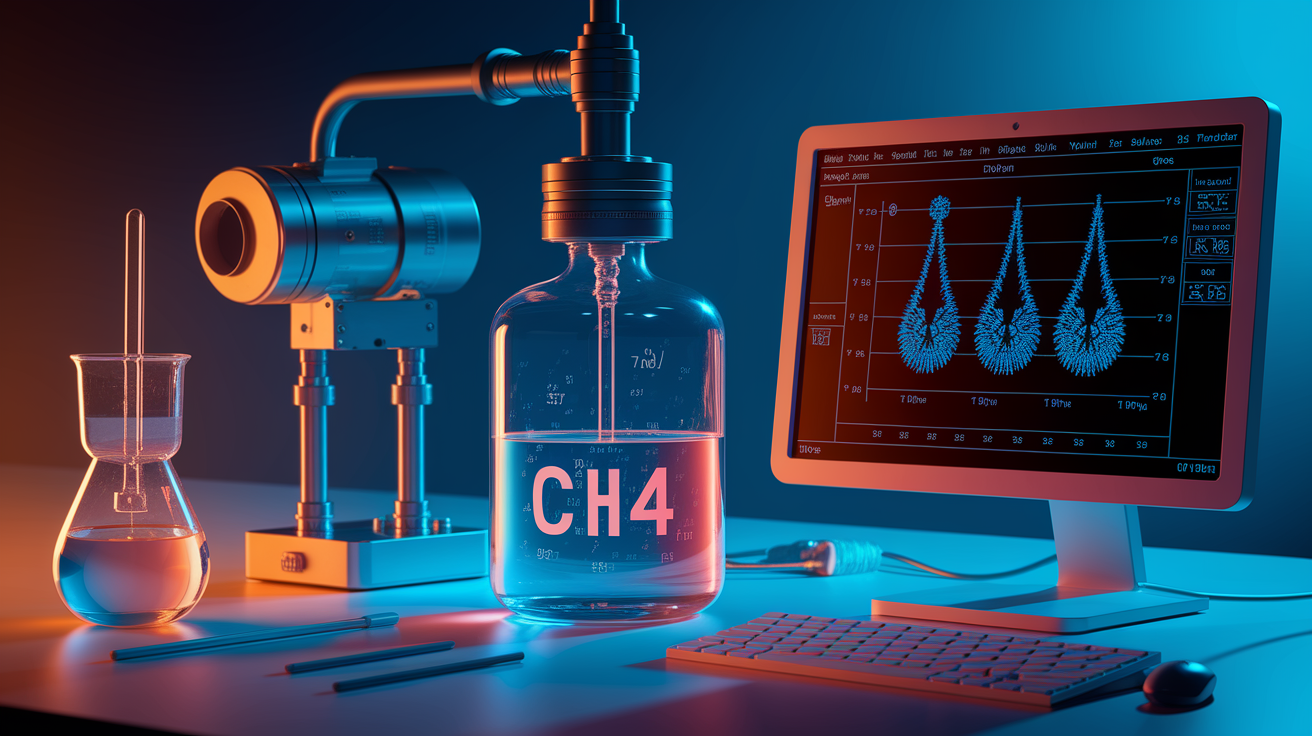
Molecules grab light when photons carry just the right energy to make them vibrate or spin faster. Methane’s got four hydrogen atoms clustered around one carbon. When infrared photons slam into it, the molecule can stretch and bend in specific ways called vibrational modes. The strongest one for detection is the ν₃ band, where carbon-hydrogen bonds stretch unevenly and absorb light near 3.3 microns. Each vibrational state also links with molecular rotation, creating a thicket of narrow absorption lines bunched around the central wavelength. These rotational-vibrational transitions are what instruments actually register as spectral fingerprints.
Lab measurements catalog every known absorption line for methane and other gases in databases like HITRAN. They log the exact wavelength, intensity, and shape of each line under different temperatures and pressures. These databases let scientists predict how methane’s spectrum should appear on Mars, where low atmospheric pressure sharpens the lines compared to Earth. When a telescope grabs a spectrum and software finds three simultaneous dips matching HITRAN predictions for methane’s ν₃ band, that match nails down the molecule’s presence. Assuming the resolution is tight enough to see lines individually and kick out false positives.
| Molecule | Band | Key Wavelength |
|---|---|---|
| Methane (CH₄) | ν₃ stretch | ~3.3 microns |
| Water (H₂O) | Combination | ~2.7 microns |
| Carbon dioxide (CO₂) | ν₃ stretch | ~4.3 microns |
Final Words
In the action, we followed the instrument chain: infrared light from Mars enters a telescope, is dispersed into a spectrum, and shows methane’s telltale dips near the 3.3 micron band when three lines line up. High spectral resolution and careful removal of Earth’s air make those lines visible.
We also covered the physics behind narrow methane lines and how lab databases like HITRAN pin down their exact positions.
If you’re wondering how do telescopes detect methane on Mars using spectroscopy, this is the practical answer, and with better instruments we’ll keep improving the view.
FAQ
Q: How is methane detected in the atmosphere of Mars?
A: Methane is detected in the atmosphere of Mars by high-resolution infrared spectroscopy, spotting absorption near 3.3 microns with ground and space telescopes and matching lines to lab databases to exclude Earth contamination.
Q: What is the spectroscopy of Mars?
A: The spectroscopy of Mars is splitting sunlight or Mars thermal light into a spectrum to spot gas and mineral absorption lines, which reveal the planet’s composition, temperature, and surface chemistry.
Q: Is Mars water drinkable?
A: Mars water is not drinkable as found: it’s mostly ice or salty brines with perchlorates and other toxins, so it needs desalination and chemical treatment before people could safely drink it.
Q: Why is Mars hard to see through a telescope?
A: Mars is hard to see through a telescope because it’s small and distant, Earth’s air blurs fine detail, and Mars dust storms and low contrast hide surface features; big, steady scopes help.