

What if one telescope turned the whole southern sky into a nonstop discovery engine?
Rubin’s Observatory will scan wide swaths of sky every night with a 3.2-gigapixel camera.
Its alert system can flag millions of changes and send them out in about a minute.
That speed and scale means we’ll catch supernovae within hours, hunt kilonovae fast enough for follow-up, and turn transient astronomy into a steady stream of new science.
Key Transient Discoveries Expected From Rubin’s LSST Survey
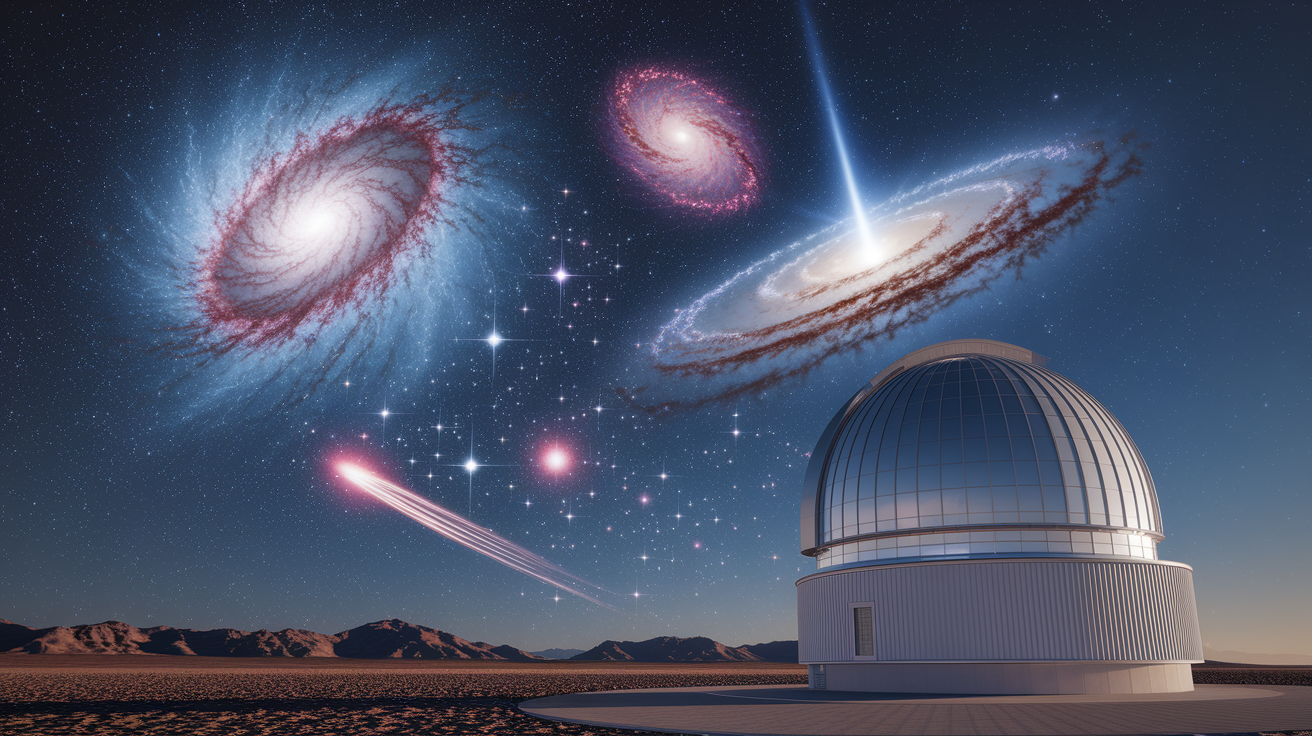
The Vera C. Rubin Observatory fired up its real-time alert system on February 24, 2026, and logged 800,000 astronomical events in one night. That was just night one. Once the Legacy Survey of Space and Time hits full speed, the system should pump out something like 7 million alerts per night for a decade straight. Every transient object and variable event visible from the Southern Hemisphere gets flagged: exploding stars, supermassive black holes throwing flares, asteroids drifting close to Earth, weird interstellar visitors passing through. Rubin’s first year alone is expected to image more objects than every other optical observatory in history combined. The scale isn’t just bigger. It changes how time-domain astronomy works. You’re not hunting specific targets anymore. You’re swimming in discoveries.
Rubin’s transient catalog covers a lot of ground:
Supernovae. Thousands of core-collapse and Type Ia events yearly, plus lensed SNe.
Kilonovae. Neutron-star mergers that show up as optical transients.
Active galactic nuclei. Supermassive black holes with brightness that won’t sit still.
Variable stars. Millions of stars changing brightness over time.
Near-Earth objects. About 130 new NEO detections nightly. That’s 36,500 over ten years.
Interstellar visitors. Rare comets and asteroids like 3I/ATLAS.
The discovery rates vary wildly depending on what you’re looking at. Supernovae will show up by the thousands each year. Simulations suggest 44 lensed Type Ia supernovae annually, which helps test cosmological models. Variables and asteroids flood the alert stream. Millions over the survey’s lifetime. Kilonovae and interstellar objects are rare, but Rubin’s nightly sweeps give it the best shot at catching them while they’re still visible. The science payoff touches dark energy measurements, gravitational-lens surveys, impact-risk tracking, stellar-evolution studies. Catching a supernova in the first hours instead of days after peak changes what you can learn about the explosion itself. Rubin’s alert speed and sky coverage make that routine.
LSST Transient Discovery Power: Why Rubin’s Survey Design Enables New Physics
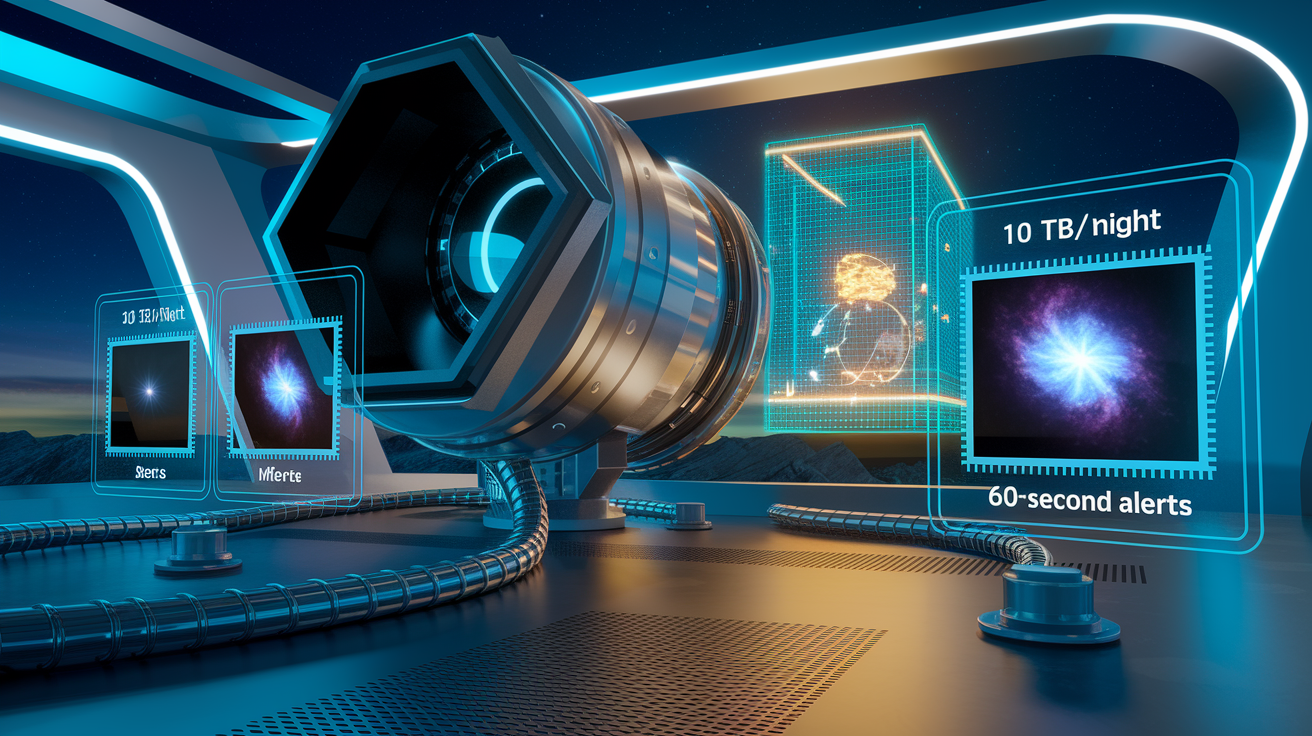
Rubin spots transients by comparing each fresh image to a template made from earlier observations of the same sky patch. Anything that appears, moves, or changes brightness gets flagged. The observatory runs the largest digital camera ever built for astronomy. A 3.2-gigapixel sensor taking 30-second exposures. It grabs a new region every 40 seconds during nighttime ops. Those images travel by fiber from Chile to Santiago, then Miami, then finally land at the Rubin Observatory United States Data Facility at SLAC in California. Round trip takes seconds. Processing turns 10 terabytes of raw images per night into alerts delivered to scientists within 60 seconds of detection. Each alert includes three postage-stamp images: the old template, the new observation, and the subtracted difference isolating the change. That difference image is your transient fingerprint.
The survey’s depth and cadence work together to catch faint, distant, short-lived events other facilities miss. Repeated nightly scans of the same regions mean Rubin detects objects that brighten or fade over hours to days, not just weeks. The 30-second exposures reach faint magnitudes, pulling in distant supernovae and dim variable stars. The real-time alert pipeline means observers worldwide can coordinate follow-up observations using bigger telescopes for spectroscopy and high-resolution imaging before the transient fades. That’s the real advantage. Rubin doesn’t just find more objects. It finds them early enough to actually do something about it.
| Transient Type | Detection Advantage | Example Timescale |
|---|---|---|
| Supernovae | Early-phase capture before peak brightness | Hours to days after explosion |
| Kilonovae | Rapid fade detection from neutron-star mergers | 1–7 days |
| Variable stars | Nightly cadence resolves short-period variations | Hours to weeks |
| Interstellar visitors | Wide-field coverage catches rare, fast-moving objects | Days to weeks in visible range |
Final Words
Right now Rubin is already sending huge alert nights and the post shows the kinds of transients we’ll see: supernovae, kilonovae, near-Earth objects, active galaxies, and countless variable stars.
Expect discovery volumes from thousands of new supernovae a year to millions of variable-star detections, plus regular asteroid and AGN finds. That scale will fill catalogs and fuel follow-up observations.
If you’re asking what discoveries will the Vera C. Rubin Observatory make for transients, the answer is a steady stream of rare and common cosmic changes that will reshape how we study the changing sky. That’s good news.
FAQ
Q: What transient types will the Rubin Observatory detect?
A: The Rubin Observatory will detect a broad range of transients, including supernovae, kilonovae, near-Earth asteroids, active galactic nuclei (AGN), variable stars, and tidal disruption events.
Q: How many alerts and transient detections will Rubin produce?
A: Rubin’s real-time alert system launched on February 24, 2026, issuing 800,000 alerts in one night; it will scale to about 7 million alerts per night, yielding thousands of supernovae and millions of variable stars yearly.
Q: Why do Rubin’s transient discoveries matter scientifically?
A: Rubin’s discoveries matter because they let scientists study populations, watch explosions from the start, link to gravitational waves and neutrinos, and map solar system objects, boosting demographics, physics, and follow-up science.
Q: What does a Rubin alert contain?
A: A Rubin alert contains three small images—template, new, and difference—plus photometry and metadata to help teams judge significance and plan rapid follow-up observations.
Q: How does Rubin detect faint and distant transients at scale?
A: Rubin detects faint, distant transients using a huge 3200-megapixel camera, short exposures, and image differencing, moving data quickly to processing centers to reveal small changes against deep templates.
Q: Can Rubin catch short-lived events like kilonovae?
A: Rubin can catch short-lived events like kilonovae because its repeated sky visits and rapid alert stream let teams spot and follow fleeting signals within hours to days.
Q: How should astronomers use Rubin alerts for follow-up?
A: Astronomers should use Rubin alerts to prioritize targets for spectroscopy, multi-wavelength follow-up, and rapid coordination with gravitational-wave or neutrino detectors to maximize scientific return.