

Can a spacecraft prove there’s an ocean it never sees directly?
JUICE won’t scoop water or take a picture beneath Ganymede’s ice.
Instead it will chase the ocean’s fingerprints, small signals left in radar echoes, magnetic fields, gravity, and the moon’s tides.
RIME, J-MAG, 3GM, and GALA each test a different signal, and together they can build a case for salty water under the shell.
This piece explains how those four methods work, what they can and can’t show, and why using them together matters.
How JUICE Will Detect Ganymede’s Hidden Ocean
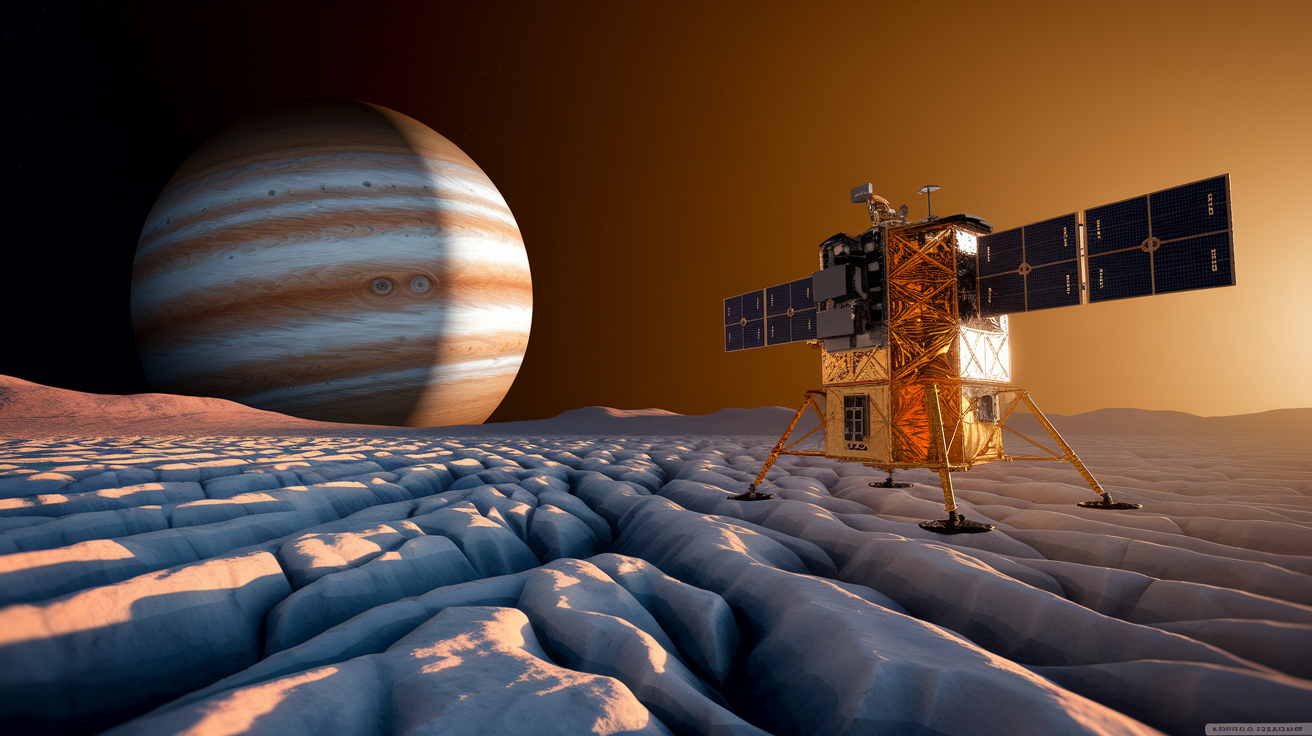
JUICE can’t photograph a hidden ocean. Can’t scoop up a sample either. Instead, the spacecraft has to catch the ocean’s fingerprints, the small physical effects a buried layer of salty water leaves on radar waves, magnetic fields, gravity, and the shape of the ice above it.
That means JUICE leans on four main lines of evidence, each coming from a different instrument, each testing the Ganymede subsurface ocean question in its own way.
- RIME transmits roughly 9 MHz radar signals into the ice and records echoes from subsurface boundaries.
- J-MAG searches for a secondary magnetic field induced in electrically conductive saltwater.
- 3GM uses precision radio tracking to map gravity and measure changes tied to tidal deformation.
- GALA records topography and repeat surface elevations to detect Ganymede’s tidal displacement.
These four methods form the backbone of the whole investigation. Each one gets its own deep dive later in this piece.
Alongside them, JANUS, MAJIS, UVS, SWI, RPWI, and the particle instruments supply geological, chemical, thermal, and plasma context. They won’t prove an ocean exists on their own, but they’ll help scientists understand the environment and surface clues tied to the bigger questions about Ganymede’s ocean.
How RIME Radar Will Probe Ganymede’s Ice Shell
(((alt-img2)))
Think of radar sounding like timing an echo in a canyon, except the “wall” that bounces the signal back isn’t something you’d see with your eyes. It’s a change in electrical properties underground, what scientists call a dielectric contrast. RIME, short for Radar for Icy Moons Exploration, sends low frequency radio pulses into Ganymede’s ice and listens for exactly that kind of hidden boundary.
From Radar Pulse to Subsurface Depth
Here’s the sequence. RIME transmits a radio pulse at around 9 MHz, a fairly low frequency chosen specifically because it travels deeper through ice than higher frequencies would. The pulse pushes down through the ice shell, and if it hits a spot where the ice’s dielectric properties, how the material responds to electric fields, suddenly change, part of the signal bounces back up toward the spacecraft.
JUICE measures how long that round trip takes, the two way travel time, and how strong the returning echo is. Converting that travel time into an actual depth isn’t automatic though. It depends on how fast radio waves move through Ganymede’s ice, which depends on the ice’s composition. So scientists lean on lab measurements and ice models to make that conversion work.
What a Liquid or Briny Layer Could Look Like
Liquid water and brine, salty water, are both much better at reflecting these radar signals than solid ice is. So if RIME’s beam reaches all the way to an ocean boundary, it should show up as an especially strong, distinct reflection, something sharper than the softer internal layering you’d expect from plain ice.
But not every strong echo means “ocean.” A small brine pocket, a buried fracture, or just messy subsurface clutter could produce something that looks similar at first glance. That’s why researchers check things like echo strength, whether the reflector stays continuous across multiple flyby tracks, the radar’s polarization behavior, and whether other instruments back up the same story.
Why RIME May Not Reach the Main Ocean
Here’s the honest limitation. RIME’s design involves a trade-off between penetration depth and resolution, and warmer ice, dust, rock fragments, porosity, and rough surfaces all eat away at how far the signal can travel before it’s too weak to detect. If Ganymede’s ice shell runs tens of kilometers thick, which some models suggest, the true ocean interface might simply sit below RIME’s practical reach. That wouldn’t mean the ocean isn’t there. It would just mean RIME’s job shifts toward mapping shallower layering, shell heterogeneity, and any localized brine pockets closer to the surface.
How J-MAG Will Identify a Conductive Ocean Beneath Ganymede
(((alt-img3)))
Here’s a useful mental picture. Imagine wrapping a coil of wire around a chunk of metal, then waving a magnet near it. The changing magnetic field pushes electrons around inside the metal, creating a small electric current, and that current creates its own secondary magnetic field. That’s electromagnetic induction, and it’s the same basic idea J-MAG uses to hunt for Ganymede’s subsurface ocean.
Ganymede sits inside Jupiter’s magnetic environment, which isn’t steady. It changes as the moon orbits, partly because Ganymede’s orbit is tilted relative to Jupiter’s spin axis. If there’s a layer of salty water down there, conductive because of dissolved salt ions, that changing external field should induce a secondary magnetic field inside the ocean itself. Solid ice, by contrast, barely conducts at all and wouldn’t produce much of a response.
Reading the Induced Field’s Amplitude and Phase
J-MAG records all three components of the magnetic field vector continuously, building up a time series during both flybys and the later orbital phase. A stronger induced signal generally points toward higher conductivity, meaning saltier water, while the timing, or phase delay, between the driving field and the induced response helps pin down how deep that conductive layer sits.
It’s not a clean one to one answer though. Different combinations of ocean depth, thickness, and salinity can produce a similar looking induced signal, a problem researchers call degeneracy. Untangling that usually requires combining multiple observation geometries and driving frequencies rather than relying on a single measurement.
Separating Ocean Signals From Ganymede’s Magnetic Environment
Ganymede isn’t magnetically quiet. It has its own intrinsic field, generated internally, on top of whatever Jupiter’s field is doing externally, on top of local plasma disturbances from the surrounding magnetosphere. All of that needs to get modeled and subtracted out before anything resembling an
Final Words
in the action, we showed that JUICE can’t snap or scoop Ganymede’s ocean, so it must read physical signals instead.
RIME, J-MAG, 3GM, and GALA each test a different effect — radar echoes, induced fields, gravity shifts, and surface tides — while cameras and spectrometers add context.
Together these methods aim to reveal a Ganymede subsurface ocean’s depth, saltiness, and how the ice shell behaves. It’s not a closed case yet, but JUICE promises our clearest view so far — and that’s exciting.
FAQ
Q: Why is it thought that Europa may have life in the liquid ocean underneath its icy crust, and what would that life look like?
A: Europa may host life because a global salty ocean likely lies beneath its ice, offering liquid water, tidal heating for energy, and chemical exchange; any life would probably be microbial, chemosynthetic, and adapted to cold, dark brines.
Q: What is Ganymede’s surface made of?
A: Ganymede’s surface is mostly water ice mixed with darker non-ice materials—silicate rock, salts, and organics—showing grooved terrain, impact craters, and regions of younger, brighter ice.
Q: What are some interesting facts about Europa?
A: Some interesting facts about Europa are: it hides a global ocean beneath thin ice, has a young, fractured surface with few craters, shows magnetic signs of salty water, and is a prime target for Europa Clipper’s upcoming study.