

What would it take to prove an ocean hides under a moon’s icy shell?
JUICE (Jupiter Icy Moons Explorer) is ESA’s big mission to do just that, using radar (send a ping and listen), magnetic and gravity measurements, and surface chemistry to build a multi-part case for subsurface oceans and to test habitability.
We’ll break down JUICE’s five main goals: map Ganymede, hunt for oceans, check chemistry and energy sources, study Jupiter’s magnetic and radiation environment, and compare Ganymede, Callisto, and Europa.
Here’s how the instruments and measurements join the dots.
JUICE Mission Goals at a Glance
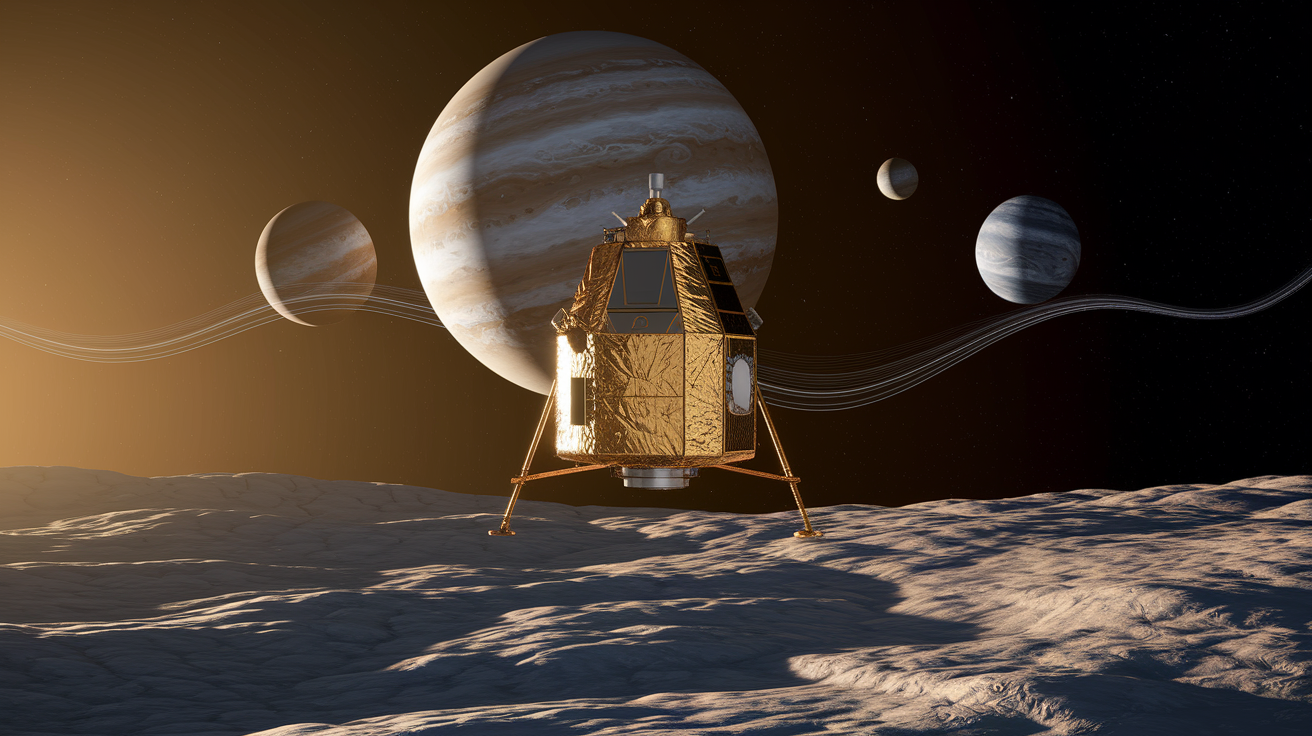
JUICE stands for Jupiter Icy Moons Explorer, and it’s the European Space Agency’s big ticket mission to Jupiter. It’s an L class mission, meaning it’s one of ESA’s largest and most ambitious science efforts. The investigation covers Jupiter as a whole system, but the real spotlight falls on three moons that scientists think might be hiding oceans under their icy crusts. Ganymede, Callisto, and Europa.
So what’s JUICE actually trying to accomplish? Here are the five main goals:
- Characterise Ganymede’s surface, interior, composition, and evolution.
- Determine whether subsurface oceans exist and investigate their properties.
- Assess water, chemistry, energy, and environmental stability relevant to habitability.
- Study Jupiter’s atmosphere, magnetic environment, and interactions with its moons.
- Compare Ganymede, Callisto, and Europa as related but distinct icy worlds.
JUICE launched on 14 April 2023, and it’s been cruising through space ever since. The spacecraft is set to reach Jupiter in July 2031, then settle into orbit around Ganymede in 2034, becoming the first spacecraft ever to orbit a moon that isn’t our own. We’ll walk through that whole journey, plus the instruments making it possible, later on. One thing worth clarifying right away though: JUICE is built to assess whether these moons could support life, not to detect life directly. We’ll come back to that distinction.
JUICE in one sentence: JUICE is Europe’s mission to investigate ocean worlds, test habitability conditions, and understand Jupiter as a connected system of moons, magnetism, and radiation.
How the JUICE Mission Investigates Hidden Oceans and Habitability
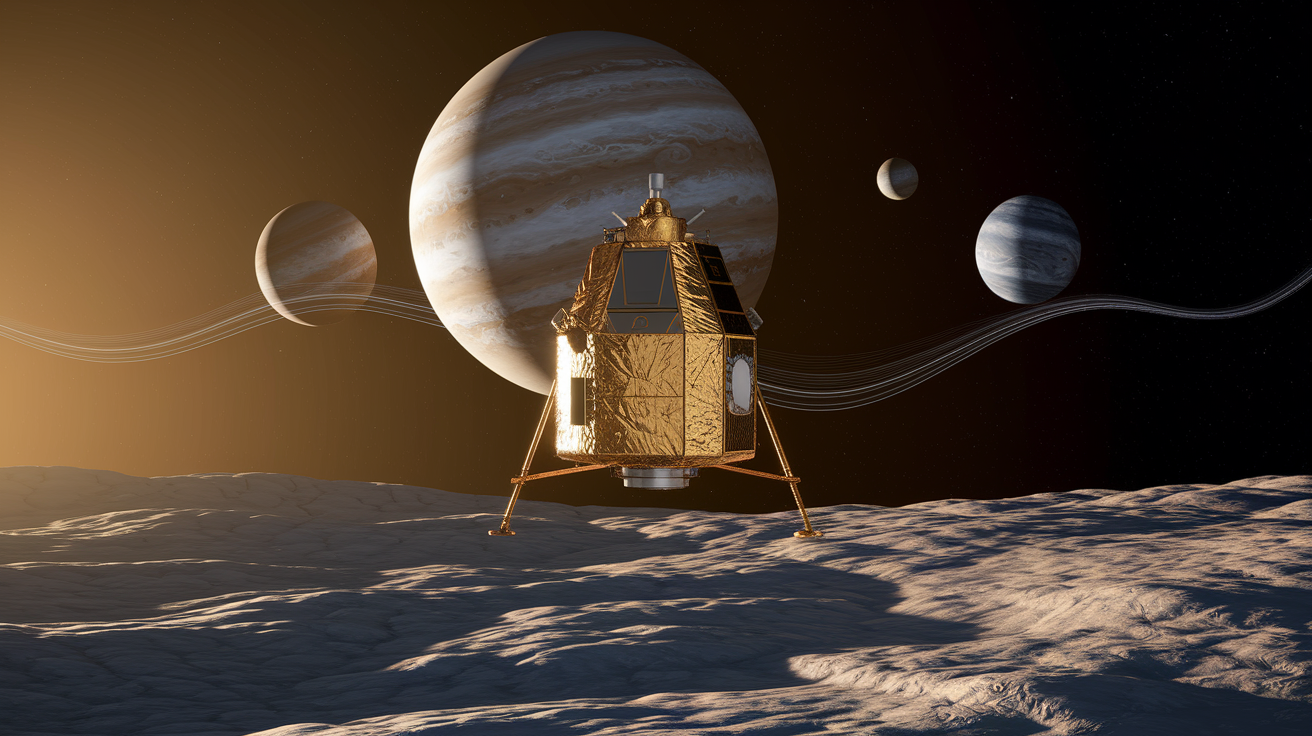
You can’t just point a camera at an icy moon and see an ocean underneath. No single instrument reading tells you everything about what’s hiding below the surface. Instead, scientists build a case, almost like detective work, where several independent lines of evidence all need to point toward the same conclusion before anyone’s confident about what’s really down there.
One major piece of that puzzle comes from radar. When a radar signal bounces off changes within the ice, like a boundary between different layers or a buried fracture, it sends back an echo that reveals structure scientists can’t see with their eyes. These echoes can show where the ice has shifted over time, where material might have moved between layers, or where there are signs of past geological activity. It’s a bit like sending a ping into the ice and listening carefully for what echoes back.
Other clues come from how the moon physically behaves under Jupiter’s gravity. Tidal deformation, how much a moon flexes as it orbits, tells scientists whether the interior is rigid or has some give to it, hinting at liquid layers underneath. Gravity measurements reveal how mass is distributed inside the moon, sort of like weighing different parts of an object without opening it up. And if there’s an electrically conductive liquid layer, like a saltwater ocean, it can create an induced magnetic signature that shows up in magnetic field readings. None of these measurements stand alone though. Each one depends on models, and scientists need the numbers to agree before they trust the picture.
Then there’s the habitability side of things, which goes beyond just finding water. Surface composition tells scientists what chemicals are present. Possible exchange between the surface and the interior, where material moves up or down through cracks, matters because it could carry nutrients or energy sources. Radiation processing, tidal heating, radiolysis (when radiation splits apart molecules), and chemical gradients are all potential energy sources that could, in theory, support some kind of chemistry interesting to astrobiology. None of this confirms life. It’s about building a picture of whether the conditions are even in the right ballpark.
A useful visual here would be a cross section of an icy moon, showing the surface, the ice shell, a possible liquid ocean, and a rocky interior, with the radar path, magnetic response, gravity variations, and tidal deformation all labeled. Worth noting, this kind of diagram is conceptual. It’s not a confirmed internal structure, just a way to visualize what the measurements are probing.
JUICE Objectives for Ganymede, Callisto, and Europa
(((alt-img3)))
JUICE doesn’t treat these three moons as interchangeable targets, even though they’re all icy and all orbit the same planet. Each one has a different surface age, different geology, different levels of internal activity, and different magnetic behavior. That’s exactly why comparing them matters. Differences between Ganymede, Callisto, and Europa can help scientists untangle what came from a shared origin billions of years ago versus what happened later, shaped by each moon’s own history.
Ganymede: The Mission’s Main Destination
Ganymede gets the lion’s share of attention, and for good reason. It’s the largest moon in the solar system, and it’s the only moon known to generate its own intrinsic magnetic field. JUICE will map its surface both globally and in fine regional detail, probe its ice and likely ocean structure, and study how its surface has evolved over time. The mission will also examine its aurorae, tied to that unique magnetic field. All of this builds toward 2034, when JUICE enters orbit around Ganymede for the most sustained, detailed study any icy moon has ever received.
Callisto: A Record of the Early Jupiter System
Callisto looks like it’s been frozen in time. Its surface is ancient and heavily cratered, which tells scientists it hasn’t been resurfaced much since the early solar system. That makes it a kind of time capsule. JUICE will study its geology, look for evidence of a subsurface ocean, and use its relatively unaltered history to piece together clues about how the Jupiter system looked billions of years ago, before things got geologically complicated on its neighboring moons.
Europa: Focused Reconnaissance of an Active Ocean World
Europa doesn’t get an orbital phase from JUICE, it gets flybys instead. But those flybys are packed with purpose. Europa’s surface is young and geologically active, covered in cracks and ridges that suggest material moving around
Final Words
JUICE is probing Jupiter as a system while zeroing in on three ocean-world candidates — Ganymede, Europa, and Callisto — to map surfaces, hunt for hidden oceans, and check environmental ingredients for habitability.
We walked through the instruments, the long gravity-assist journey, what JUICE can and can’t resolve remotely, and how it pairs with Europa Clipper.
For a quick takeaway, the JUICE mission objectives explained here boil down to characterise Ganymede, seek ocean evidence, assess chemistry and energy, study Jupiter’s environment, and compare the moons. It’s an encouraging step for future ocean-world science.
FAQ
Q: What is the Juno mission of NASA?
A: The Juno mission of NASA is a spacecraft studying Jupiter’s atmosphere, magnetic field, gravity, and interior to learn how the planet formed and how its deep structure works.
Q: How long will JUICE take to get to Jupiter?
A: JUICE will take about eight years to reach Jupiter, launching in April 2023 and arriving in July 2031 after gravity-assist flybys that save fuel.
Q: What are the goals of space exploration?
A: The goals of space exploration are to understand planets and origins, test technologies, gather knowledge for society, find resources, and identify environments that might support life.
Q: Where is the JUICE mission now?
A: The JUICE mission is currently en route to Jupiter, launched 14 April 2023, completed lunar–earth and Venus gravity assists, and continues its cruise toward a July 2031 Jupiter arrival.