

Can a telescope 700 light-years away tell us if distant worlds hold real water?
James Webb’s infrared eyes have done just that: they’ve found clear water vapor and carbon dioxide (CO2) in exoplanet atmospheres, plus surprises like sulfur dioxide and silicate clouds.
By reading molecular fingerprints in infrared spectra, JWST is giving the first complete chemical inventories of hot gas giants, rocky worlds, and wide companions.
Thesis: these discoveries are rewriting our view of atmospheric chemistry and planet formation, and they show how JWST will map which worlds can hold—or lose—their air.
Key JWST Findings Revealed About Exoplanet Atmospheres
The James Webb Space Telescope started delivering atmospheric data in mid-2022, and the results don’t look like anything Hubble or Spitzer could’ve captured. JWST’s infrared instruments pulled out molecules and chemical processes that were completely invisible before. What astronomers thought they knew about how distant worlds keep, lose, or transform their atmospheres? A lot of that just got rewritten.
Here’s what JWST has confirmed so far:
Sulfur dioxide (SO₂) in WASP-39b’s atmosphere. First definitive detection of photochemistry on an exoplanet. Announced late 2022, published in Nature.
Carbon dioxide (CO₂) on WASP-39b. Confirmed alongside water vapor and cloud signatures in the same hot Saturn.
Silicate clouds on VHS 1256b. Direct detection of grain particles in a turbulent, high-temperature atmosphere. Astrophysical Journal Letters reported it.
Heavy-element enrichment in HD 149026b. Super-abundances of carbon and oxygen that break Solar System trends. Published in Nature.
No atmosphere on TRAPPIST-1b. Thermal-emission measurements from November and December 2022 ruled out significant gas around this innermost rocky planet.
JWST works in infrared wavelengths roughly 20 times redder than visible light. That range holds the molecular fingerprints of water, carbon dioxide, methane, sulfur dioxide, silicate grains. Substances that absorb or emit at specific wavelengths as starlight passes through or bounces off a planet’s atmosphere. Before JWST, Hubble and Spitzer couldn’t isolate many of these signals, especially around smaller or denser worlds. The new data span gas giants, sub-stellar objects, rocky planets. JWST can probe atmospheric chemistry across the full range of exoplanet types discovered so far.
How JWST Measures Exoplanet Atmospheres Using Infrared Spectroscopy
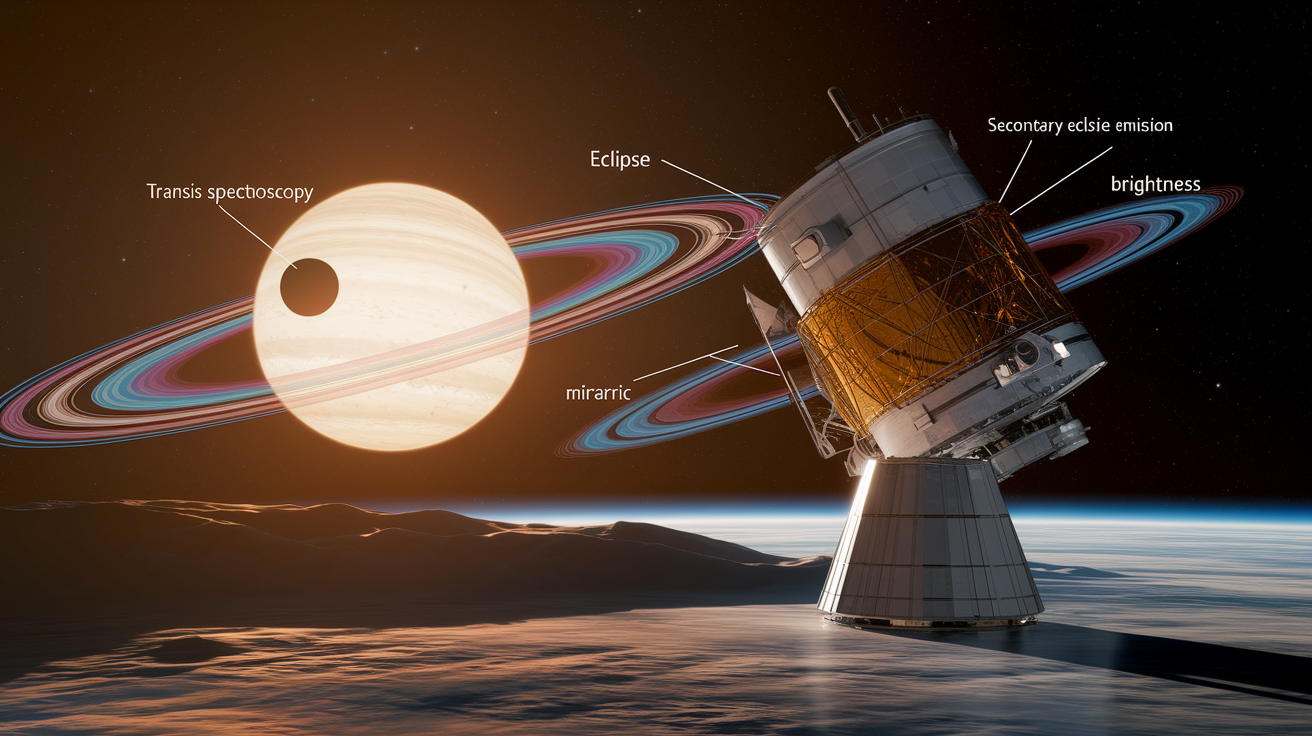
JWST uses three main strategies to isolate and analyze the thin shells of gas surrounding distant planets. During a transit, the telescope captures starlight filtered through the planet’s atmosphere, revealing absorption features that correspond to specific molecules. During a secondary eclipse (when the planet passes behind its star), JWST measures the drop in total system brightness to extract the planet’s own thermal emission. Mid-infrared observations push into wavelengths where molecules like water vapor, carbon dioxide, and methane radiate heat. That means direct measurement of atmospheric temperature and composition.
| Method | Wavelength range | What it measures | Sample planet |
|---|---|---|---|
| Transit spectroscopy | 0.6–5.3 µm (near to mid-infrared) | Molecular absorption lines in transmitted starlight | WASP-39b |
| Secondary-eclipse emission | 2.4–12 µm (mid-infrared) | Thermal emission from the planet’s dayside | TOI-561 b |
| Mid-IR brightness monitoring | 5–28 µm | Temperature and atmospheric presence/absence | TRAPPIST-1b |
| Direct imaging + spectroscopy | 1–20 µm | Cloud particles and chemical composition in wide-separation planets | VHS 1256b |
The mid-infrared range is critical. Many atmospheric molecules are transparent at visible wavelengths but absorb or emit strongly in the infrared. TRAPPIST-1b’s thermal-emission measurements, for instance, used mid-IR brightness changes as the planet moved behind its star to test whether any atmosphere was trapping heat on the dayside. TOI-561 b’s atmosphere was confirmed when NIRSpec captured more than 37 hours of emission spectra, revealing a cooler dayside than a bare-rock model would predict. Evidence that gases were absorbing and redistributing stellar energy.
JWST’s Breakthrough Sulfur Dioxide and CO₂ Detection in WASP-39b
WASP-39b sits roughly 700 light-years from Earth and completes an orbit around its star every four days. It’s a hot Saturn. About the mass of Saturn but far closer to its star and therefore much hotter. JWST observed WASP-39b as part of its early-release exoplanet science program, and the resulting spectra delivered the clearest chemical inventory of any exoplanet atmosphere to date.
The headline finding was sulfur dioxide. “This is the first time we see concrete evidence of photochemistry… on exoplanets,” said Shang-Min Tsai, co-author of the study published in Nature. Alongside SO₂, JWST confirmed:
Carbon dioxide (CO₂). Water vapor (H₂O). Sodium (Na). Potassium (K). Evidence of high-altitude hazes or clouds.
The detection of multiple molecules in a single set of observations showed JWST’s ability to build a complete atmospheric profile. Temperature structure, chemical makeup, hints of weather processes. All from a few transits.
Photochemistry on WASP-39b
Sulfur dioxide doesn’t form easily in a planet’s deep atmosphere. Its presence requires high-energy ultraviolet photons from the host star to break apart other sulfur-bearing molecules and recombine them into SO₂. This process is called photochemistry. It’s the same mechanism that generates ozone in Earth’s stratosphere when UV light splits molecular oxygen.
Before JWST, models predicted that photochemistry should occur on highly irradiated exoplanets, but no telescope had the sensitivity to detect the products. The SO₂ absorption feature in WASP-39b’s transmission spectrum is direct proof that stellar radiation drives chemical reactions in the upper layers of the atmosphere, reshaping gas composition in ways that can’t be explained by temperature and pressure alone. That confirmation opens a new category of atmospheric science: mapping how chemistry, radiation, and atmospheric circulation interact on worlds with no solar-system analogs.
Heavy-Element Enrichment Discovered in HD 149026b (Smertrios)
HD 149026b, nicknamed Smertrios, is a hot Jupiter with an unusually high concentration of heavy elements. Atoms heavier than helium, such as carbon and oxygen. JWST’s mid-infrared spectra revealed that the planet’s atmosphere contains far more of these elements than theoretical models predicted for a gas giant of its mass.
Jacob Bean, co-author of the study published in Nature, explained the significance: “We have shown definitively that the atmospheric compositions of giant extrasolar planets do not follow the same trend” as the planets in our solar system. In the solar system, larger planets tend to have lower fractions of heavy elements relative to hydrogen and helium. Jupiter and Saturn, for example, are mostly hydrogen. HD 149026b breaks that pattern.
Key heavy-element indicators detected by JWST:
Elevated carbon-to-oxygen ratio. Suggests formation in a region of the protoplanetary disk rich in carbon-bearing solids.
High carbon abundance. Well above solar composition ratios.
High oxygen abundance. Also enriched relative to hydrogen.
Deviation from the mass-metallicity trend. The planet’s bulk metallicity doesn’t match expectations based on its total mass.
These measurements provide clues to where and how Smertrios formed. The excess heavy elements likely came from solid material (ice and rock) that the planet accreted during or after its gas-gathering phase. The findings indicate that giant exoplanets form under a wider range of conditions than the solar system’s gas giants. Their final atmospheric compositions are shaped by migration, collisions, and the chemistry of their birth environments.
Silicate Clouds and Atmospheric Turbulence on VHS 1256b

VHS 1256b isn’t a planet in the traditional sense. It’s a low-mass companion object orbiting a pair of stars at a distance roughly four times that between Pluto and the Sun. That wide separation makes it easier for JWST to isolate the object’s light and study its atmosphere directly, without the overwhelming glare of a nearby star.
JWST’s spectra revealed a turbulent, cloud-filled atmosphere with a temperature near 1,500°F (about 815°C). The clouds are made of silicate grains. Tiny particles of rock vapor that condense high in the atmosphere and then rain inward as they cool. Brittany Miles, lead author of the study published in the Astrophysical Journal Letters, noted the object’s unusual orbital distance: “VHS 1256b is about four times farther from its stars than Pluto is from our sun.” That makes it a rare target for this level of atmospheric detail.
| Parameter | Value | Significance | Publication | Solar System comparison |
|---|---|---|---|---|
| Atmospheric temperature | ~1,500°F / 815°C | Hot enough to vaporize silicate rock | Astrophysical Journal Letters | Hotter than Venus’s surface (~900°F) |
| Cloud composition | Silicate grains | First direct detection of rocky cloud particles | Astrophysical Journal Letters | No solar-system analog; Earth clouds are water/ice |
| Orbital distance | ~4× Pluto–Sun distance | Wide enough to separate object light from starlight | Astrophysical Journal Letters | Far beyond Neptune’s orbit (~30 AU) |
| Spectral features | Absorption from silicate particles | Reveals atmospheric turbulence and grain cycling | Astrophysical Journal Letters | Similar physics to brown dwarfs |
| Object classification | Planetary-mass companion or very-low-mass brown dwarf | Bridges planet and star formation pathways | Astrophysical Journal Letters | Mass range between Jupiter and smallest stars |
The silicate-cloud detection demonstrates JWST’s ability to identify not just gas-phase molecules but also solid particles suspended in an atmosphere. These particles affect how the atmosphere absorbs and reflects light, which in turn influences the object’s energy balance and weather patterns. The turbulent motion inferred from the spectra suggests strong vertical mixing. Hot gas rising, cooling, condensing into clouds, and sinking again. A cycle that resembles convection in Earth’s atmosphere but driven by much higher temperatures and pressures.
JWST Findings on TRAPPIST-1b: Evidence of No Detectable Atmosphere

TRAPPIST-1 is a small, cool star located about 40 light-years from Earth. It’s orbited by seven rocky planets roughly the size of Earth. TRAPPIST-1b is the innermost of these worlds, completing an orbit in just 1.5 days and receiving approximately four times the radiation that Earth receives from the Sun. JWST observed the planet in mid-infrared wavelengths during November and December 2022, measuring the system’s brightness as TRAPPIST-1b passed behind its star.
The result, published in Nature, was a non-detection. JWST saw no evidence of atmospheric heat retention. The measured thermal emission matched what you’d expect from a bare rock surface with no significant gas envelope. Thomas Greene, co-author of the study, remarked, “Although the negative finding might sound disappointing, the work illustrates the power of JWST” to rule out atmospheres and constrain planetary conditions.
Four factors explain why TRAPPIST-1b likely lost or never retained an atmosphere:
High stellar irradiation. The planet receives four times Earth’s incident energy, heating the surface enough to vaporize lighter gases.
Frequent stellar flares. TRAPPIST-1 is an M dwarf, a class of star known for powerful flares that can strip atmospheres through radiation pressure and charged-particle bombardment.
Thermal emission consistency with bare rock. JWST’s mid-IR measurements showed no sign of heat redistribution or atmospheric absorption, matching models for an airless world.
Mass-loss models. Simulations suggest that planets this close to active M dwarfs lose volatiles rapidly over geologic time, even if they formed with thick atmospheres.
The TRAPPIST-1b result is as scientifically valuable as a detection. It confirms that proximity to an active star can strip away atmospheres on rocky planets. Direct implications for habitability studies. The outer TRAPPIST-1 planets receive less radiation and may still retain atmospheres, but JWST’s ability to measure (or rule out) thin gas layers around Earth-sized worlds is a critical step toward understanding which environments can support stable climates.
JWST’s Evidence for an Atmosphere on Rocky World TOI-561 b

TOI-561 b orbits an old, metal-poor star roughly 280 light-years from Earth. The planet completes an orbit in less than 11 hours, placing it at a distance about 1/40 that between Mercury and the Sun. Prior observations by NASA’s TESS mission measured an unusually low bulk density, hinting that the planet might have a composition rich in lighter elements or volatiles. JWST followed up in May 2024 with a marathon observation campaign using the NIRSpec instrument.
Observation duration. JWST recorded data continuously for more than 37 hours, capturing nearly four complete orbits.
Technique. Secondary-eclipse emission spectroscopy, isolating the planet’s infrared glow as it passed behind the star four times.
Temperature comparison. Models predicted a dayside temperature near 2,700°C (4,900°F) if the planet had no atmosphere. JWST measured approximately 1,700°C (3,100°F), a reduction of about 1,000°C.
Inferred atmosphere. The cooler-than-expected dayside requires a thick, volatile-rich atmosphere capable of absorbing infrared radiation and transporting heat to the nightside via strong winds.
Magma-ocean hypothesis. The surface is likely molten, with gases outgassing from the magma and reabsorbing back into the melt in a continuous cycle. What one co-author described as “really like a wet lava ball.”
The findings, published December 11, 2024, in the Astrophysical Journal Letters, represent the strongest evidence yet that an ultra-short-period rocky planet can retain a substantial atmosphere despite extreme irradiation. The result challenges the assumption that small, close-in worlds must be airless. It opens a path to study interior composition and geologic activity through atmospheric proxies.
How Secondary-Eclipse Data Reveals Atmospheric Heat Transport
When TOI-561 b moves behind its host star, the total brightness of the system drops by a tiny amount. The missing light is the planet’s own thermal emission. By measuring that drop across a range of infrared wavelengths, JWST isolates the planet’s emission spectrum. If the planet has no atmosphere, the spectrum reflects surface temperature and emissivity, which depend mainly on rock composition. If an atmosphere is present, gases absorb specific wavelengths, and the overall brightness depends on how efficiently the atmosphere traps and redistributes heat.
TOI-561 b’s emission spectrum showed absorption features consistent with water vapor or other volatile molecules. The measured dayside temperature was far cooler than a bare-rock prediction. That discrepancy means heat is being moved from the dayside to the nightside, most likely by atmospheric winds that carry hot gas around the planet faster than it can radiate away. The secondary-eclipse technique turns brightness measurements into a direct probe of atmospheric circulation and energy balance, revealing processes that would be invisible in a simple transit observation.
What JWST’s Atmospheric Discoveries Mean for Planet Formation and Habitability
JWST’s first wave of exoplanet results has rewritten theoretical expectations across multiple areas of planetary science. Laura Flagg, a member of one early-release team, captured the scope of the shift: “We are going to be able to see the big picture of exoplanet atmospheres… everything is going to be rewritten.” Jonathan Lunine added, “It appears that every giant planet is different, and we’re starting to see those differences thanks to JWST.”
The data show that giant planets don’t follow a single formation pathway or compositional trend. HD 149026b’s heavy-element enrichment, for example, implies accretion histories and migration patterns that differ sharply from Jupiter’s. TRAPPIST-1b’s atmospheric loss confirms that M-dwarf radiation environments can strip volatiles from rocky planets, narrowing the habitable zone and raising the bar for atmospheric retention. TOI-561 b demonstrates that magma-ocean atmospheres can persist under extreme irradiation, suggesting that even “uninhabitable” worlds can teach us about volatile cycling and interior-surface interactions.
Six key things from JWST’s atmospheric discoveries:
Atmospheric diversity. No two giant exoplanets studied so far share identical compositions, indicating formation conditions vary widely across planetary systems.
Photochemistry confirmation. The SO₂ detection on WASP-39b proves that stellar UV radiation drives chemical transformations in exoplanet atmospheres, adding a new layer to climate and composition models.
Formation constraints. Heavy-element abundances and carbon-to-oxygen ratios trace the chemistry of protoplanetary disks and the timing of planet assembly.
Habitability limits. Atmospheric escape around M dwarfs and the absence of gas on TRAPPIST-1b set boundaries for where rocky planets can maintain stable climates.
Atmospheric escape. JWST can measure (or rule out) thin atmospheres on Earth-sized worlds, providing the data needed to test mass-loss theories and refine habitable-zone definitions.
Instrument capabilities. The telescope’s sensitivity to mid-infrared wavelengths and high spectral resolution unlocks molecular detections that were impossible with Hubble or Spitzer.
These findings lay the groundwork for the next phase of exoplanet science. Mapping temperature profiles, searching for biosignature gases, testing whether any rocky planet in the habitable zone of a Sun-like star retains water vapor and carbon dioxide in concentrations that could support life. JWST has shown it can detect atmospheres, rule them out, and measure their chemistry with precision. What follows will determine whether any of those atmospheres resemble Earth’s.
Final Words
JWST jumped straight into the action, delivering detections of new molecules and surprising atmospheric states across a range of worlds. From SO2 and CO2 in WASP‑39b to silicate clouds on VHS 1256b, heavy‑element enrichment on HD 149026b, the lack of an atmosphere on TRAPPIST‑1b, and evidence for an atmosphere on TOI‑561b, the telescope’s infrared spectroscopy made these findings possible.
If you ask what did james webb telescope discover about exoplanet atmospheres, the short answer is: diversity: new chemistry, clouds, and unexpected atmospheric survival and loss.
These results reshape how we test planet formation and habitability, and point to more discoveries ahead.
FAQ
Q: What did James Webb Telescope discover on Proxima B?
A: The James Webb Telescope has not reported a confirmed discovery on Proxima b. JWST has not detected a verified atmosphere or biosignatures there; targeted observations and peer‑reviewed results would be required.
Q: What planet has 99.7% chance of life?
A: No planet has a 99.7% chance of life. Scientists do not assign such precise probabilities; habitability estimates are highly uncertain and depend on limited atmospheric and environmental data.
Q: What can James Webb tell us about exoplanets?
A: The James Webb Telescope can reveal exoplanet atmospheric composition (water, CO2, SO2), clouds, temperature structure, photochemistry, and presence or absence of atmospheres using infrared spectra from transits and eclipses.
Q: What did the James Webb Telescope discover about the 3i Atlas?
A: The James Webb Telescope has not announced findings about “3i Atlas.” That name doesn’t match published JWST targets—please provide the exact object designation (for example an ATLAS comet) for an accurate summary.